
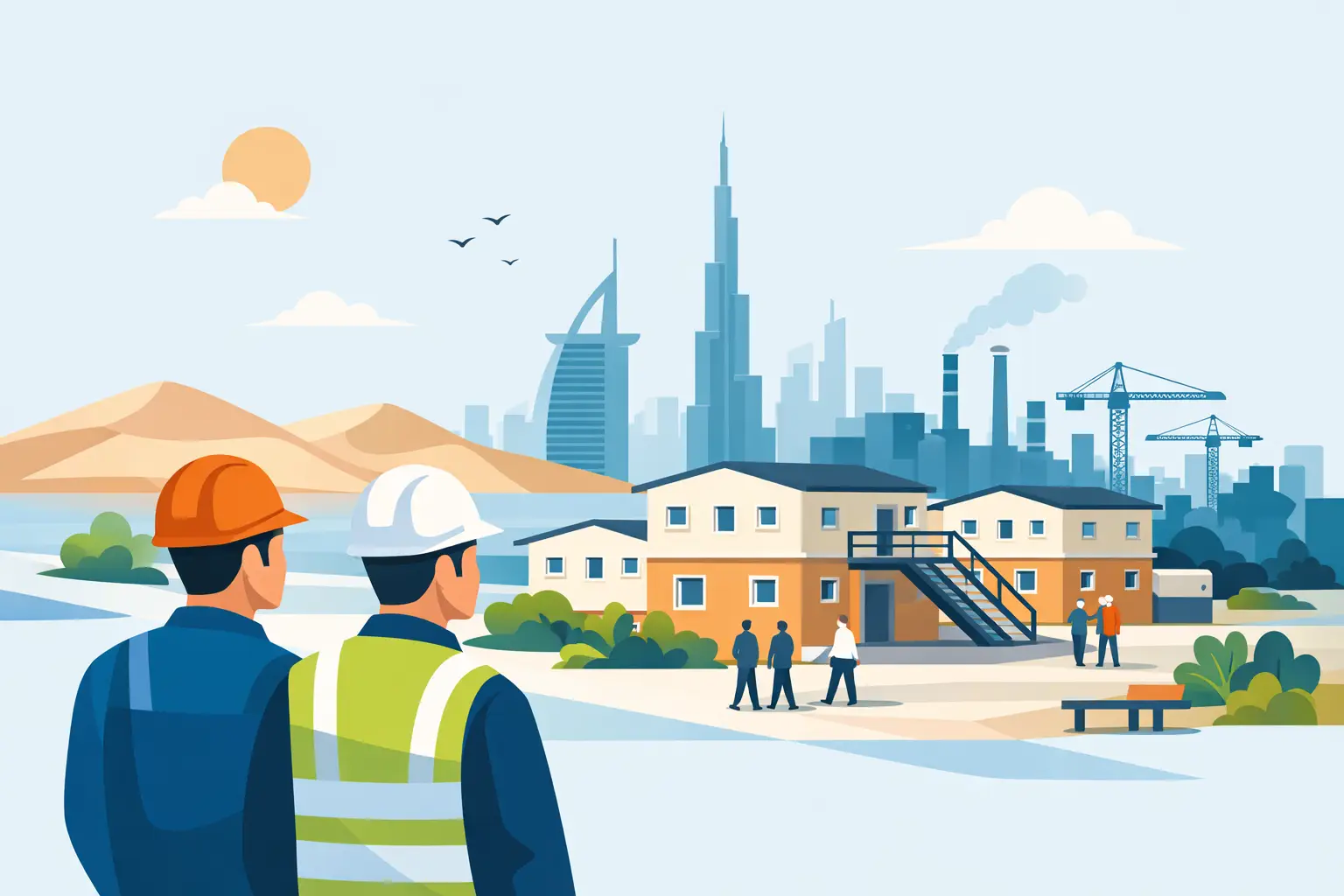
A factory can be commissioned in phases. A logistics corridor can be optimized over time. Workforce instability is less forgiving. For manufacturers entering the UAE or scaling within it, labor accommodation is no longer a side issue handled after land, utilities, and permits. It is part of the operating model from day one.
That is why industrial workforce housing UAE has moved from a support function to a strategic variable. For advanced manufacturers, clean-tech operators, and global industrial investors, the quality, location, and integration of workforce housing now affect ramp-up speed, retention, compliance, productivity, and long-term cost control.
The old industrial park logic treated housing as adjacent, outsourced, or improvised. The next generation of industrial development is built differently. It recognizes that serious production capacity depends on a stable workforce ecosystem, not just factory shell delivery.
Industrial workforce housing UAE is now an infrastructure question
In the UAE, industrial growth is accelerating across sectors that demand more than basic labor availability. Electric mobility, hydrogen systems, precision engineering, semiconductor-adjacent manufacturing, renewable energy components, and aerospace-linked production all place higher expectations on workforce planning. These sectors need technicians, supervisors, engineers, maintenance specialists, quality teams, and support staff who can operate in structured, highly regulated environments.
When housing sits far from the production base, the cost shows up everywhere. Commute times increase fatigue. Transportation complexity adds operating expense. Shift reliability weakens. Health and safety oversight becomes harder. Retention suffers, especially when workers compare one employer ecosystem against another.
For investors and operators, this changes the conversation. Workforce housing is not only a welfare provision or regulatory requirement. It is part of the industrial stack, alongside energy, logistics, warehousing, utilities, and digital infrastructure.
What serious occupiers should expect from industrial workforce housing UAE
The baseline is clear: safe, compliant, dignified accommodation. But serious occupiers should expect more than baseline.
Well-planned workforce housing should support operational continuity. That means proximity to industrial assets, reliable transport management, healthcare access, food and retail convenience, and living conditions that reduce turnover risk. The strongest models also create separation where needed, because a production workforce is rarely a single group. Executive housing, technical staff residences, and worker accommodation may require different formats, densities, and service profiles.
This is where many conventional industrial zones fall short. They can provide plots, roads, and utility access, yet leave occupiers to solve the human side independently. That may work for light industrial activity with modest staffing complexity. It becomes far less efficient for large-scale, high-value manufacturing where workforce consistency has a direct effect on output quality.
The business case goes beyond compliance
There is a tendency to frame workforce housing as a cost center. For basic operations, that assumption can survive for a while. For advanced industrial platforms, it does not hold up under scrutiny.
The first benefit is retention. Housing quality has a measurable effect on tenure, morale, and employer reputation. Replacing trained workers is expensive, particularly in sectors where onboarding, safety certification, and equipment familiarization take time.
The second is productivity. Workers who live in better-managed environments, with reduced travel friction and more predictable daily routines, are more likely to show consistent performance. For manufacturers running multi-shift operations, that consistency matters.
The third is ESG alignment. Investors, institutional partners, and multinational boards increasingly examine labor conditions as part of environmental, social, and governance commitments. Industrial assets that integrate dignified housing and community infrastructure are better positioned for scrutiny from capital markets, global customers, and regulatory stakeholders.
The fourth is resilience. When housing is planned as part of the industrial ecosystem, operators have more control over labor continuity during peak production periods, supply chain disruptions, or sudden demand increases.
This does not mean every company should own and operate residential assets directly. In some cases, managed third-party accommodation still makes sense. But the strategic question remains the same: is housing integrated into the industrial model, or left exposed as an operational weak point?
Why integration beats proximity alone
Not all near-site accommodation creates the same value. A camp close to a factory is better than one hours away, but proximity on its own is not the full answer.
The stronger model is integration. That means workforce housing exists within a broader live-work environment that also includes healthcare, retail, food services, mobility planning, recreation, and in some cases education or skills development support. This kind of planning reduces daily friction for employers and employees at the same time.
For industrial investors, integration also helps future-proof capacity. A site designed as an ecosystem can scale more intelligently than a site built around isolated assets. As tenant headcount grows, the housing and support environment can expand with fewer hidden costs. That matters when manufacturing operations move from pilot stage to regional production hub.
It also matters for talent attraction. The UAE is increasingly competing for skilled industrial labor at multiple levels, from line supervisors to specialized technical staff. The employer proposition is no longer only salary and visa support. It includes quality of place.
The UAE advantage depends on execution
The UAE offers a compelling industrial proposition: strategic geography, efficient trade routes, policy support, investor-friendly frameworks, and rising momentum in advanced manufacturing. But these macro advantages only translate into operating success when site-level execution is right.
That is where workforce housing becomes decisive. An investor may secure land at an attractive cost, gain access to port infrastructure, and establish utility connections within a favorable timeline. Yet if housing is fragmented, distant, or below the standards expected by a global business, the total operating equation weakens.
This is especially true for companies entering the region with long-horizon plans. They are not looking for a short-term industrial foothold. They are building regional manufacturing capacity, supply chain depth, and long-term workforce structures. For those occupiers, the surrounding human infrastructure is as relevant as the real estate itself.
A better model for industrial development
The next phase of UAE industrial growth will favor master-planned environments that combine production assets with the broader systems required to sustain them. That includes modular factory infrastructure, logistics readiness, energy planning, environmental compliance, and workforce accommodation designed into the project rather than appended later.
This model reflects a wider shift in industrial strategy. Investors are asking harder questions about total ecosystem performance. Can the site support phased expansion? Is there room for supplier clustering? Are there services for employees beyond the gate? Can the development support ESG reporting expectations? Is the workforce environment stable enough to protect output quality over time?
These are not secondary considerations. They are part of the due diligence framework for advanced manufacturing investment.
That is why integrated hubs are gaining relevance in the UAE. They reduce fragmentation and create a clearer path from capital deployment to operating stability. In Ras Al Khaimah, this approach is increasingly aligned with the needs of manufacturers seeking lower operating costs without giving up infrastructure quality or strategic connectivity. Within that context, Rana Group’s ecosystem-led model reflects where industrial planning is headed – not toward isolated facilities, but toward industrial environments where production, people, and growth can be planned together.
What decision-makers should assess before choosing a site
When reviewing industrial locations, executives should examine workforce housing with the same discipline they apply to utilities and logistics. The right question is not simply whether accommodation exists. The better question is whether it supports the labor profile the operation will need over the next five to ten years.
A labor-intensive assembly operation may prioritize scale, transport efficiency, and cost control. A semiconductor-related facility may need a more differentiated mix of technical staff support, cleaner residential standards, and stronger proximity to healthcare and urban services. A hydrogen mobility or EV manufacturing tenant may require both worker accommodation and family-oriented housing pathways for management and specialist hires.
There is no single template. The right answer depends on sector, staffing mix, automation level, and growth timeline. But one principle is consistent: industrial success is stronger when workforce housing is treated as strategic infrastructure, not as an afterthought handled under pressure.
For the companies building the next generation of manufacturing capacity in the UAE, that mindset will separate functional sites from future-ready ones. The factories of the future need more than land and power. They need places where the future can work, stay, and scale.

[…] why the best phasing plans begin with a platform view. Roads, substations, water systems, drainage, worker accommodation options, service corridors, digital connectivity, and logistics interfaces must be conceived for the full […]
[…] long-term success depends on factors that usually sit outside a standard real estate transaction. Workforce housing, healthcare access, training pipelines, logistics integration, and R&D adjacency all influence […]
[…] Residential options near the workplace reduce commuting strain and improve reliability. Education and training facilities create a path for upskilling. Healthcare improves employee welfare and operational continuity. Retail and hospitality services make a location more livable for both workers and management. For multinational operators, this is not cosmetic. It directly shapes recruitment outcomes and leadership mobility. […]
[…] provide factory shells. They support the wider operational needs that keep talent in place – housing access, healthcare, training pathways, and daily convenience. For high-skill sectors, this becomes even […]