
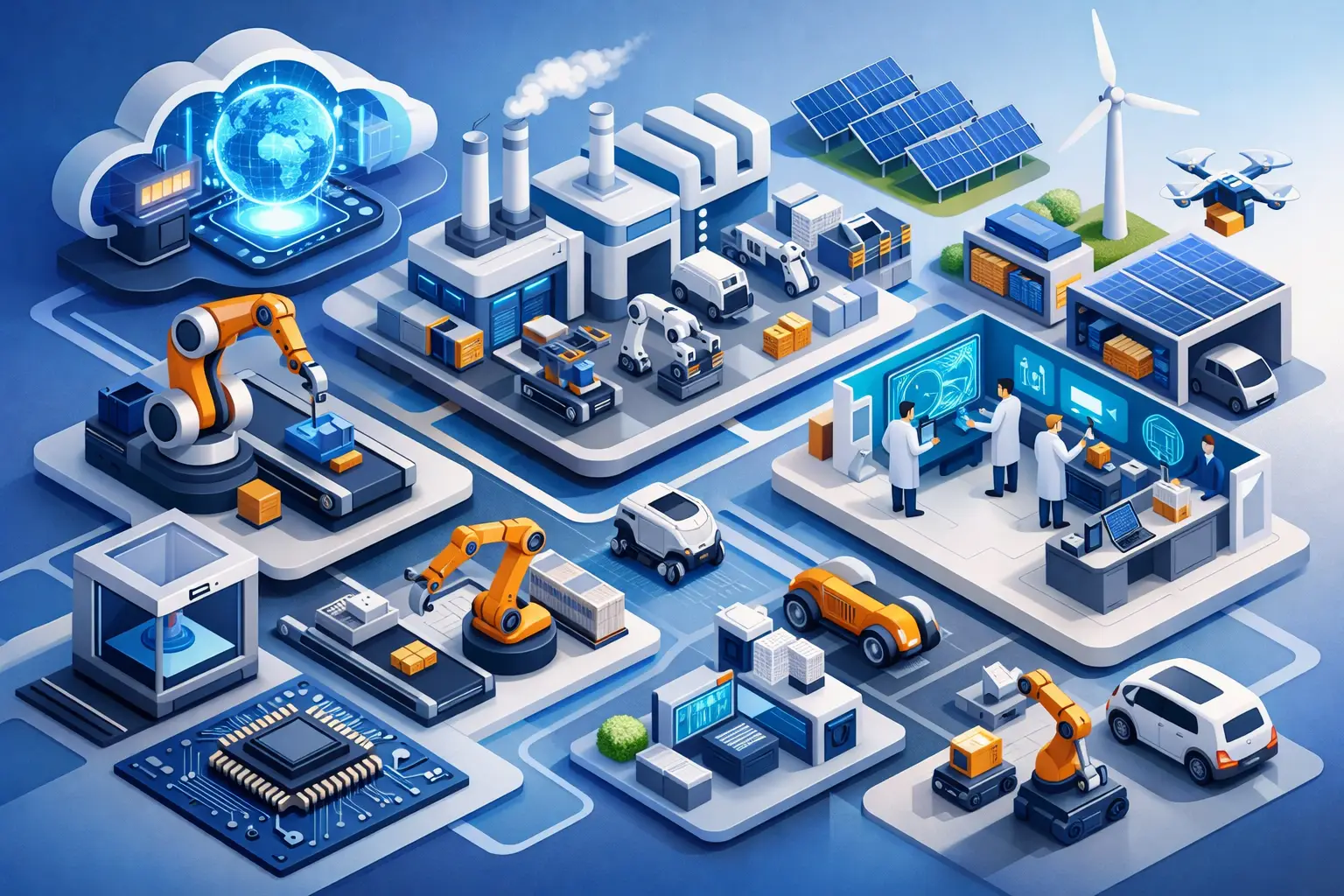
A factory can be built in months. An industrial base that attracts capital, keeps talent, supports suppliers, and scales with next-generation production takes far longer. That is the real lesson behind any serious advanced manufacturing ecosystem case study: the competitive edge rarely comes from a single asset. It comes from how infrastructure, policy, workforce, logistics, and livability work together.
For manufacturers entering a new region, that distinction matters. A standalone site may solve for immediate production capacity, but it often leaves the harder issues untouched – labor stability, permitting coordination, supplier proximity, utility resilience, ESG performance, and executive confidence that the platform can grow with demand. The ecosystem model addresses those constraints at the design stage rather than after operations begin.
What this advanced manufacturing ecosystem case study actually measures
A useful case study is not a brochure and it is not a skyline rendering. It should test whether an industrial hub can reduce execution risk for high-value manufacturers while improving long-term economics. For investors and operators, that means evaluating four questions.
First, does the location support advanced production, not just basic warehousing or assembly? Cleanroom-ready environments, high-load utilities, logistics connectivity, and space for technical expansion matter more than generic industrial inventory. Second, can the model support multiple strategic sectors at once without losing focus? Clustering electric mobility, semiconductors, renewable energy systems, and aerospace-adjacent manufacturing can generate real spillover value, but only if the infrastructure is planned with those needs in mind.
Third, does the surrounding environment support workforce retention and operational continuity? Manufacturing leadership teams are increasingly aware that talent decisions are not made inside the factory alone. Housing, healthcare, education, retail, and mobility shape whether skilled teams stay. Fourth, can the project align with national industrial strategy and private capital requirements at the same time? If the answer is yes, the ecosystem becomes more than a real estate play. It becomes economic infrastructure.
The shift from industrial park to industrial ecosystem
Traditional industrial parks were designed around land subdivision and utility access. That model still serves low-complexity uses, but advanced manufacturing asks more from a location. High-spec production requires precision infrastructure, integrated logistics, dependable compliance pathways, and room for suppliers, research partners, and workforce services to grow nearby.
The ecosystem approach changes the development logic. Instead of offering plots and leaving tenants to solve the rest, the hub is planned as an operating environment. Turnkey factories, modular industrial units, logistics assets, specialized production spaces, and adjacent community infrastructure are treated as parts of one system. This reduces time lost to fragmented decision-making and lowers the friction that often slows regional expansion.
That does not mean every manufacturer needs a fully integrated environment on day one. Some companies can succeed in lighter industrial formats, especially if their labor model is simple or their supply chain is already anchored locally. But for high-value sectors with regulatory complexity, technical workforce needs, and global customers, a fragmented setup often becomes expensive later. What looks cheaper at entry can produce higher coordination costs over time.
Why clustering matters in an advanced manufacturing ecosystem case study
Clusters are often discussed in broad terms, yet their value is highly practical. When EV systems manufacturers, hydrogen mobility suppliers, power electronics firms, clean-tech producers, and semiconductor-linked operations are co-located or strategically adjacent, three things happen.
The first is supply chain compression. Transport distances fall, supplier qualification cycles can shorten, and inventory planning improves. The second is knowledge transfer. Engineering talent, technical service providers, and equipment specialists become easier to access within one market. The third is investor confidence. Capital tends to move faster when a location shows visible concentration in sectors with long-term demand.
Still, clustering has trade-offs. A hub that tries to serve every sector usually weakens its proposition. Specialization matters. The stronger model is selective breadth – enough sector adjacency to create synergies, but enough discipline to ensure utilities, compliance frameworks, and building specifications match the industries being targeted.
This is where purpose-built planning becomes decisive. A site designed for cleanroom-ready semiconductor activity, EV manufacturing support, renewable energy production, and advanced logistics can serve a different class of tenant than a general industrial zone retrofitted for modern demand.
Infrastructure is the real operating advantage
Industrial leaders do not expand based on vision language alone. They expand when infrastructure lowers risk. In a strong ecosystem model, infrastructure is not just physical capacity. It is a strategic instrument.
Purpose-built factories can reduce lead time and capex uncertainty. Modular units create flexibility for suppliers and phased occupiers. Integrated logistics facilities improve inbound and outbound movement. Dedicated land for sector-specific clusters allows future scale without requiring a company to relocate after its first expansion stage. For advanced industries, that continuity is valuable because process validation, workforce training, and equipment installation are not easily transferable.
Utilities are equally important. Power reliability, water strategy, environmental controls, and room for sustainability upgrades influence both operating cost and customer compliance. Many manufacturers now face procurement pressure from global buyers who want credible carbon reporting and cleaner production environments. An ESG-compliant industrial setting can therefore affect commercial competitiveness, not just corporate reporting.
The same is true of geographic access. Port connectivity, efficient links to regional markets, and investor-friendly industrial regulations create an operating advantage that compounds over time. Lower costs matter, but lower complexity often matters more.
The workforce equation manufacturers can no longer ignore
One of the most overlooked findings in any advanced manufacturing ecosystem case study is that workforce risk has become site-selection risk. Advanced production depends on engineers, technicians, operators, supervisors, and support functions who can commit to the location for years, not quarters.
That is why the live-work-innovate model has gained strategic relevance. When residential options, healthcare, education, retail, hospitality, and R&D assets are integrated into the broader industrial environment, employers gain a stronger platform for recruitment and retention. This is not lifestyle packaging. It is workforce infrastructure.
For multinational manufacturers entering a new market, this approach can reduce the friction of startup operations. Leadership teams can relocate key staff more easily. Skilled workers see a longer-term path in the location. Training partnerships become more viable when education and industry operate in proximity. In sectors where production quality depends on stable teams and process discipline, those factors directly affect output.
What investors should take from this model
From an investment perspective, ecosystem-led industrial development is attractive because it can diversify revenue and strengthen tenant stickiness. Industrial leasing remains central, but the value proposition expands when logistics, housing, services, and innovation assets reinforce the same operating base. The result is a platform with greater strategic depth than a conventional warehouse park.
That said, execution discipline is everything. Large-scale industrial ecosystems require phasing logic, sector prioritization, utility planning, and capital sequencing that match real market absorption. Overbuilding too early can dilute returns. Underbuilding supporting services can weaken tenant retention. The strongest projects balance ambition with delivery readiness.
This is where institutional credibility matters. Developers and operators must present a clear case for why the hub exists, which sectors it serves, how infrastructure will be delivered, and what long-term economic role it is built to play. In that context, Rana Group positions the Erisha Smart Manufacturing Hub as a next-generation industrial platform rather than a conventional real estate scheme – a distinction that matters to occupiers making decade-long decisions.
The strategic takeaway from this case study
The core lesson is straightforward. Advanced manufacturing does not scale efficiently in isolation. It scales in environments where production assets, supply chains, workforce systems, and daily life are planned as one ecosystem.
For industrial investors and manufacturers evaluating expansion in the Middle East or other high-growth corridors, that shifts the site-selection question. The issue is no longer just where land is available or where incentives are strongest. The better question is where long-term industrial performance is most likely to compound.
That answer will vary by sector, operating model, and capital horizon. Some companies need immediate plug-and-play capacity. Others need room for supplier clustering, R&D integration, and workforce community building. But the direction is clear: the future belongs to industrial ecosystems that are engineered for resilience, speed, and strategic relevance.
The smartest manufacturing locations will not simply host production. They will make expansion easier with every phase that follows.
