
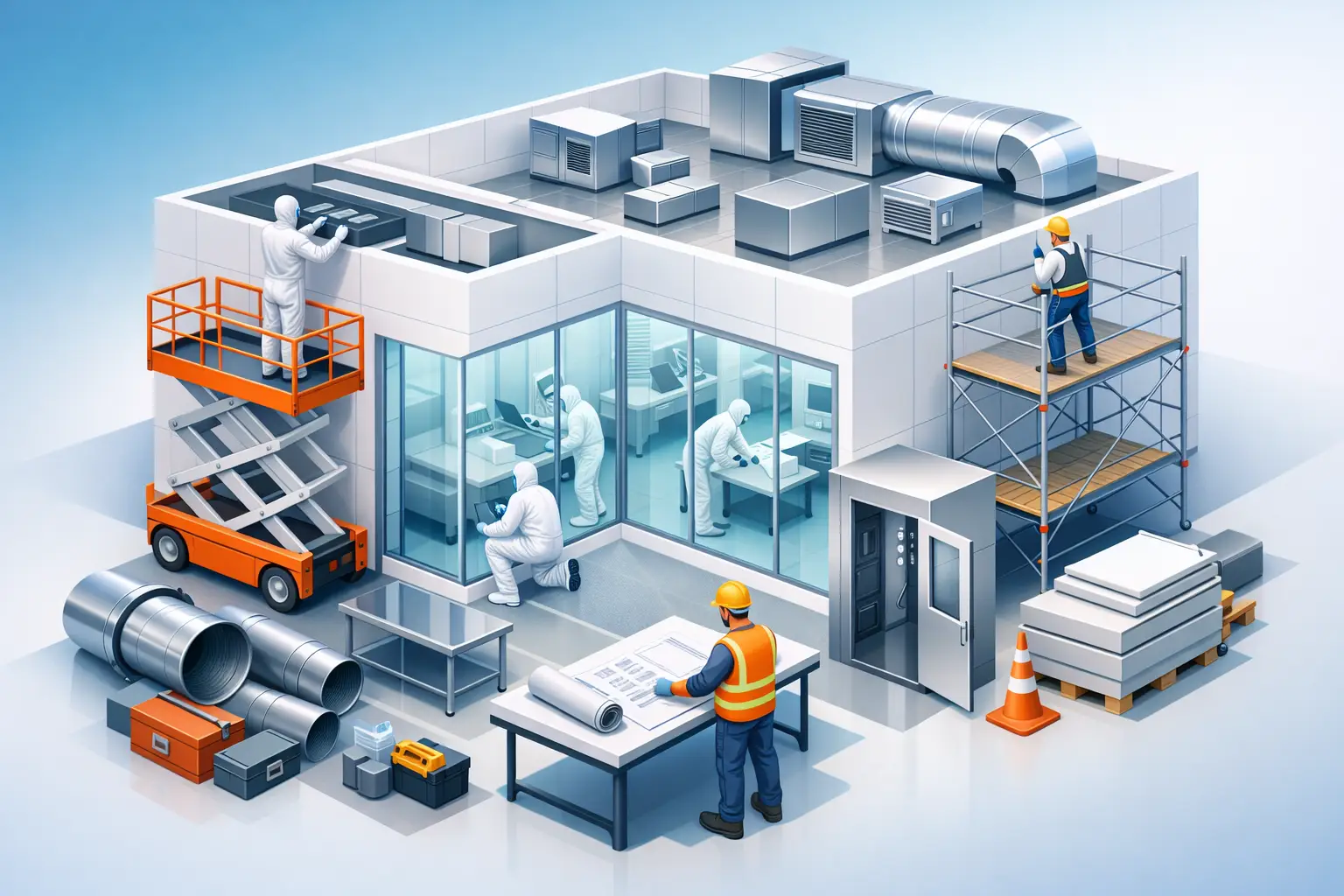
A cleanroom project rarely fails because of walls, panels, or mechanical equipment alone. It fails when the facility strategy is disconnected from the manufacturing process it is supposed to protect. That is the real starting point for how to build cleanroom facilities – not with a drawing set, but with a clear operational brief that defines product sensitivity, contamination risks, throughput targets, staffing patterns, utility loads, and future expansion.
For investors and operators in semiconductors, batteries, aerospace components, medical manufacturing, and precision electronics, this distinction matters. A cleanroom is not just a controlled environment. It is a capital-intensive production asset, and every design decision will affect yield, compliance, operating cost, and the speed at which a site can move from construction into qualified production.
How to build cleanroom facilities around the process
The most common mistake in cleanroom development is treating the cleanroom as a standalone box inside a factory shell. In practice, the cleanroom must be planned as part of a larger manufacturing system that includes people flow, material flow, equipment installation, maintenance access, waste handling, and utility resilience.
That starts with classification. Not every process requires the same level of particulate and environmental control. An ISO Class 5 area for critical semiconductor steps is very different from an ISO Class 8 assembly environment. Overbuilding the classification can drive up capital and energy costs for years. Underbuilding can compromise product quality and lead to expensive retrofit work. The right answer depends on process risk, customer requirements, and regulatory exposure.
Temperature, humidity, pressure cascade, vibration control, and chemical compatibility also need to be set early. In advanced manufacturing, contamination is not limited to dust. It can include molecular contamination, static discharge, corrosive fumes, outgassing from materials, and instability caused by equipment heat loads. If those factors are not reflected in the basis of design, the project team will end up solving strategic problems too late, and at a much higher cost.
Site selection is part of cleanroom performance
A cleanroom can only perform as well as the site infrastructure supporting it. That includes power quality, backup capacity, water availability, wastewater treatment, logistics access, and the labor ecosystem around the facility. For manufacturers entering a new market, these factors often determine whether the cleanroom remains a competitive asset over the long term.
This is why site selection should be approached as an operating model decision, not a real estate transaction. A location with lower occupancy costs but unstable utilities or weak logistics may become far more expensive over time. By contrast, a manufacturing hub with integrated industrial infrastructure, workforce support, and expansion-ready land can reduce commissioning risk and improve long-term asset efficiency. That broader logic is central to how ecosystems such as Rana Group’s industrial platform are designed – around industrial continuity, not just building delivery.
The building shell must support cleanroom logic
Once process requirements are defined, the next priority is the relationship between the building shell and the cleanroom envelope. Ceiling heights, structural spans, rooftop loading, slab flatness, vibration performance, and service corridors all affect how efficiently the cleanroom can be delivered and operated.
A cleanroom-ready shell should allow enough plenum space for filtration, return air strategy, and maintenance access. It also needs clear zoning between controlled and uncontrolled areas. If circulation routes are poorly planned, operators end up mixing personnel, raw materials, finished goods, and maintenance traffic in ways that increase contamination risk and reduce operational discipline.
The strongest designs separate functions before construction begins. Gowning, airlocks, material transfer, equipment move-in, support labs, warehouse interfaces, and technical service areas should be integrated into one coherent layout. That does not always mean a larger footprint. It means a more deliberate one.
Airflow, pressure, and filtration drive performance
When people ask how to build cleanroom facilities, they often focus on finishes. In reality, airflow strategy is the technical core of the project. Filtration, air changes per hour, directional flow, return paths, and room pressurization determine whether the space can consistently meet its target classification.
HEPA or ULPA filtration requirements should be matched to the process rather than selected by default. The same is true for laminar versus mixed airflow approaches. A high-spec airflow design may be justified for highly sensitive production, but it comes with higher fan energy, stricter balancing requirements, and more complex maintenance.
Pressure cascades also need to reflect process logic. In many facilities, higher pressure is used to protect cleaner spaces from adjacent areas, but there are exceptions. If hazardous materials are involved, certain rooms may need negative pressure to protect people and surrounding spaces. These trade-offs should be resolved through coordinated engineering and process review, not left to late-stage commissioning.
Materials and finishes are not a cosmetic decision
Cleanroom materials are selected for cleanability, durability, chemical resistance, and particle control. That applies to wall systems, ceilings, floors, doors, windows, sealants, and service penetrations. A finish that looks suitable in a brochure may still fail in production if it sheds particles, degrades under sanitization, or reacts poorly to process chemicals.
The best material strategy is usually the one that matches the specific cleaning regime and operational intensity of the facility. Epoxy flooring may be appropriate in one application, while sheet vinyl or specialty resin systems may perform better in another. Flush details, coved transitions, and sealed interfaces matter because they reduce particle traps and make validation easier.
There is also a commercial reality here. Premium materials can improve lifecycle performance, but not every area requires the same specification. Critical zones should receive the highest level of control, while adjacent support spaces can often be designed more efficiently without compromising the process.
Utilities must be designed for continuity, not just capacity
Advanced manufacturing cleanrooms rely on more than HVAC. They often require process gases, compressed air, vacuum, high-purity water, chilled water, chemical distribution, fire protection integration, monitoring systems, and highly stable power. Capacity is important, but continuity is what protects production.
A facility that meets peak load on paper can still underperform if redundancy is weak or maintenance access is poor. This is especially relevant for manufacturers with high-value wafers, sensitive coatings, or continuous-process equipment where an interruption can destroy output in minutes.
That is why utility strategy should distinguish between business-critical systems and support systems. Some lines need N+1 resilience or backup generation. Others may tolerate planned downtime. The design should reflect the economics of the process, not a generic engineering template.
Validation, compliance, and commissioning should start early
Cleanrooms are not finished when construction ends. They are finished when they are qualified for operation. That means design, construction, and commissioning teams need a validation mindset from the beginning.
Testing typically includes airflow visualization, particulate counts, pressure differentials, temperature and humidity verification, filtration integrity, and recovery testing. Depending on the sector, there may also be additional regulatory or customer qualification requirements tied to documentation, traceability, and environmental monitoring.
This is where many projects lose time. If systems are not documented properly, if installation details do not match approved drawings, or if controls are poorly integrated, commissioning can drag well beyond the planned production date. For industrial occupiers, those delays are not administrative. They are revenue delays.
Build for scale, because the first phase is rarely the last
The smartest cleanroom facilities are not designed only for day-one demand. They are designed for phased growth. Product lines evolve, toolsets change, customer volumes rise, and new qualification requirements emerge. A site that cannot expand without major disruption becomes a strategic constraint.
Future-ready planning can take several forms. It may mean reserving utility corridors, structural capacity, shell space, or adjacent plots for later expansion. It may mean designing modular cleanroom zones that can be upgraded by classification or reconfigured around new equipment. The right approach depends on capital strategy and market visibility, but the principle is constant: flexibility protects enterprise value.
For companies establishing a regional manufacturing base, this matters even more. A cleanroom should not be viewed as a one-time fit-out. It should be treated as part of a long-term industrial platform capable of scaling with technology, export demand, and supply chain repositioning.
The strongest cleanroom projects are built with discipline at the front end. They align process needs, infrastructure readiness, lifecycle cost, and expansion logic before procurement accelerates. If you get that sequence right, the cleanroom becomes more than a controlled environment. It becomes a production advantage with the resilience to support where the future works.

[…] and renewable energy equipment, each facility generates direct jobs and triggers adjacent demand. Cleanroom-ready spaces require specialized operators and engineering support. Modular factories reduce time to occupancy, […]
[…] matters most when companies need more than a standard shell building. Cleanroom-ready spaces, modular industrial units, specialized logistics zones, and turnkey factories can materially reduce […]
[…] housing sits too far from shift patterns. Permitting works for standard assembly but not for cleanroom, hydrogen, or battery operations. That is why an industrial infrastructure review checklist matters […]