
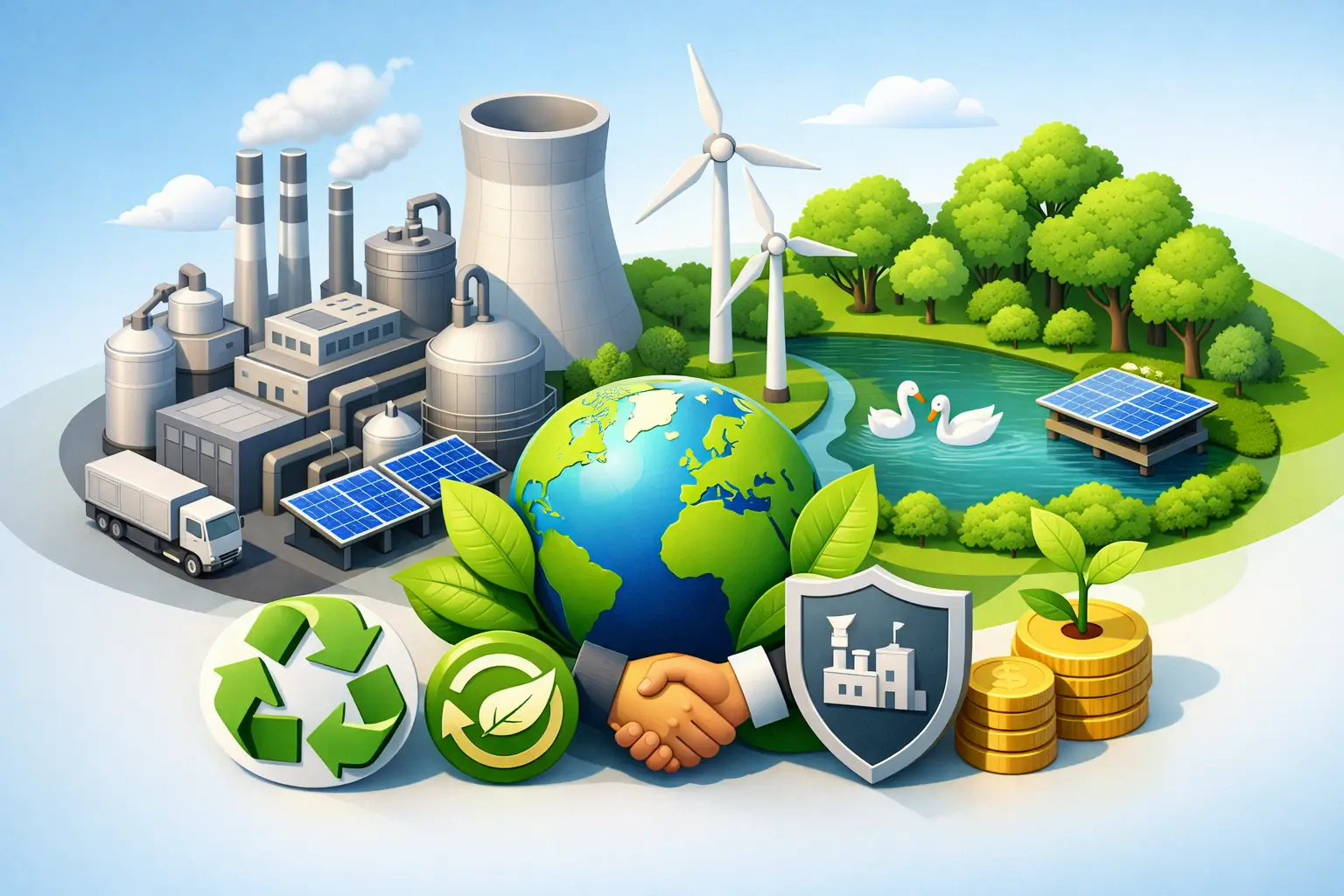
A factory can meet code, hit output targets, and still fall short of what capital markets, regulators, and global customers now expect. That is the real issue behind what makes industrial projects ESG compliant. ESG is no longer a branding exercise layered onto an industrial asset after design is complete. For serious manufacturers, investors, and industrial developers, it is a framework that shapes whether a project can attract capital, secure partners, support talent, and remain competitive over the long term.
The strongest industrial projects treat ESG as an operating system, not a checklist. They are designed to reduce environmental intensity, strengthen workforce and community outcomes, and prove that decision-making is disciplined, transparent, and accountable. In practice, that means ESG compliance is not defined by one certification or one sustainability report. It is defined by how the project performs across the full industrial lifecycle.
What makes industrial projects ESG compliant in practice
At an industrial level, ESG compliance sits at the intersection of infrastructure quality, measurable performance, and governance discipline. A project is more likely to meet ESG expectations when environmental targets are built into site planning, when social value is reflected in workforce and community design, and when governance standards are formalized early enough to influence procurement, construction, and operations.
That sounds straightforward, but the standard is rising. Large occupiers are under pressure from customers, lenders, and boards to disclose emissions, supply chain risk, labor practices, and resilience planning. Industrial assets that cannot support those requirements become harder to finance and harder to lease. Assets that can support them gain strategic value.
Environmental performance starts with the physical plan
For industrial projects, the environmental side of ESG begins long before a tenant starts production. It starts with land use, utility planning, building design, and transport connections. If a site forces long truck journeys, wastes energy, strains water systems, or depends on costly retrofits to meet future standards, its ESG profile is weak even if it advertises green features.
A compliant industrial project typically shows a clear path to lower emissions intensity. That may include efficient building envelopes, renewable power integration, district cooling where appropriate, smart metering, electrified internal transport, and layouts that reduce logistics friction. In advanced manufacturing, energy reliability matters as much as energy source. A clean-tech manufacturer cannot scale if the power strategy is unstable.
Water is another dividing line. In many industrial sectors, water stress is both an operational risk and an ESG issue. Projects that incorporate water recycling, efficient treatment systems, leak monitoring, and fit-for-purpose reuse are better positioned than those relying on conventional supply assumptions. The same is true for waste. A serious ESG framework looks at material recovery, hazardous waste controls, and industrial symbiosis opportunities between tenants.
There is a trade-off here. Best-in-class environmental infrastructure often raises upfront capital costs. But for institutional investors and long-horizon operators, the alternative is usually more expensive – higher operating costs, more difficult compliance, and assets that age poorly against tightening standards.
Social performance is about workforce resilience, not philanthropy
The social pillar is where many industrial projects remain too narrow. ESG compliance is not achieved by adding a community initiative to a project brochure. For industrial developments, the real social test is whether the asset supports a stable, skilled, and productive workforce while creating credible value for the surrounding economy.
That means worker safety is non-negotiable. Industrial projects must be designed around safe movement, emergency readiness, air quality management, and operational controls suited to the sectors they serve. But safety alone is not enough. If a project cannot help tenants attract and retain talent, it becomes less competitive.
This is why integrated industrial ecosystems are gaining ground. When industrial development is paired with housing, healthcare, education, retail, and mobility infrastructure, workforce friction drops. Commute times shrink. Skilled employees are more likely to stay. Employers gain a more reliable labor base. ESG performance improves because the project is not treating people as an external variable.
For multinational manufacturers, that matters. Expansion decisions are increasingly shaped by whether a location can support both production and people. A site with technical infrastructure but no workforce ecosystem may still function, but it will struggle to deliver durable social value.
Governance is where ESG becomes credible
Environmental targets and social claims only matter if the governance structure can support them. This is often what separates a persuasive industrial platform from a marketing-led one.
Governance in an ESG-compliant industrial project means clear accountability, documented standards, traceable data, and consistent decision-making across development and operations. Procurement policies should define supplier expectations. Reporting systems should track energy, water, waste, safety, and compliance metrics. Leadership oversight should be visible, not implied.
For investors and industrial occupiers, governance is also about predictability. Can the project demonstrate regulatory discipline? Are approvals, land use controls, and operational standards managed in a way that reduces risk? Is there a credible framework for tenant alignment, especially in mixed-sector environments where one operator’s practices can affect the wider ecosystem?
This is where many projects encounter an it-depends scenario. A single-tenant industrial asset may manage governance more simply than a large multi-tenant hub. But a master-planned industrial ecosystem can create stronger governance outcomes if it standardizes infrastructure, embeds reporting systems across the site, and aligns tenants around defined operating principles.
ESG compliance must match the sector, not just the site
Not all industrial activity carries the same ESG profile. A semiconductor facility, an EV component plant, a hydrogen mobility manufacturer, and a logistics operator each face different environmental loads, workforce requirements, and compliance expectations. So the question is not only what makes industrial projects ESG compliant. It is whether the project can support ESG compliance for the specific sectors operating inside it.
That requires specialization. Cleanroom-ready space, low-contamination design, resilient utilities, safe chemical handling, advanced ventilation, and high-capacity digital infrastructure are not optional in many high-value sectors. If the core facility is not built around those realities, tenants inherit risk and cost.
Sector-focused planning also affects financing and partnerships. Investors are more likely to back industrial assets that understand the operational demands of future-growth industries rather than treating all manufacturing as interchangeable. The industrial market is moving toward specialized ecosystems because specialization improves both compliance and performance.
Data, disclosure, and finance now shape project viability
A project cannot claim ESG alignment if it cannot measure it. Data quality has become central to compliance because lenders, investors, and multinational customers increasingly require evidence, not broad statements. They want to see emissions baselines, reduction pathways, utility efficiency data, safety records, and governance controls that stand up to due diligence.
This changes the financing equation. Industrial projects with credible ESG reporting can access a wider range of capital conversations, including sustainability-linked structures and mandates with stronger screening criteria. Projects without that visibility may still attract investment, but often on less favorable terms or with more scrutiny.
There is also a commercial effect at the tenant level. Occupiers with their own net-zero or disclosure commitments look for sites that help them report accurately and improve performance over time. In that sense, ESG-compliant infrastructure is not just a risk shield. It is a leasing advantage.
Why integrated industrial ecosystems are better positioned
The next generation of industrial development is moving beyond isolated factory plots. It is being built as a connected economic platform where utilities, logistics, workforce services, R&D capacity, and community infrastructure operate as part of one system. That model is more aligned with ESG because it addresses the full conditions that shape industrial performance.
A master-planned environment can centralize energy strategy, improve transport efficiency, support better water management, and create stronger workforce outcomes than fragmented industrial expansion. It can also offer a clearer governance model because standards are built into the platform, not negotiated from scratch at every parcel.
This is the logic behind ecosystem-led developments such as Rana Group’s industrial model at https://www.ranagroup.ae. The market is shifting toward places where manufacturing, innovation, and daily life can coexist in a more efficient and investment-ready form. That is not a design preference. It is a strategic response to how capital, talent, and global industry are changing.
The real test of ESG compliance
What makes industrial projects ESG compliant is not the presence of a green label or a polished sustainability narrative. It is whether the project is designed to lower resource intensity, protect and support people, and operate under governance standards that can withstand serious scrutiny. The industrial assets that lead over the next decade will be the ones that treat ESG as core infrastructure for growth.
For investors and occupiers, the practical question is simple: does this project make future compliance easier or harder? The answer will shape operating costs, financing options, brand credibility, and long-term resilience. In industrial development, that is where ESG moves from principle to competitive edge.
The smartest projects are not waiting for the next reporting cycle to answer that question. They are building the answer into the ground from day one.

[…] investors and occupiers, ESG alignment is not a branding exercise. It means environmental performance that can stand up to procurement […]
[…] an ESG perspective, this is critical. Sustainability should not be designed only for top-tier executives. It has to […]
[…] factories usually perform better when occupiers need a facility model aligned with ESG expectations from day one. That is because sustainability features, utility efficiency, and operational planning […]