
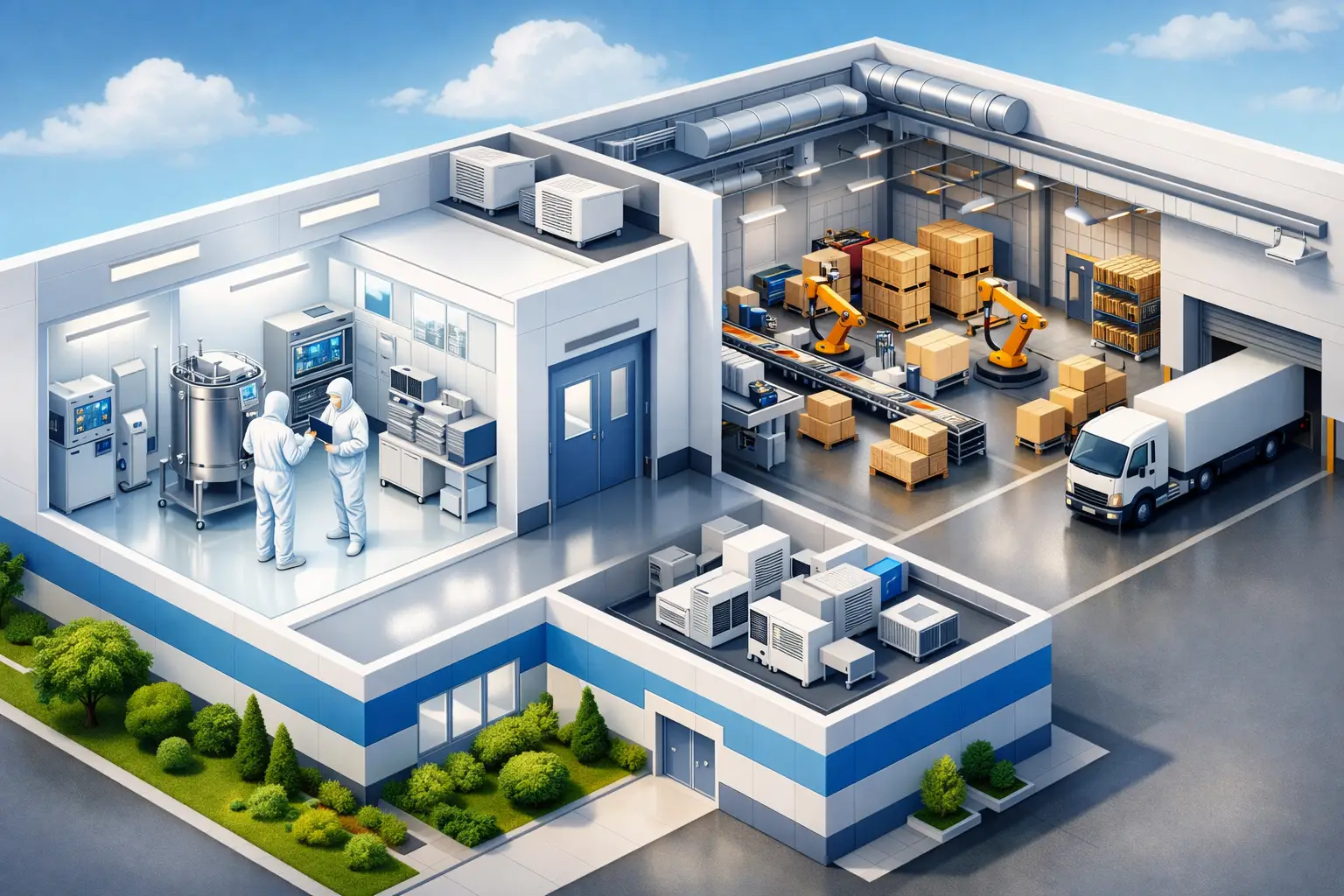
For semiconductor, battery, precision electronics, and advanced materials operators, a bad site decision does not show up in the lease. It shows up later – in delayed qualification, utility retrofits, contamination risk, and lost production time. That is why a cleanroom ready industrial space review has to go far beyond square footage and headline rental rates.
What matters is not whether a building can eventually support controlled manufacturing. What matters is how much time, capital, and operational friction it will take to get there. For expansion leaders and investors, that distinction is the difference between accelerated market entry and a long, expensive fit-out cycle that keeps moving the launch date.
What a cleanroom ready industrial space review should actually measure
The term “cleanroom ready” is often used loosely. In practice, it should signal that the base building, utility strategy, and operational context have already been designed with controlled environments in mind. If that foundation is weak, the tenant ends up funding a custom rescue job rather than an efficient conversion.
A serious review starts with the building shell and structural logic. Ceiling heights, load capacity, vibration profile, slab quality, envelope integrity, and layout flexibility all affect whether the space can support clean manufacturing without major redesign. A building that looks attractive on paper can still fail if column spacing limits line planning or if the structure creates unnecessary vibration exposure for sensitive processes.
Mechanical and utility readiness is even more decisive. Cleanrooms depend on disciplined airflow, pressure differentials, filtration, temperature stability, humidity control, and process-specific power. If the incoming electrical capacity is undersized, if HVAC routes are constrained, or if water and waste systems were not planned for industrial-grade treatment and redundancy, the occupier inherits both delay and risk.
Then there is the site context. Even a well-designed interior can be undermined by poor logistics flow, weak separation between heavy industrial traffic and controlled production zones, or an operating environment that complicates workforce access and supplier coordination. Clean manufacturing does not operate in isolation. It depends on an ecosystem that can support uptime.
The real advantage of cleanroom ready industrial space
The strongest argument for cleanroom-ready space is speed, but speed only matters when it is credible. Many industrial projects claim fast occupancy while leaving major compliance, utility, and commissioning burdens unresolved. A true cleanroom-ready environment compresses the path from lease execution to validated production because the hard infrastructure questions have already been addressed early.
That affects capital planning as much as scheduling. When developers provide purpose-built or conversion-ready industrial space with the right utility backbone, tenants can direct more investment toward production equipment, process engineering, and workforce ramp-up instead of hidden building corrections. It shifts capital from reactive construction to productive manufacturing assets.
There is also a strategic advantage in certainty. Expansion into a new market carries enough unknowns around regulation, supply chain development, and labor availability. The facility itself should reduce uncertainty, not add to it. For multinational operators entering the Middle East or building regional capacity, a space that has been designed around high-value manufacturing standards can materially improve confidence at board level.
Cleanroom ready industrial space review criteria that deserve closer scrutiny
A credible cleanroom ready industrial space review should examine four categories in detail: technical readiness, operational resilience, expansion flexibility, and ecosystem fit.
Technical readiness
Technical readiness begins with utilities, but it should not end there. Review available power quality, backup strategy, cooling approach, compressed gases if relevant, water treatment capacity, drainage planning, and contamination control assumptions. Ask whether the facility was conceived for clean manufacturing or whether it is simply being marketed that way after the fact.
Process adjacency matters as well. If receiving, warehousing, gowning, production, testing, and outbound logistics cannot be sequenced efficiently, operators lose productivity every day. The site should support disciplined movement of materials, people, and waste streams with minimal crossover risk.
Operational resilience
For advanced manufacturing, uptime is a financial metric. A resilient site accounts for maintenance access, redundancy planning, emergency response, security, and the practical realities of 24-hour operations. If a building can technically host a cleanroom but sits within an ecosystem that struggles with transport access, service response, or utility reliability, the risk profile changes fast.
This is where master planning becomes valuable. Industrial occupiers increasingly favor environments that do not treat each tenant as a standalone island. Integrated hubs can support more predictable logistics, shared service capability, and stronger planning around utilities and future demand.
Expansion flexibility
Many manufacturers enter a market with one line and scale to several. That makes flexibility a core investment criterion, not a nice extra. Review whether the unit can expand within the same site, whether neighboring modules can be consolidated, and whether the wider development has enough industrial depth to support future phases.
This point is often underestimated in early-stage site selection. A space that works for year one but forces relocation by year three may become more expensive than a larger, better-planned option with room to scale. Clean manufacturing fit-outs are not trivial to move.
Ecosystem fit
The best industrial decisions are rarely about a building alone. They are about whether the surrounding environment supports talent attraction, supplier access, executive mobility, compliance expectations, and long-term operating efficiency. This is especially true for sectors such as semiconductors, EV components, hydrogen systems, and aerospace-adjacent production, where specialized labor and supporting services are essential.
A site within a broader live-work-innovate environment can create measurable operational value. Workforce retention improves when housing, healthcare, education, and daily services are planned into the wider destination. Strategic partners and customers also respond differently to an industrial base that reflects long-term institutional confidence rather than temporary warehouse conversion.
Where the trade-offs usually sit
Not every occupier needs the same level of readiness. Some firms prefer a highly specified turnkey solution because speed to qualification is the primary goal. Others want a cleanroom-ready shell with room to tailor process architecture around proprietary equipment. Neither approach is automatically better.
The trade-off comes down to control, timing, and capital allocation. A more complete solution can shorten deployment but may limit customization. A more open-ended shell may offer design freedom but usually extends engineering timelines and increases execution burden. The right answer depends on process sensitivity, internal project management capacity, and how quickly the business needs revenue-generating production online.
Cost should also be viewed carefully. Lower lease rates can be misleading if the facility requires extensive infrastructure correction. Conversely, a premium for a better-prepared industrial environment may be justified if it removes months of delay and reduces commissioning risk. Sophisticated occupiers review total occupancy cost over the ramp-up period, not just nominal rent.
Why location still shapes the review
A cleanroom ready industrial space review is incomplete without considering the economics and strategic role of location. Port access, customs efficiency, regulatory clarity, labor market depth, energy strategy, and regional market reach all influence the true value of the facility. For global manufacturers, the site is part of a broader network decision.
That is why industrial ecosystems with direct links to export markets and investor-friendly frameworks are attracting greater attention. In environments such as Erisha Smart Manufacturing Hub, the proposition is not simply industrial floor area. It is the combination of sector-aligned infrastructure, scalable development planning, ESG-compliant design, and an operating model built for advanced manufacturing growth. For decision-makers evaluating a Middle East base, that kind of integrated platform can materially improve both speed and long-term competitiveness.
The standard is rising
Clean manufacturing sectors are becoming less tolerant of generic industrial product. As capital intensity rises and qualification cycles tighten, manufacturers need facilities that are engineered for precision, not adapted through compromise. Investors are responding the same way. They want industrial assets that can attract high-value occupiers, support technical operations, and remain relevant as production requirements evolve.
That changes how space should be reviewed. The right question is no longer, “Can this building hold a cleanroom?” It is, “Was this environment planned to support advanced manufacturing at scale, with fewer surprises between commitment and production?” The difference is substantial, and the market is beginning to price it accordingly.
For any leadership team considering expansion, the smartest move is to review the site as if operations start tomorrow and scale next year. If the infrastructure, utilities, and ecosystem can support both realities, you are not just leasing space. You are securing a platform for industrial growth.
