
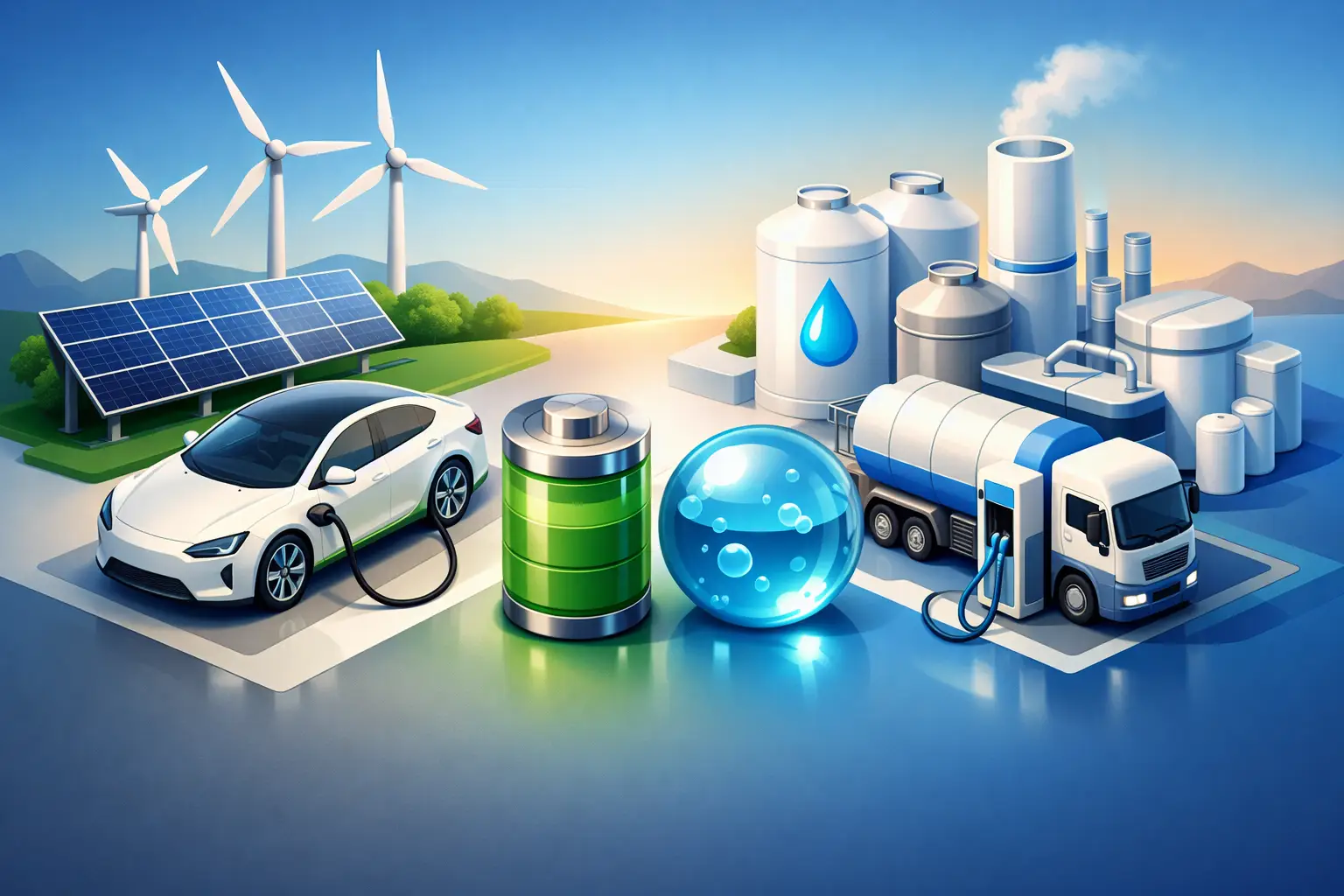
For EV and hydrogen manufacturers, location risk is no longer just about land and rent. It is about whether a site can support scale, supply-chain resilience, compliance, workforce retention, and export velocity at the same time. That is the real frame behind the question, is Erisha Smart Manufacturing Hub the right place to set up production of EV and Hydrogen vehicles and its components?
For serious manufacturers, the answer depends less on marketing claims and more on operating logic. If your business needs a sector-focused industrial base with room to expand, proximity to regional and global trade routes, lower operating friction, and infrastructure designed for advanced manufacturing rather than generic warehousing, Erisha makes a strong case. If your strategy depends on a mature local supplier base already clustered around your exact bill of materials, then due diligence needs to go deeper.
What EV and hydrogen manufacturers actually need
EV and hydrogen mobility production places unusual pressure on site selection. A conventional industrial park may offer space, but space alone does not solve the operational complexity of battery systems, power electronics, lightweight materials, hydrogen storage components, precision assembly, testing zones, or multimodal logistics.
A viable production base needs several things working together. The first is infrastructure that can adapt to different manufacturing models, from modular component lines to full vehicle assembly. The second is logistics access that supports inbound parts and outbound finished goods without bloating lead times. The third is a policy and business environment that gives investors confidence over a long planning horizon. The fourth is an ecosystem that helps attract and keep skilled people.
That last point is often underestimated. A plant can be commissioned with machinery, but sustained performance depends on engineers, operators, managers, suppliers, and service partners who can live and work in an environment built for continuity. This is where Erisha’s proposition becomes more strategic than a normal real estate pitch.
Is Erisha Smart Manufacturing Hub the right place for EV and hydrogen production?
Erisha is compelling because it is structured as an industrial ecosystem, not a standalone plot offering. For EV and hydrogen manufacturers, that matters. These sectors do not scale well in isolation. They benefit from being in a specialized environment where mobility, energy, clean technology, R&D, logistics, and workforce support are planned together.
The hub is designed around advanced manufacturing use cases, including dedicated clusters for EVs and hydrogen mobility. That gives occupiers something more valuable than generic capacity – alignment. Layout, utility planning, factory formats, logistics positioning, and ecosystem partnerships can be shaped around the real operating needs of future-facing industries.
This becomes especially relevant when companies are deciding whether to launch with a lighter footprint and grow in phases, or commit to larger-format facilities from the start. Erisha’s model supports both. Turnkey factories can reduce time to operation. Modular units can help companies enter the market with less fixed exposure. Larger industrial footprints create a pathway for vertical integration as production volumes rise.
Why location strategy matters more in this sector
For EV and hydrogen businesses, geography is not only about local demand. It is about access to trade corridors, distribution economics, and the ability to serve multiple markets from one base. Ras Al Khaimah offers an investor-friendly UAE platform with strong connectivity to the GCC and beyond, while generally maintaining lower operating costs than more saturated industrial centers.
That cost differential can influence everything from lease economics to labor support services and logistics overhead. For manufacturers trying to protect margin while investing heavily in technology, the operating base matters as much as the production line.
Port access also changes the equation. Vehicle components, battery inputs, industrial equipment, and finished mobility products all depend on predictable freight flows. A production hub with access to maritime gateways and regional trade networks offers a practical advantage that spreadsheet models should not ignore.
For companies thinking beyond one jurisdiction, Erisha’s wider positioning across multiple geographies also creates a strategic narrative around industrial connectivity. Businesses evaluating regional manufacturing footprints may find value in the broader cross-market logic explored in Will Erisha’s India-USA-UAE Triangle Help Industry?.
Infrastructure readiness is where the decision gets real
Many industrial projects sound attractive until a manufacturer asks basic questions. Can the site support specialized build-outs? How fast can operations start? Is there room for future lines, testing, warehousing, and supplier adjacency? Can facilities be adapted for high-spec production environments?
Erisha’s strength is that it is being positioned for advanced production, not only storage or light assembly. Its offering includes turnkey factories, modular industrial units, logistics facilities, and specialized spaces that can support higher-value manufacturing operations. For EV and hydrogen companies, this creates room for multiple production models – components first, then subsystem assembly, then potentially broader vehicle integration.
That flexibility is important because many clean mobility companies do not scale in a straight line. They move through pilot production, market validation, supplier localization, phased automation, and export expansion. A site that can evolve with that journey is worth more than one that simply provides initial occupancy.
The question of fit also depends on what you plan to produce. Powertrain components, hydrogen storage systems, drivetrain electronics, charging-related hardware, lightweight body structures, thermal systems, and final vehicle assembly all have different needs. Erisha is likely strongest for businesses that want a future-ready industrial platform rather than a fully mature automotive supplier cluster on day one.
The ecosystem advantage goes beyond the factory gate
This is where Erisha separates itself from a conventional manufacturing zone. The hub is built around a live-work-innovate model that integrates industrial activity with residential, healthcare, education, retail, hospitality, and R&D assets. For investors and operators, that is not a lifestyle extra. It is workforce and business continuity infrastructure.
Advanced manufacturing competes for talent. Engineers and technical managers are more likely to stay in locations that support family life, daily convenience, health access, and professional development. For multinational firms, this can lower friction in relocation and improve long-term retention.
It also supports collaboration. Clean mobility companies increasingly need technology partners, testing support, compliance expertise, and adjacent innovators. A mixed-use industrial ecosystem can generate more of those interactions than a site built only for isolated production units. That broader logic is also reflected in Why Education, Healthcare, Hospitality Matter.
ESG is not a branding layer – it is a market requirement
For EV and hydrogen manufacturers, ESG alignment is no longer optional. Investors, customers, regulators, and institutional partners all examine whether production environments support sustainability goals in measurable ways. A facility making low-emission mobility products inside a poorly aligned industrial ecosystem creates a credibility gap.
Erisha’s positioning around ESG compliance is therefore commercially relevant. It gives clean-tech manufacturers a stronger operational narrative when engaging capital partners, government stakeholders, procurement teams, and global customers. This matters even more for companies that expect scrutiny around lifecycle emissions, responsible industrial development, and future reporting requirements.
Manufacturers weighing that dimension can look more closely at Is Erisha Smart Manufacturing Hub ESG and SDG Aligned?. The underlying point is simple: the site of production increasingly affects brand, finance, and market access.
Where the trade-offs are
A serious site decision always comes with trade-offs. Erisha appears well suited for manufacturers that value integrated infrastructure, cost efficiency, strategic geography, and future scale. It is especially attractive for businesses entering the Middle East, building export capacity, or looking for a base aligned with next-generation industrial sectors.
But fit depends on your operating model. If your production system requires immediate access to a deeply localized supplier network for every component category, you will need to map how much can be sourced regionally, how much must be imported, and how quickly localization can be built. If you need highly specialized testing ecosystems already concentrated in one mature automotive corridor, you should compare that requirement against Erisha’s current and planned capabilities.
This does not weaken the case. It simply defines it more clearly. Erisha is strongest as a strategic platform for growth-stage and scale-stage manufacturers that want to build in a future-oriented ecosystem, not just occupy industrial land.
So, who should seriously consider Erisha?
The strongest candidates are EV manufacturers entering regional markets, hydrogen mobility companies building component and subsystem production, clean-tech firms seeking export-oriented manufacturing, and multinational groups that want an ESG-aligned operating base with room to scale.
It also makes sense for companies that understand industrial competitiveness has changed. The winning location is no longer the cheapest plot. It is the one that reduces total operating complexity over time – infrastructure, logistics, workforce, compliance, expansion, and investor confidence included.
For a broader view of sector fit, Who Can Set Up in Erisha Smart Manufacturing Hub? adds useful context.
If your decision criteria are narrowly transactional, you may evaluate Erisha as another industrial option. If your decision criteria are strategic, focused on where advanced mobility manufacturing can scale with fewer structural constraints, Erisha deserves to be on the shortlist. The better question may not be whether the hub can host EV and hydrogen production, but whether your next production base is prepared for where this industry is actually heading.
