
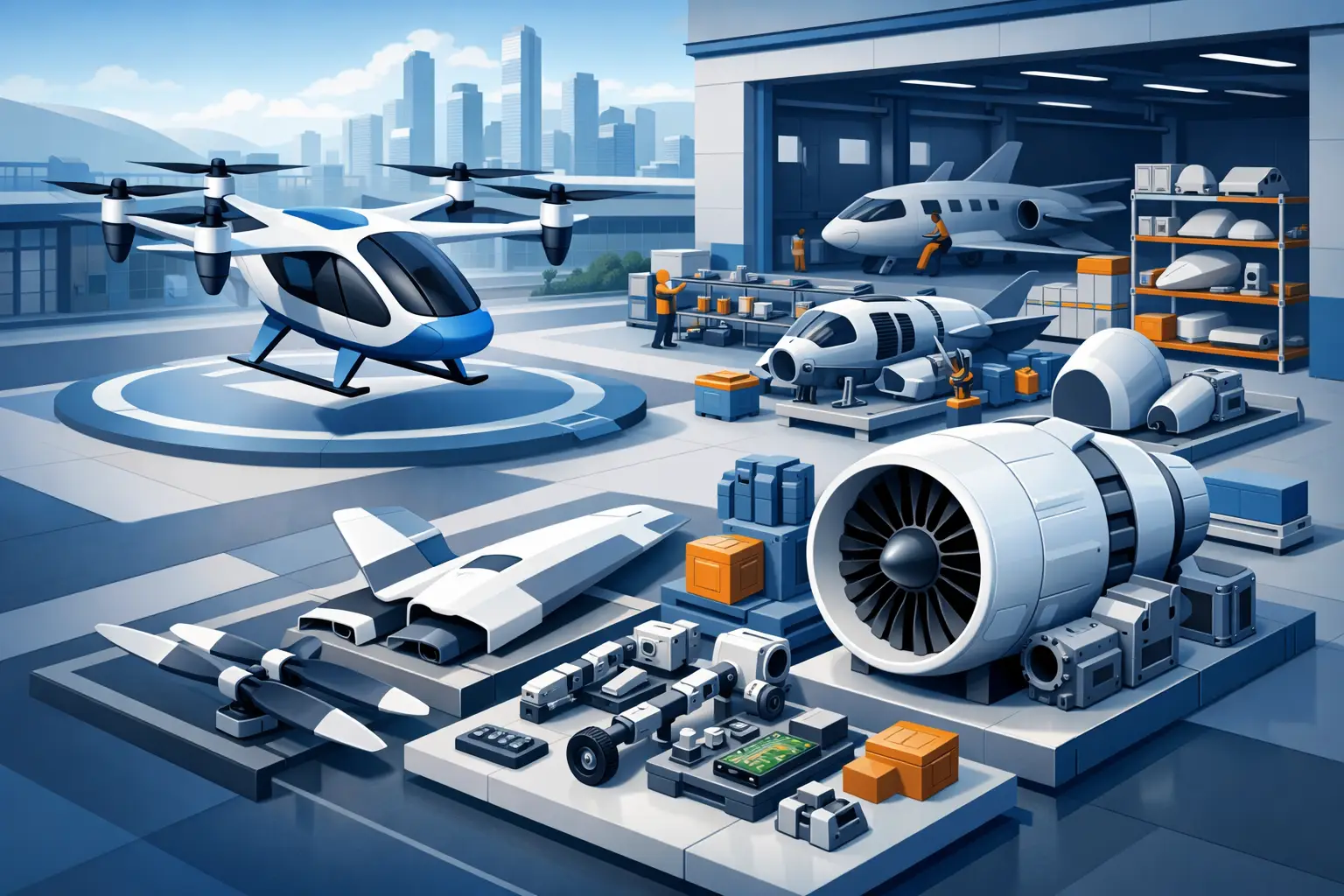
Aerospace manufacturing does not choose locations casually. When an eVTOL platform company or an aircraft and helicopter spare parts manufacturer evaluates a new base, the decision turns on precision, certification pathways, logistics speed, workforce depth, and long-term operating economics. That is why the real question behind “Are eVTOL and spare parts of Aircrafts and Helicopters Industries can set up manufacturing lines in Erisha Smart Manufacturing Hub” is not simply yes or no. It is whether the hub offers the industrial conditions serious aerospace-adjacent manufacturers actually need.
The answer is yes – with an important distinction. Erisha Smart Manufacturing Hub is not positioned as a generic warehouse zone hoping aerospace will arrive. It is being built as a sector-driven industrial ecosystem for advanced manufacturing, including eVTOL aircraft, mobility technologies, and high-value component production. For investors and operators looking at the Middle East as a manufacturing base, that changes the equation.
Why eVTOL and aerospace spare parts fit Erisha Smart Manufacturing Hub
eVTOL and aerospace spare parts manufacturing sit at the intersection of advanced materials, electronics, precision engineering, assembly control, and dependable supply chains. They need more than land and utilities. They need an environment that reduces friction from setup through scale.
Erisha Smart Manufacturing Hub is designed around that logic. Its value lies in purpose-built infrastructure, modular industrial formats, logistics access, and a broader live-work-innovate model that supports retention of technical talent. For a manufacturer producing rotor system components, lightweight structures, avionics housings, composite interiors, battery enclosures, or precision-machined helicopter parts, these factors are not secondary benefits. They directly affect production stability and expansion speed.
This is especially relevant for eVTOL companies. Many are moving from prototype and validation phases toward pilot production, supplier localization, and regional market development. That stage demands flexible industrial real estate, room for phased expansion, and a policy environment that supports capital deployment without the cost burden seen in many mature manufacturing markets.
What manufacturing lines could realistically be set up here?
Not every aerospace activity belongs in the same location. Final aircraft certification, full airframe integration, heavy engine manufacturing, and flight-testing ecosystems have distinct requirements. But a wide range of high-value manufacturing lines can be established within a smart industrial hub designed for advanced sectors.
For eVTOL, realistic line setups include structural subassemblies, composite parts manufacturing, battery pack integration, propulsion component assembly, electronics enclosures, thermal management systems, cabin modules, landing gear subcomponents, and aftermarket support parts. For aircraft and helicopter industries, the opportunity is equally strong in spare parts such as machined metal components, brackets, ducts, housings, cabin fittings, replacement interiors, electrical assemblies, wire harness systems, UAV-adjacent parts, and MRO-linked parts distribution and light manufacturing.
The commercial logic is straightforward. Aerospace OEMs and Tier 1 and Tier 2 suppliers increasingly want regionalized support capacity closer to emerging operators and service markets. A manufacturer does not always need to begin with full aircraft production. It can start with specialized components, spares, kitting, and assembly lines, then scale into deeper manufacturing as demand and certification pathways mature.
The infrastructure question investors should ask first
The strongest industrial decisions are made backward from operational requirements. Can the site support clean production? Can it separate precision manufacturing from heavy logistics flows? Can it provide scalable factory formats rather than forcing every tenant into a one-size-fits-all building?
Erisha Smart Manufacturing Hub is compelling because it is planned for advanced production sectors, not retrofitted after the fact. Turnkey factories, modular industrial units, logistics facilities, and cleanroom-ready spaces matter because aerospace-adjacent production often evolves in stages. A company may enter with CNC machining and light assembly, then add electronics integration, quality labs, bonded warehousing, or specialized process rooms later.
That flexibility reduces capital waste. It also shortens time to operation, which matters for manufacturers under pressure to localize supply chains, hit investor milestones, or support regional fleet operators.
This is one reason the broader industrial proposition is stronger than a conventional industrial park. As discussed in Who Can Set Up in Erisha Smart Manufacturing Hub?, the platform is being shaped for sector-relevant occupiers that need more than basic space. Aerospace-adjacent manufacturers fit that profile well.
Why Ras Al Khaimah adds strategic value
Location only matters when it improves economics or market access. In this case, it does both.
Ras Al Khaimah offers a serious cost advantage for manufacturers that want a UAE base without absorbing the highest occupancy and operating premiums seen elsewhere. For eVTOL and aircraft spare parts businesses, that matters because these industries often face long product cycles, extensive qualification work, and tight control over fixed costs during scaling.
The emirate also offers practical access to ports, regional trade routes, and GCC markets. That makes it attractive for companies supplying operators, MRO networks, distributors, and OEM-linked programs across the Middle East, Africa, and South Asia. For firms balancing inbound raw materials with outbound high-value components, logistics connectivity is not a talking point. It is part of margin protection.
There is also a broader strategic factor. The UAE continues to position itself as a platform for advanced industry, technology manufacturing, and economic diversification. An aerospace-adjacent production line inside a future-ready manufacturing hub aligns with that national direction far better than a standalone industrial lease in an undifferentiated zone.
What makes Erisha more credible than a standard industrial site
Many industrial developments offer land. Fewer offer a manufacturing ecosystem. That difference becomes critical in sectors where talent, compliance, supplier coordination, and executive oversight shape long-term viability.
Erisha Smart Manufacturing Hub has been framed as a mixed-use industrial ecosystem with industrial, residential, healthcare, education, retail, hospitality, and R&D assets planned around it. For aerospace manufacturers, that is not lifestyle packaging. It addresses a real operating problem: technical teams and leadership are harder to attract and retain when industrial sites are isolated, inconvenient, or disconnected from quality-of-life infrastructure.
This integrated model supports workforce stability, visiting partner access, and long-horizon industrial occupancy. It is one of the reasons the concept goes beyond real estate and moves into ecosystem strategy, a point expanded in Why Erisha Smart Manufacturing Hub Has It All.
For board-level decision-makers, that matters because factory performance is never just about the building. It is about whether the surrounding environment supports reliable execution over ten to twenty years.
The sectors that stand to benefit most
The best fit is not limited to one type of aviation company. Several categories stand out.
Emerging eVTOL developers can use the hub for regional component manufacturing, supplier localization, battery and propulsion subassembly, and aftermarket support. Tier 2 and Tier 3 aerospace suppliers can establish machining, fabrication, composites, and electronic assembly lines that serve both civil aviation and next-generation mobility programs. Helicopter and aircraft spare parts manufacturers can build distribution-linked production operations where inventory, light manufacturing, and regional fulfillment work together.
There is also a strong case for hybrid players. Some companies now serve UAV, defense-adjacent, civil aviation, and advanced air mobility programs from the same supply base. A flexible manufacturing ecosystem is better suited to that blended model than a narrowly zoned traditional site.
The trade-offs and what companies still need to evaluate
A serious industrial assessment has to acknowledge that not every aerospace function can be dropped into a new site on day one.
Certification pathways, export controls, customer approvals, and supplier qualification requirements still need to be managed by each manufacturer. If a business requires highly specialized aviation testing infrastructure, direct airport adjacency, or a deeply localized certified supply chain from day one, its setup plan may need phasing. In some cases, the right move is to begin with parts manufacturing, assembly, warehousing, and regional support before adding more sensitive production processes.
That is not a weakness. It is how many smart aerospace expansions work. The best manufacturing footprints are built in layers, with infrastructure, compliance, and market demand advancing together.
The stronger question is whether the site allows that layered approach. Erisha does. It offers room to start with high-value, mid-complexity manufacturing and expand into broader aerospace production as programs mature.
ESG, industrial resilience, and investor appeal
Aerospace and advanced mobility capital is moving toward locations that can support not only output, but also policy alignment, sustainability reporting, and long-term resilience. Manufacturers are increasingly assessed by customers, investors, and public-sector partners on carbon exposure, energy strategy, and the quality of their industrial environment.
That is why ESG alignment is not a side issue for advanced manufacturing hubs. It shapes financing, partnerships, customer trust, and recruitment. Erisha’s positioning around ESG-compliant development strengthens its relevance for future-facing sectors, especially those like eVTOL that are often marketed around cleaner mobility and next-generation transportation outcomes. The broader case is explored in Is Erisha Smart Manufacturing Hub ESG and SDG Aligned?.
For manufacturers with institutional investors or multinational governance requirements, that type of alignment can improve the attractiveness of a regional expansion case.
So, can eVTOL and aircraft spare parts industries set up here?
Yes – and more importantly, they can do so in a way that supports scale, operational discipline, and regional market access.
The phrase “Are eVTOL and spare parts of Aircrafts and Helicopters Industries can set up manufacturing lines in Erisha Smart Manufacturing Hub” points to a real strategic opportunity. eVTOL subassembly, aircraft and helicopter spare parts production, aerospace-adjacent machining, composite manufacturing, electronics integration, and aftermarket support lines all have a credible place within this model.
What makes the opportunity strong is not only the sector fit. It is the combination of specialized infrastructure, cost-conscious location strategy, logistics accessibility, ESG positioning, and ecosystem planning. That combination gives manufacturers a practical route into the UAE and the wider region without forcing them into a fragmented expansion model.
For companies deciding where the next aerospace-adjacent production line should go, the better question is no longer whether a smart manufacturing hub can support them. It is whether they can afford to build their regional strategy in a location that was not designed for the future of industry.
