
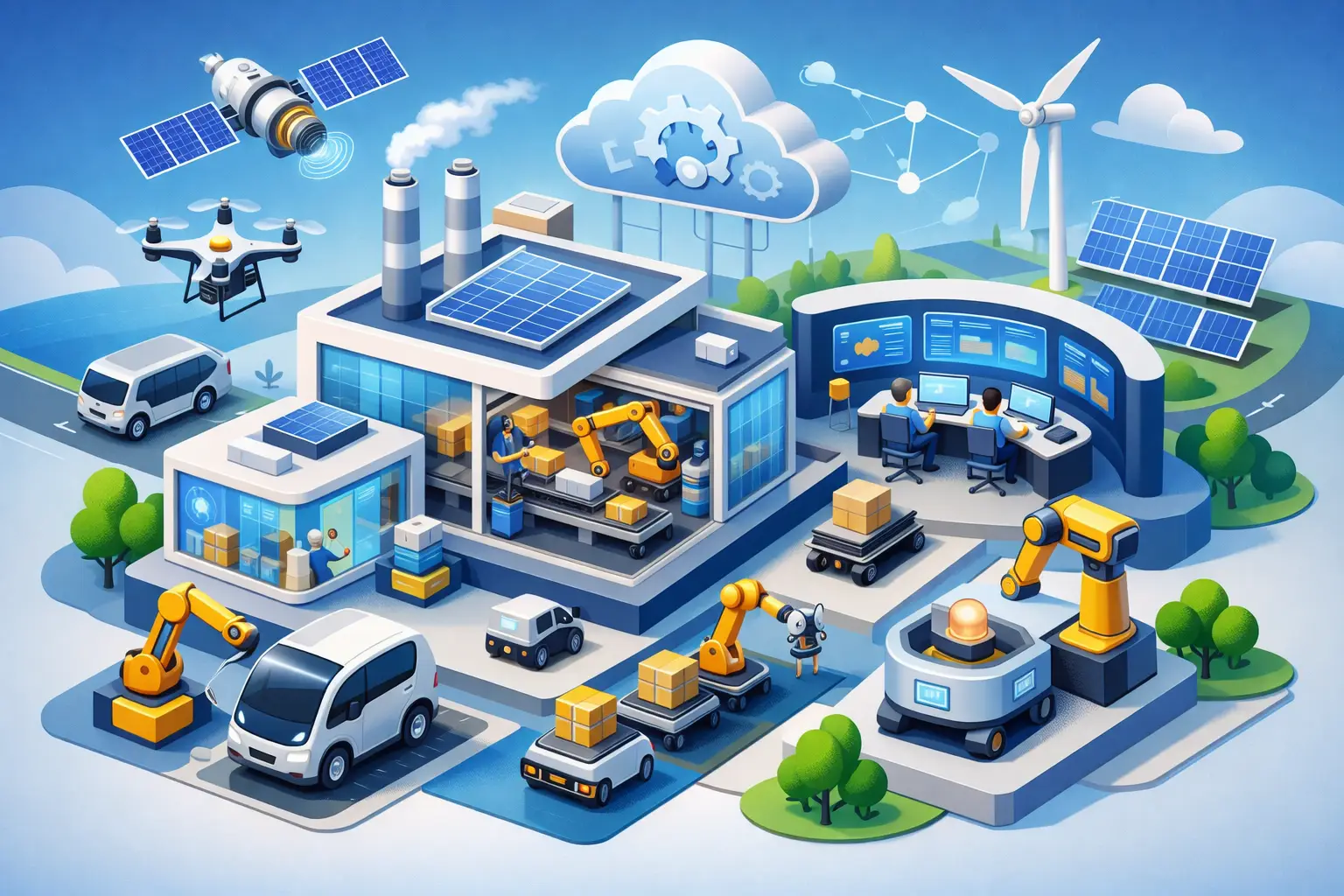
Most industrial zones solve for land. Very few solve for industrial continuity.
That is the real answer to the question, “Why Erisha Smart Manufacturing Hub have Residential, commercial, eduction, healthcare, community center, shopping mall along with Industry and innovation?” Because next-generation manufacturing does not scale on factory space alone. It scales on talent stability, operating efficiency, supplier access, executive confidence, ESG alignment, and the daily systems that allow an industrial ecosystem to keep performing at a high level.
A serious manufacturing platform cannot be treated as a collection of sheds and roads. Advanced industry requires a full environment. When manufacturers in EVs, semiconductors, hydrogen mobility, aerospace-adjacent production, and renewable energy assess expansion opportunities, they are not only asking where they can build. They are asking whether the location can support workforce retention, family life, logistics coordination, innovation partnerships, and long-term capital deployment. That is why Erisha is designed as a live-work-innovate ecosystem rather than a conventional industrial park.
Why Erisha Smart Manufacturing Hub includes more than factories
The traditional industrial park model was built for a different era. It assumed labor could commute indefinitely, supply chains would remain predictable, and industrial growth could be separated from education, healthcare, housing, and community infrastructure. That model now creates friction.
For advanced manufacturers, friction shows up in expensive staff turnover, delayed ramp-ups, difficulty attracting technical talent, fragmented services, and weak collaboration between operations, R&D, suppliers, and training institutions. Every gap outside the factory gate eventually becomes a cost inside the factory.
Erisha addresses that problem by integrating residential, commercial, education, healthcare, community, retail, and industrial assets into one master-planned environment. This is not lifestyle packaging added onto an industrial development. It is operating logic. The purpose is to reduce the hidden inefficiencies that limit industrial performance over time.
When a skilled engineer can live close to work, when a technician has access to healthcare, when a family has retail and community services nearby, and when companies can engage training pipelines without sending people across cities, the result is not just convenience. It is a stronger industrial base.
Residential and commercial assets support workforce retention
Every manufacturer understands the cost of replacing trained people. In high-value sectors, talent is not interchangeable. Cleanroom operators, process engineers, line managers, quality specialists, compliance teams, and technical maintenance staff represent institutional knowledge. Losing them slows production, increases training costs, and creates quality risk.
That is why residential infrastructure matters inside an industrial ecosystem. Housing near the workplace improves retention, reduces commute fatigue, and makes relocation more attractive for domestic and international talent. It also supports the practical needs of leadership teams and specialist hires who often evaluate a manufacturing base not only on capex and utilities, but on whether their people can actually build a sustainable life there.
Commercial space adds another layer of value. It creates room for business services, vendors, finance support, technical consultants, and customer-facing functions that often need to sit close to industrial operators. In a serious manufacturing environment, commercial activity is not separate from industrial productivity. It strengthens it.
This integrated model is central to Why Erisha Smart Hubs Combine Living and Work, because manufacturing growth is no longer defined only by built-up area. It is defined by whether the ecosystem can keep people, knowledge, and production capacity in motion over years, not quarters.
Education is not an amenity. It is industrial infrastructure
Industrial investors often underestimate how much expansion risk sits inside the talent pipeline. You can secure land, install advanced equipment, and structure supply agreements, but if the local ecosystem cannot continuously produce and upgrade relevant skills, scale becomes fragile.
That is why education is built into the Erisha model. For sectors such as semiconductors, EV manufacturing, hydrogen systems, advanced materials, and eVTOL-related production, workforce development has to be local, structured, and ongoing. Education assets support technical training, industry-academic collaboration, executive development, and the creation of a deeper labor bench over time.
This matters for occupiers in two ways. First, it helps reduce dependence on constant external recruitment. Second, it creates a pathway for adaptation as manufacturing technologies evolve. A hub that can train, retrain, and attract technical talent becomes more valuable every year.
That broader logic is explored further in Why Education, Healthcare, Hospitality Matter, but the strategic point is straightforward: education inside an industrial ecosystem is not soft infrastructure. It is production infrastructure.
Healthcare protects productivity and investor confidence
Healthcare is often discussed as a social benefit. In an advanced industrial setting, it is also a business requirement.
Manufacturing hubs depend on healthy, reliable, and settled workforces. Access to healthcare reduces disruption for employees and their families, supports occupational well-being, and improves the attractiveness of the hub for senior staff, technical specialists, and international assignees. It also signals that the development is built for permanence, not short-term occupancy.
From an investor perspective, healthcare infrastructure contributes to risk reduction. It supports labor continuity, strengthens the employer value proposition for tenants, and helps create the kind of environment institutional partners are more likely to back. In global site selection, confidence is built not just through industrial specs, but through the completeness of the surrounding ecosystem.
That is especially relevant in a manufacturing platform positioned for long-term sectors where capital deployment and operational timelines are measured in decades.
Community centers and shopping malls are part of industrial performance
Some investors hear community center or shopping mall and assume the strategy is drifting away from industrial focus. The opposite is true.
A community center helps create social cohesion, shared identity, and quality of life inside a large-scale economic zone. That matters because industrial ecosystems are made of people before they are made of buildings. Workers, managers, researchers, suppliers, and families all perform better in places that feel stable, connected, and human.
Retail infrastructure matters for the same reason. Daily needs should not require long, inefficient trips outside the ecosystem. Shopping, services, food, and basic consumer access save time, support residential viability, and improve the lived experience of the workforce. For companies, that translates into a location that is easier to staff, easier to scale, and easier to defend competitively.
This is the difference between an industrial address and an industrial destination. One provides occupancy. The other supports continuity.
Industry and innovation work better together in one environment
Erisha is not built for generic light industry. It is designed for sector-specific growth in advanced manufacturing and future-facing technologies. That changes the role of the master plan.
Innovation requires adjacency. Manufacturers benefit when R&D, testing, component suppliers, logistics, skilled labor, executive functions, and support infrastructure are close enough to interact quickly. Time lost between these nodes becomes innovation drag. Time saved creates speed in prototyping, validation, production ramp-up, and market response.
By placing industrial operations alongside education, commercial services, community assets, and innovation-enabling infrastructure, the hub creates a more efficient environment for high-value sectors. This is particularly relevant in clusters where technology cycles move fast and where collaboration between production and research is constant.
For companies evaluating whether this model aligns with their sector, Who Can Set Up in Erisha Smart Manufacturing Hub? offers a clearer view of the tenant profile and industrial fit.
Why this model matters more in the Middle East
The Middle East is entering a decisive phase of industrial repositioning. National strategies across the region are focused on manufacturing depth, energy transition, technology localization, logistics strength, and economic diversification. In that environment, industrial real estate alone is no longer enough. Governments, investors, and occupiers increasingly favor platforms that can anchor long-term ecosystems.
That is where Erisha becomes strategically relevant. In Ras Al Khaimah, the value is not only in lower operating costs, regulatory access, and connectivity to GCC and global markets. It is also in creating an environment where industrial growth can compound. A tenant may enter for factory capacity, but long-term value is created when the surrounding ecosystem reduces friction across talent, services, supply coordination, and innovation activity.
This broader thesis is part of What Industrial Ecosystem Development Gets Right. The strongest industrial hubs of the next decade will not be the ones with the most land. They will be the ones with the most complete operating environment.
A mixed-use industrial hub is a stronger investment thesis
For strategic investors and multinational manufacturers, the real question is not whether mixed-use components belong in a manufacturing hub. The real question is whether a serious industrial platform can remain competitive without them.
A hub that integrates residential, commercial, education, healthcare, community, retail, and industry creates multiple reinforcing advantages. It supports tenant attraction, raises retention, improves labor resilience, strengthens ESG credibility, and increases the long-term utility of the asset base. It also helps align the development with national industrial priorities rather than limiting it to a narrow real estate proposition.
That is why Rana Group positions Erisha as ecosystem infrastructure. The objective is to build a place where advanced manufacturing can operate, attract talent, collaborate, expand, and endure.
Factories matter. Logistics matter. Utilities matter. But the future of industrial leadership belongs to environments where people can live, companies can grow, and innovation can move without unnecessary friction. That is why Erisha is built with more than industry inside it.
