
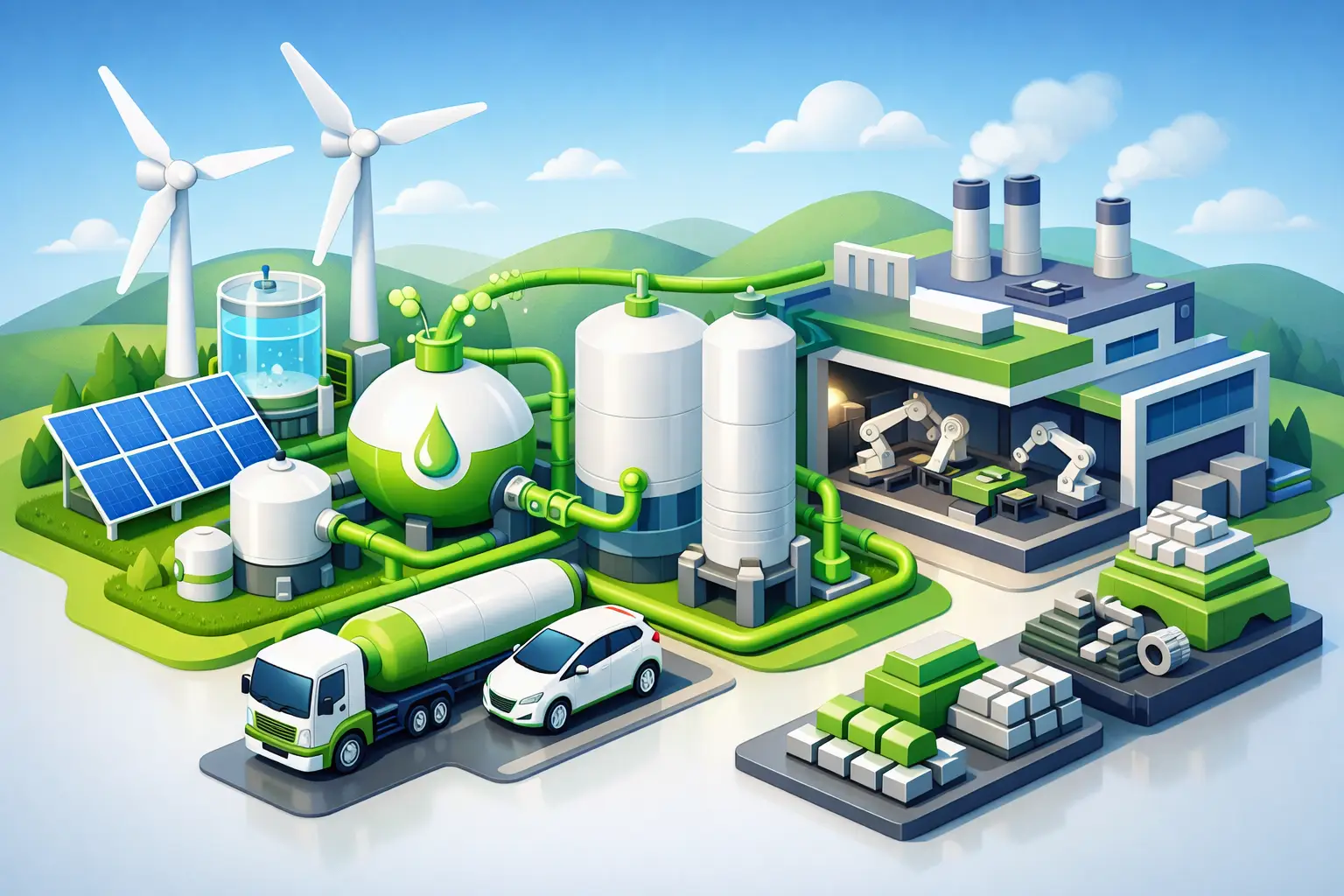
The green hydrogen race will not be won by companies that only assemble end products. It will be won by those that control inputs, compress lead times, reduce logistics friction, and build industrial ecosystems around the full value chain. That is the real question behind “Is Erisha Smart Manufacturing Hub made for back word integration of green hydrogen equipments – solar panel, Electrolizer, wind mills, BESS, H2 Fuel cells ?” The short answer is yes – if the objective is to create a serious manufacturing base for upstream and adjacent clean-energy components rather than a standalone plant with disconnected suppliers.
For investors and manufacturers, backward integration is not just a technical planning choice. It is a margin strategy, a resilience strategy, and increasingly an ESG strategy. Green hydrogen economics remain sensitive to power cost, equipment cost, transport dependencies, and uptime. If a manufacturing hub can support co-located production of solar modules, electrolyzer systems, battery energy storage systems, wind-related components, and hydrogen fuel cell assemblies, it creates a more defensible industrial proposition.
Why backward integration matters in green hydrogen
Green hydrogen projects are often discussed as energy infrastructure. In practice, they are industrial supply chain systems. The cost and viability of hydrogen production depend on a chain that includes renewable power equipment, power management systems, balance-of-plant engineering, storage, mobility applications, and export logistics.
That is why backward integration matters. A company manufacturing electrolyzers gains strategic advantage when nearby suppliers can produce key electrical systems, fabricated assemblies, skids, structural components, energy storage modules, and renewable generation inputs. A fuel cell manufacturer gains speed when power electronics, testing environments, logistics support, and engineering talent are already embedded in the same ecosystem. A hydrogen mobility business gains even more when adjacent EV and clean mobility clusters can share vendors, workforce, and utility planning.
Erisha is built around that industrial logic. It is not positioned as a conventional industrial park where land is leased and every occupier solves infrastructure on its own. It is planned as a sector-led manufacturing ecosystem where specialized tenants can scale inside a wider operating environment designed for advanced production.
Is Erisha Smart Manufacturing Hub made for backward integration of green hydrogen equipment?
Yes, and the reason is structural.
A hub suitable for backward integration needs more than available land. It needs modularity, utility planning, logistics capability, sector adjacency, workforce support, and enough scale to attract upstream and downstream participants. Erisha’s model aligns with those requirements because it brings together purpose-built industrial space, turnkey factory options, logistics assets, clean-tech sector clustering, and a broader live-work-innovate environment that supports long-duration industrial growth.
That matters for green hydrogen equipment because these industries do not operate in isolation. Solar panel production depends on precision manufacturing, warehousing, supply movement, testing, and often export readiness. Electrolyzer manufacturing requires controlled assembly environments, utility reliability, and access to engineering support. BESS production involves electronics integration, safety compliance, storage planning, and logistics discipline. Wind component manufacturing can demand larger-format industrial layouts, movement corridors, and multimodal access. Fuel cell manufacturing requires technical talent, quality control systems, and room for future scale.
Erisha is designed to support those needs at ecosystem level rather than unit level. That is the distinction investors should focus on.
The strongest fit is not one product – it is the cluster effect
The most credible case for Erisha is not that it is only for electrolyzers or only for solar. The stronger case is that it can support a manufacturing cluster across the green hydrogen equipment stack.
Solar panel manufacturers benefit from co-location with storage, power electronics, and hydrogen-linked energy users. Electrolyzer companies benefit from proximity to renewable generation equipment makers, metal fabrication capacity, component assembly partners, and mobility applications. BESS operators and manufacturers fit naturally because hydrogen production and storage economics are tied to power smoothing, load balancing, and renewable intermittency. Fuel cell businesses gain from adjacency to mobility, charging, hydrogen handling, and advanced engineering ecosystems.
This is why sector specialization matters. A general industrial zone may provide space. A specialized manufacturing hub can provide demand adjacency, supplier density, and shared operating logic. Those factors lower friction over time, which is exactly what backward integration is supposed to achieve.
For companies evaluating a clean mobility and energy platform, this is closely tied to the case made in Is Erisha Right for EV and Hydrogen Production?. Hydrogen equipment manufacturing becomes stronger when linked to vehicle systems, energy storage, and adjacent advanced manufacturing demand rather than treated as an isolated vertical.
What kinds of green hydrogen equipment are best suited to Erisha?
Not every part of the hydrogen value chain has the same infrastructure profile. Some activities are lighter, more modular, and faster to establish. Others require larger footprints and more specialized utility configurations. That means the answer is not a blanket yes to every process at every scale.
Solar module assembly, component integration, and supporting electrical manufacturing are strong candidates because they benefit from modular industrial design, logistics access, and co-location with storage and hydrogen users. Electrolyzer system assembly and skid integration are also well aligned, especially where the model includes engineering support, pre-commissioning, and export-oriented manufacturing.
BESS manufacturing and integration are an especially strong fit because they sit at the intersection of renewable energy, industrial power management, and clean mobility. Hydrogen projects need flexible energy architecture. BESS companies need advanced industrial environments with room for testing, compliance processes, and outbound logistics. Those needs overlap.
Wind presents a more nuanced picture. Smaller wind components, electronics, nacelle subassemblies, and control systems may fit efficiently. Very large turbine blade manufacturing or highly specialized heavy component production may depend on footprint, transport corridor geometry, and local shipment economics. That is not a weakness in the model. It is simply industrial reality. Backward integration works best when each equipment category is matched to the right factory format and supply flow.
Fuel cell manufacturing is another strong adjacency play. It connects to hydrogen mobility, stationary power, and advanced energy systems. Companies in this segment need quality-controlled manufacturing environments, supplier ecosystems, and access to markets that are scaling clean transport and distributed energy. A hub built around future-facing sectors can provide that platform.
Why location and infrastructure economics matter more than branding
For serious manufacturers, branding does not close an investment committee decision. Operating logic does.
A hub intended for green hydrogen backward integration must reduce landed cost, simplify movement of materials, and support access to regional and export markets. It must also help companies recruit and retain skilled teams over time. This is where Erisha’s value proposition moves beyond industrial real estate.
Its integrated environment matters because advanced manufacturing does not succeed on factory design alone. It depends on workforce continuity, executive mobility, partner access, and the quality of the wider business ecosystem. When residential, healthcare, education, retail, hospitality, and R&D assets exist alongside industrial operations, companies gain an advantage that standard zones often miss. The site becomes easier to operate, easier to scale, and easier to position as a long-term regional base.
That broader ecosystem is one reason the hub is relevant to investors focused on resilience as much as expansion. It also reinforces why the project’s ESG positioning is commercially important, not cosmetic. Is Erisha Smart Manufacturing Hub ESG and SDG Aligned? addresses that in more detail, and for clean-tech manufacturers it is increasingly part of customer qualification and capital strategy.
The investment case depends on how companies define integration
There is a difference between full backward integration and ecosystem-enabled backward integration.
Full backward integration means one company internalizes many stages of production under direct ownership. That can work, but it is capital intensive and often slower. Ecosystem-enabled backward integration means a company anchors in a hub where critical upstream and adjacent suppliers can co-locate, partner, or expand over time. For many clean-tech firms, that is the better path because it preserves flexibility while still reducing dependence on distant supply chains.
Erisha is particularly compelling under the second model. It gives manufacturers room to establish core production first, then deepen supplier relationships around them. That lowers initial risk while keeping open the possibility of greater vertical control later.
This matters for multinational operators entering the Middle East. They are not only looking for immediate facility readiness. They are looking for whether a location can mature into a strategic manufacturing base over five, ten, or fifteen years. A hub that can attract suppliers, innovation partners, and adjacent sector players offers a stronger answer than a site that only offers land and utilities.
That is also why the platform appeals across sectors. The same ecosystem logic that supports hydrogen and renewable energy can support aerospace-adjacent manufacturing, advanced mobility, and semiconductor-linked activity. The question is less whether the hub can house a factory, and more whether it can help build an industrial network. On that measure, Erisha stands out.
So, is Erisha made for this purpose?
If the requirement is a future-ready industrial base for green hydrogen backward integration across solar panels, electrolyzers, BESS, selected wind components, and H2 fuel cells, Erisha is aligned with that mission. Not because it makes a broad marketing claim, but because its structure supports the industrial realities behind that ambition – sector clustering, modular manufacturing formats, logistics access, clean-tech adjacency, and an integrated operating environment designed for scale.
The smarter way to read the opportunity is this: Erisha is not just a place to install a green hydrogen equipment plant. It is a place to build the supply architecture around it. For decision-makers planning the next phase of clean industrial expansion, that distinction can shape cost, speed, and competitive advantage for years to come.
