
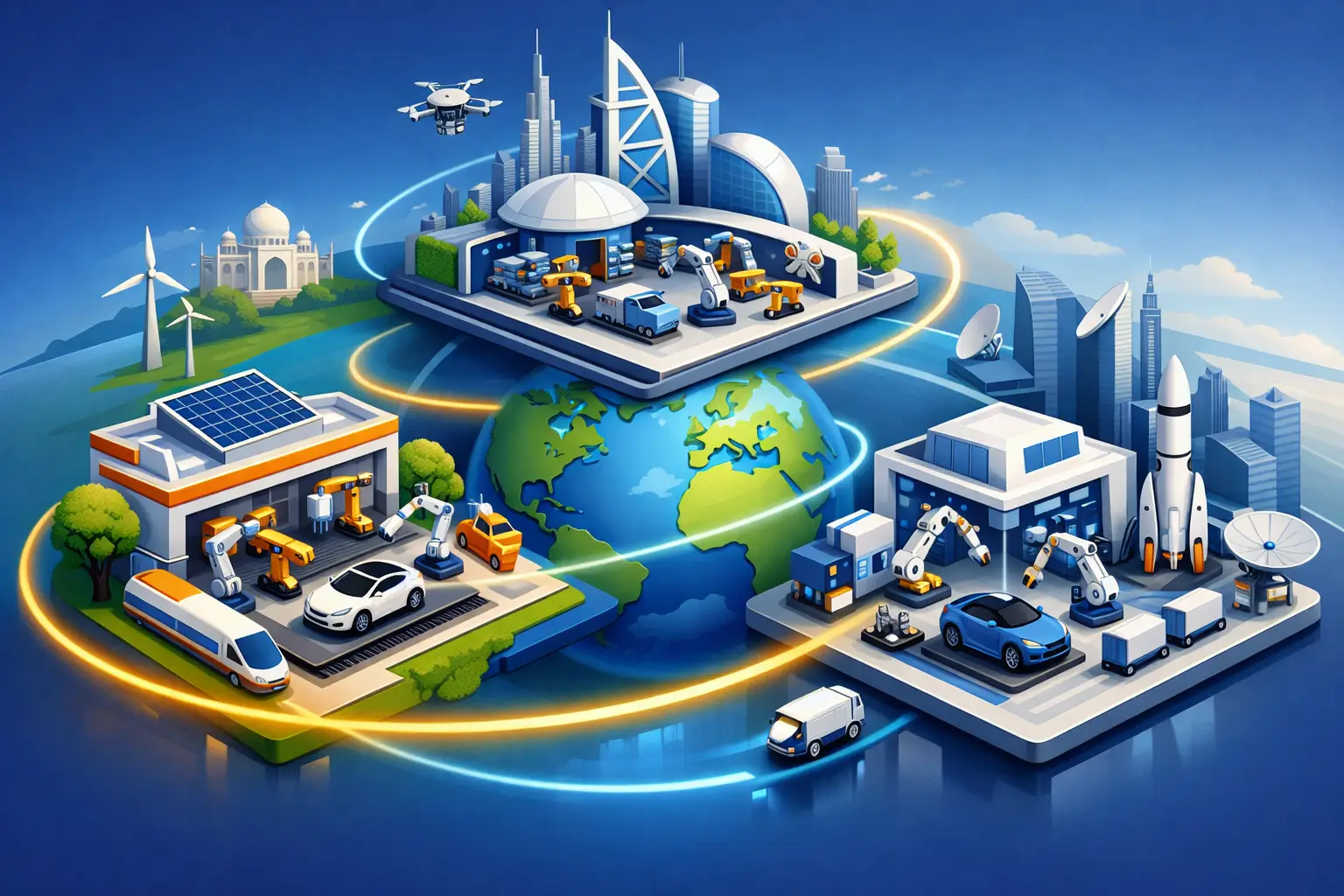
Industrial expansion rarely fails because of ambition. It fails because the platform is wrong. A company may have demand, capital, and product-market fit, yet still lose years to fragmented logistics, utility constraints, workforce churn, and facilities that were never designed for advanced production. That is why the idea behind the Erisha Smart Manufacturing Hub in India, UAE, USA matters. It is not about adding more industrial land to the map. It is about creating a better operating model for high-value manufacturing.
For investors and manufacturers evaluating cross-border growth, the question is no longer whether to expand. The question is where expansion can happen with speed, discipline, and long-term strategic advantage. In that context, a smart manufacturing hub must do more than provide sheds and roads. It must reduce operational drag, support sector-specific requirements, and create an environment where industrial activity can scale without rebuilding the ecosystem around it every few years.
Why the Erisha smart manufacturing hub in India, UAE, and USA stands out
Most industrial parks were designed for a previous era. They work well enough for storage, light assembly, or basic logistics, but advanced manufacturing has moved beyond that model. EV production, hydrogen mobility systems, semiconductor-adjacent operations, clean energy components, and aerospace-linked manufacturing all require a different level of planning. They need utility reliability, logistics efficiency, expansion flexibility, environmental compliance, and workforce support in one coordinated framework.
That is where the Erisha model takes a stronger position. Instead of treating industrial real estate as a standalone asset class, it treats manufacturing as an ecosystem. Purpose-built factories, modular industrial units, logistics facilities, and cleanroom-ready environments matter on their own. Their real value, however, increases when they sit inside a master-planned setting that also addresses housing, healthcare, education, retail, hospitality, and research and development.
For decision-makers, this changes the economics. A plant is no longer isolated from the daily realities that affect output. Talent retention improves when people can live and work within a connected environment. Operational continuity improves when supply chain functions and support services are designed into the site strategy from the start. ESG performance becomes more credible when sustainability is built into planning rather than added later as a compliance exercise.
What manufacturers actually need from a next-generation hub
A serious manufacturing location has to answer a set of practical questions. Can production start without a long facility redesign cycle? Can the site support growth from pilot lines to scaled output? Will the labor ecosystem keep pace with technical hiring needs? Are ports, highways, and export channels close enough to support predictable lead times? Can leadership justify the location not only on cost, but on resilience?
These questions matter even more in sectors with capital-intensive equipment and strict quality requirements. Cleanroom-ready spaces, specialized utility planning, and dedicated industrial clusters are not luxuries for these companies. They are conditions for entry. A smart hub that is built around these needs has a clear advantage over generic industrial inventory.
There is also a strategic issue that often gets missed in early expansion models. Lower cost does not automatically mean lower total operating cost. A cheap site with weak logistics, fragmented vendor access, and poor workforce support can become more expensive within a few quarters. A stronger platform may cost more upfront on paper, yet produce better returns through speed, uptime, tenant fit, and lower disruption.
The value of a three-market footprint
The case for an Erisha smart manufacturing hub in India, UAE, and USA is not based on geography alone. It is based on how different manufacturing strategies can be aligned across those markets. Each geography can serve a different role in a broader industrial portfolio, depending on product mix, supply chain structure, customer base, and regulatory requirements.
India offers scale, engineering depth, and a long-term industrial growth story that continues to attract manufacturing investment. It is a strong base for companies looking at production capacity, supplier ecosystem development, and cost-competitive scaling for domestic and export markets.
The UAE plays a different but highly strategic role. It offers investor-friendly regulation, global connectivity, port access, and a business environment increasingly aligned with advanced industry, energy transition, and innovation-led diversification. For companies targeting GCC markets, wider MENA demand, and efficient links to Europe, Asia, and Africa, the UAE becomes more than a regional office location. It becomes an operational platform.
The USA, particularly for firms with North American ambitions, remains essential for market proximity, customer confidence, and strategic manufacturing presence. For some companies, US operations support final assembly, localization, or specialized production. For others, they provide commercial credibility and risk balance across regions.
The trade-off is complexity. A multi-market footprint can create coordination pressure if each location is developed in isolation. The advantage appears when sites are planned as part of a coherent industrial strategy rather than separate real estate decisions.
Why Ras Al Khaimah changes the regional equation
Within the UAE, location selection is not a minor detail. It affects land economics, utility planning, logistics performance, and long-term expansion capacity. Ras Al Khaimah has become increasingly relevant because it offers something many industrial occupiers are searching for – room to grow without the cost pressure and congestion often associated with larger commercial centers.
For advanced manufacturing, that matters. A company investing in EV, hydrogen, renewable energy, or semiconductor-linked production does not want to outgrow its site after the first stage. It wants a platform that can absorb future phases, supplier adjacencies, testing functions, and workforce community needs.
The Erisha Smart Manufacturing Hub in Ras Al Khaimah is positioned around that logic. The model is not simply to host factories. It is to build a live-work-innovate environment where industrial tenants can operate at scale inside a more complete economic ecosystem. That is a different proposition from a conventional free zone unit or a standard industrial subdivision.
For multinational firms, this also creates a stronger narrative at board level. Expansion into the Gulf is easier to defend when the location offers both regional access and a long-term operating advantage. A site that combines specialized industrial infrastructure with community and research assets carries more strategic weight than one that offers land alone.
Sector specialization is not a branding exercise
Many industrial projects claim to support future industries. Fewer are designed around the actual needs of those sectors. There is a meaningful difference between saying a site welcomes clean-tech manufacturers and structuring the hub around dedicated clusters, utility logic, logistics flows, and facility formats those companies can use.
That distinction is especially relevant in EV manufacturing, hydrogen mobility, eVTOL-related systems, semiconductors, and renewable energy production. These sectors demand coordination between production, testing, storage, safety, compliance, and talent development. They also evolve quickly. A hub built for sector specialization is better placed to adapt than one trying to retrofit itself around emerging tenants.
This is where infrastructure strategy becomes market strategy. The right physical environment can attract not just occupiers, but suppliers, R&D partnerships, institutional capital, and technical talent. Over time, that concentration creates network effects. Companies benefit from being near adjacent capabilities, and the hub becomes more valuable as an ecosystem than as a collection of plots.
A sharper lens on ESG and workforce reality
For serious manufacturers, ESG is now tied to financing, procurement, market access, and reputation. It is no longer enough to publish sustainability targets while operating from infrastructure that was never designed with environmental performance in mind. Industrial tenants increasingly need sites that can support cleaner energy pathways, efficient land use, future mobility integration, and better workforce living conditions.
There is also a labor issue that often sits beneath operational planning. Advanced manufacturing talent does not make location decisions on salary alone. Engineers, technical operators, and specialist managers consider quality of life, commuting burden, family needs, and professional growth. A hub that integrates residential and community assets has a practical advantage in attracting and keeping people who are hard to replace.
That is one reason the ecosystem model matters. It closes the gap between industrial ambition and human reality.
A platform like this speaks directly to manufacturers that are tired of solving the same infrastructure problems every time they enter a new market. It offers a more strategic answer: build where the operating environment is designed to carry growth, not just host it. For companies planning the next decade rather than the next lease, that difference is decisive.
Those tracking the evolution of industrial infrastructure can view more at https://www.ranagroup.ae. The larger point is simpler. The future of manufacturing will not be won by companies that only build products well. It will be won by those that choose ecosystems capable of compounding performance over time.
