
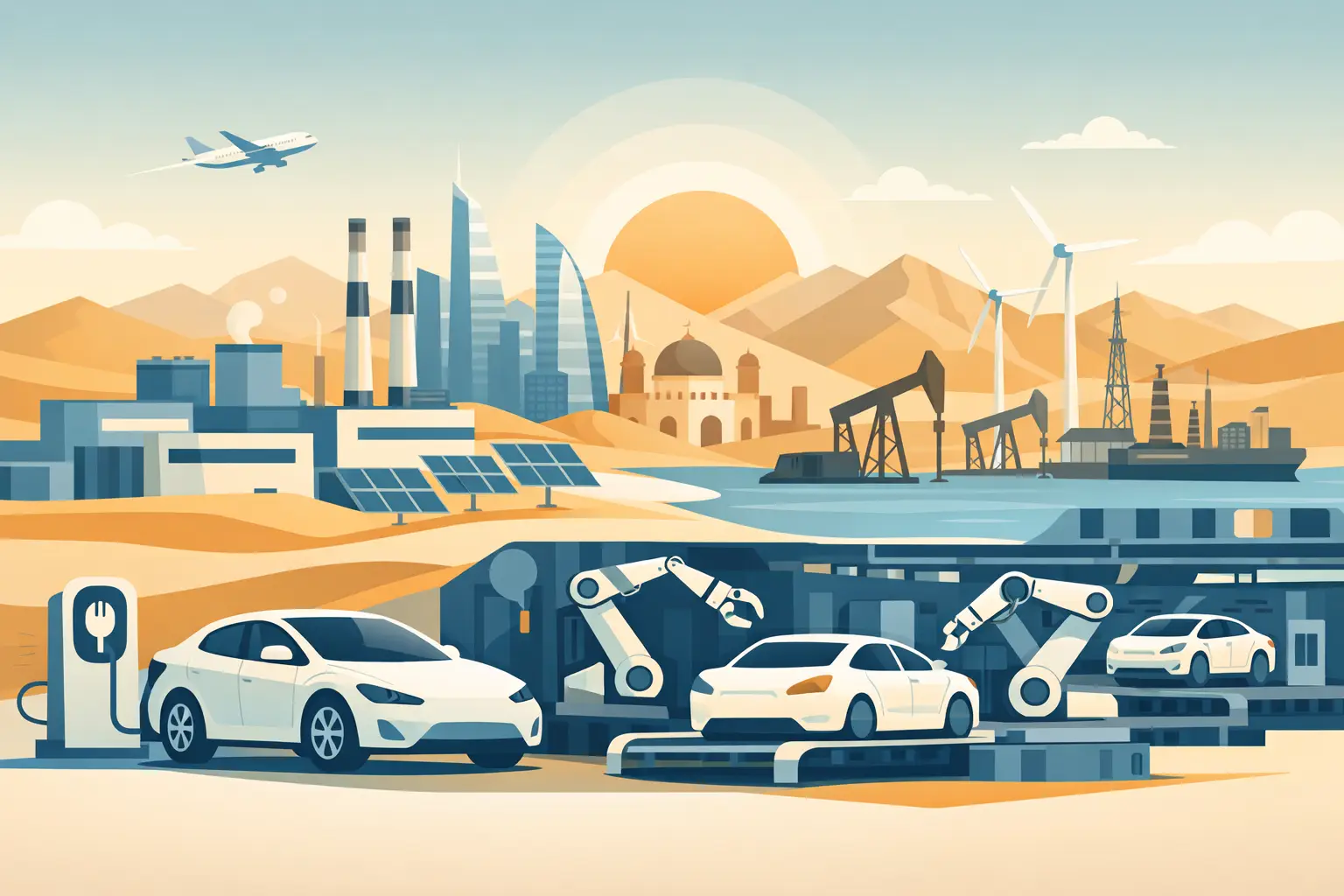
The race for EV capacity is no longer centered on one region
The next decisive question for automotive and clean-tech leaders is not whether electric vehicle production will expand. It is where the next wave of capacity can be built with speed, cost discipline, policy alignment, and long-term resilience. That is why the idea of an EV manufacturing hub Middle East has moved from a speculative talking point to a serious boardroom consideration.
For manufacturers, suppliers, and strategic investors, this is not just about geography. It is about control over timelines, logistics, energy strategy, export reach, and the ability to scale in a market environment designed for industrial growth rather than constrained by legacy systems.
The Middle East, led by the UAE and the Gulf’s broader industrial agenda, is increasingly positioned to serve that role.
Why an EV manufacturing hub in the Middle East is gaining traction
Electric vehicle manufacturing is capital-intensive, supply-chain dependent, and highly sensitive to operating conditions. That makes location strategy unusually important. The right base can improve margins, reduce time to market, and support multi-market distribution. The wrong one can trap a company in cost inflation, labor bottlenecks, infrastructure delays, or export inefficiencies.
The Middle East is gaining attention because it offers a rare combination of strategic factors in one region. Industrial land remains more accessible than in many saturated manufacturing markets. Ports and freight corridors are globally connected. Governments are actively shaping non-oil industrial growth. Energy infrastructure is strong, and the clean energy transition is becoming part of the industrial proposition rather than an afterthought.
For EV manufacturers, this matters at every level of the value chain. Vehicle assembly needs predictable utilities, logistics integration, and room to expand. Battery-related operations need safety planning, specialized facilities, and regulatory clarity. Suppliers need clustering effects that reduce transport friction and improve coordination. Advanced mobility companies also need a location that can support R&D, prototyping, pilot production, and talent attraction in parallel.
That is where the regional model becomes compelling. In the strongest cases, the Middle East is not offering isolated factory plots. It is offering industrial ecosystems.
The real advantage is not tax or location alone
There is a tendency to reduce location decisions to incentives or map position. That misses the bigger issue. EV production succeeds when infrastructure, regulation, workforce strategy, and sector adjacency are designed together.
An effective EV manufacturing hub Middle East proposition has to deliver more than a low-cost entry point. It must support industrial continuity. That includes modern roads and port access, yes, but also modular expansion capacity, cleanroom-ready or high-spec industrial spaces where needed, integrated logistics, customs efficiency, ESG alignment, and a surrounding environment that helps retain skilled teams.
This last point is often underestimated. The workforce challenge in advanced manufacturing is no longer just recruitment. It is retention, quality of life, and the ability to build stable operations over time. A live-work-innovate model can make a meaningful difference for companies trying to attract engineers, managers, technicians, and international specialists.
For decision-makers, the practical question is simple: can this location support an operating business five years from now, not just a construction project next year?
Why the UAE stands out within the regional landscape
Not every market in the Middle East offers the same degree of readiness. The UAE stands apart because it combines investor-friendly regulation, strong logistics, export connectivity, and an increasingly sophisticated industrial policy environment.
That combination matters for EV manufacturers seeking regional and international reach. From the UAE, companies can serve GCC demand, connect to African growth markets, and maintain trade links with Europe and Asia through established shipping routes. For operations leaders, that translates into optionality. A factory base in the right UAE location can function as both a regional production center and an export platform.
The cost side also deserves attention. Compared with many mature manufacturing centers, the UAE can offer lower total operating friction when land access, permitting efficiency, logistics performance, and infrastructure quality are considered together. This does not mean every project will be cheaper on a line-item basis. Labor profiles, component sourcing, and utility requirements will vary. But in many cases, the total business environment is more predictable, and predictability has real value in advanced manufacturing.
There is also a policy narrative at work. The UAE’s economic diversification strategy, clean mobility ambitions, and advanced industry agenda are aligned with sectors such as EVs, hydrogen mobility, semiconductors, and renewable energy manufacturing. For investors, alignment with national priorities can improve confidence that industrial growth is being supported at a structural level rather than promoted through short-term messaging.
What manufacturers should evaluate before choosing a hub
An EV strategy should not treat the Middle East as one uniform opportunity. The region’s promise is real, but execution depends on site-specific fundamentals.
First, assess whether the location supports phased growth. Many EV businesses do not begin with full-scale capacity. They start with assembly, specialized component manufacturing, or pilot lines before expanding into deeper vertical integration. A viable hub should allow that progression without forcing relocation.
Second, examine infrastructure readiness in operational terms, not brochure terms. Power reliability, water availability, heavy vehicle access, storage, hazardous material planning, and proximity to ports all affect factory performance. If the project includes battery systems or advanced electronics, facility specifications become even more critical.
Third, consider industrial clustering. EV manufacturing benefits from adjacency to suppliers, materials handling, energy systems, testing capability, and complementary sectors such as hydrogen mobility, power electronics, and smart manufacturing. A standalone site may work for a narrow operation, but a cluster model usually creates stronger long-term economics.
Fourth, evaluate the surrounding ecosystem. Housing, healthcare, education, and daily amenities are not secondary issues in high-value industrial development. They shape whether a company can build and keep a capable workforce. That is especially true for multinational operators bringing in technical leadership or specialist teams.
Finally, test the ESG proposition carefully. Sustainability claims are easy to make and harder to operationalize. Manufacturers should ask how a hub supports energy efficiency, emissions targets, resource planning, and environmental compliance at the site level. For many boards and investors, this is now part of the core investment case.
The hub model is changing what industrial development means
The strongest industrial projects in the region are moving beyond the old industrial park model. They are being planned as sector-specific platforms with logistics, innovation, community infrastructure, and expansion pathways built into the master plan.
This shift is especially relevant for EVs because the industry sits at the intersection of mobility, energy, software, electronics, and sustainability. A successful production environment needs room for cross-sector collaboration. It also needs the credibility to attract suppliers, technology partners, financiers, and institutional stakeholders.
That is where integrated developments gain an advantage. A master-planned environment that combines advanced manufacturing facilities with logistics assets, R&D capacity, residential support, and ESG-focused planning can lower operational risk for tenants. It can also accelerate ecosystem effects that standalone industrial sites rarely achieve.
Within that context, developments such as the Erisha Smart Manufacturing Hub reflect the direction serious industrial infrastructure is taking in the UAE – purpose-built, sector-led, and designed for long-horizon industrial value creation rather than short-term occupancy.
The opportunity is strong, but timing matters
There is no single formula for building an EV manufacturing footprint in the region. Some companies will prioritize export-oriented assembly. Others will focus on battery systems, commercial vehicles, charging hardware, or specialized components. Some will need immediate turnkey capacity, while others will want land and modular growth options.
That is precisely why the Middle East is becoming more relevant. It can support different entry models, provided the industrial platform is credible and the location strategy is disciplined.
But timing matters. As more manufacturers, mobility companies, and clean-tech investors evaluate the region, the most advantaged sites will not remain equally available. Infrastructure-backed, policy-aligned, expansion-ready locations tend to separate quickly from the rest of the market.
For leaders making regional manufacturing decisions, the question is no longer whether the Middle East belongs in the conversation. The question is which platform is built to carry industrial ambition at the scale the next decade will require.
The companies that answer that question early will be better positioned to shape the market, not simply enter it later.
