
A hiring bonus can fill a production line for a quarter. It rarely secures a workforce for five years. That is the central lesson behind any serious factory campus workforce retention example: retention is not primarily an HR tactic. It is an infrastructure outcome.
For advanced manufacturers, especially in sectors with exacting quality standards and round-the-clock operations, labor stability shapes yield, safety, training costs, and expansion speed. When operators, technicians, and engineers spend too much time commuting, cycling through temporary housing, or patching together daily services far from the plant, attrition rises. The hidden cost is not only replacement hiring. It is delayed ramp-up, weaker process discipline, and a slower path to scale.
That is why the strongest industrial platforms are moving beyond the old industrial park model. They are building factory campuses designed to support work, life, mobility, and innovation in one environment. For investors and occupiers, that shift deserves attention because it changes the economics of labor retention at the site level.
What a factory campus workforce retention example actually shows
A useful factory campus workforce retention example is not a story about perks. It is a demonstration of how physical planning reduces the friction that causes workers to leave.
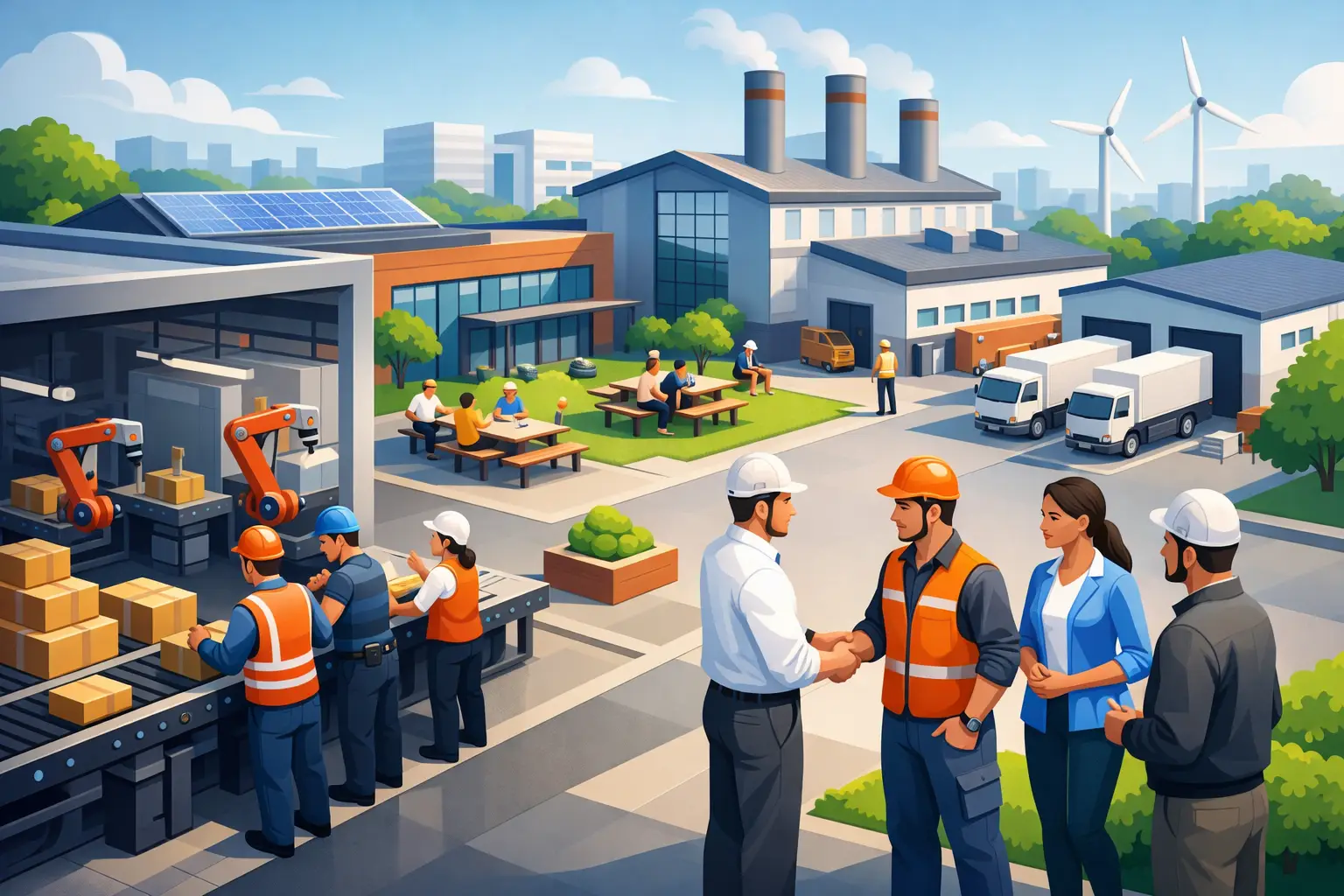
Consider a large manufacturing campus with three layers of design. The first layer is production infrastructure: purpose-built factories, modular expansion capacity, utility reliability, logistics access, and sector-specific specifications such as cleanroom readiness or hazardous material controls. The second layer is workforce support: nearby housing, transport options, healthcare access, food and retail services, and training facilities. The third layer is long-term value creation: education partnerships, R&D capacity, and community assets that make the location viable not just for employees, but for their families and future careers.
In that model, retention improves because the campus removes recurring pain points from daily life. Shift workers can reach the plant without a punishing commute. Skilled hires relocating from another market can find housing without entering a fragmented search. Mid-level managers evaluating a two- or three-year assignment can see schools, clinics, and basic amenities close at hand. Engineers and technicians can imagine a professional pathway rather than a single job posting.
That distinction matters. A workplace that is efficient for production but difficult for life tends to retain only until the next offer appears. A campus that supports both is harder to leave.
Why retention has become a site selection issue
Industrial decision-makers increasingly treat workforce availability as a headline factor in expansion. The next step is recognizing that workforce retention belongs in the same conversation.
A region may offer labor supply on paper, but if the operating environment produces constant turnover, that supply is less valuable than it appears. Manufacturers end up paying twice – first to recruit, then to retrain. In advanced sectors such as EV components, semiconductor-adjacent manufacturing, hydrogen systems, or aerospace-linked assembly, the cost of turnover can be particularly high because process knowledge is not instantly replaceable.
This is where the campus model changes the investment case. Instead of treating labor retention as a recurring operating problem, it treats it as a design problem that can be solved upfront. Housing placement, transportation planning, service proximity, and talent development infrastructure all become part of industrial competitiveness.
Not every company needs a fully integrated campus. A smaller light-industrial operator with stable local labor may perform well in a conventional zone. But once operations become skill-intensive, shift-heavy, or reliant on imported and relocating talent, the case for integrated planning becomes far stronger.
The infrastructure behind a stronger retention curve
When retention is discussed too loosely, the conversation drifts toward culture programs and benefits packages. Those matter, but they are downstream. The upstream drivers are more structural.
Housing is one of them. If workers must choose between high costs close to the plant and cheaper options far away, attendance pressure rises and tenure often falls. Workforce-oriented residential planning changes that equation. It does not mean every employee lives on site. It means the campus acknowledges that labor stability depends on realistic access to suitable housing across income bands.
Mobility is another. Long and unreliable commutes erode retention faster than many employers admit. The issue is not only travel time. It is schedule uncertainty for shift changes, fatigue, and the daily friction that accumulates over months. Factory campuses with integrated transit logic, shuttle systems, road access, and proximity planning create a more durable labor base.
Services also matter more than they appear in spreadsheets. Healthcare access, childcare options, food services, retail convenience, and recreation all influence whether workers see a job as sustainable. For technical and managerial talent, schools and professional networks can be decisive. These are not soft amenities. They are part of the operating environment.
Then there is capability development. A campus connected to training institutions, apprenticeship pipelines, and applied R&D creates a retention mechanism that salary alone cannot replicate. Workers stay longer when they can move upward without moving away.
A practical factory campus workforce retention example
Imagine a clean-tech manufacturing hub built for multi-tenant occupancy, with a mix of turnkey factories, specialized industrial units, logistics support, and adjacent land for phased expansion. The developer does not stop at industrial shells. It also master-plans residential zones, healthcare services, retail, education assets, and shared innovation facilities within the same broader ecosystem.
A battery components manufacturer enters first, followed by an EV systems supplier and a precision fabrication company. In year one, each tenant focuses on startup hiring. Turnover is elevated but manageable. By year two, the difference between this campus and a standard industrial location becomes visible.
Operators living near the site show stronger attendance consistency than those dependent on long-distance travel. Technicians recruited from abroad settle faster because accommodation and basic services are not fragmented across multiple districts. Supervisors remain longer because family needs can be met without relocation pressure. Shared training resources reduce onboarding time, and a visible cluster effect gives employees confidence that their skills will remain relevant even as firms scale or specialize.
The result is not perfect retention. No serious operator should expect that. Some roles will always turn over faster than others, and wage competition remains real in growth markets. But the campus lowers avoidable churn. It converts retention from a reactive cost center into a strategic advantage.
This is the broader significance of a factory campus workforce retention example. It shows how ecosystem planning can improve labor durability across multiple tenants, not just within one employer.
Why this matters to investors and industrial occupiers
For occupiers, better retention supports production continuity, quality control, and faster expansion. For investors, it strengthens tenant resilience and campus performance over time.
A site that helps manufacturers keep people is more than a place to operate. It becomes a platform for compounding value. Tenants are more likely to expand in place when workforce conditions are stable. New entrants are easier to attract when the labor proposition is visible and credible. Institutional partners take greater interest when infrastructure, talent, and ESG alignment are part of the same development logic.
There is also a strategic policy dimension. Governments across growth markets want industrial development that creates durable employment, skill formation, and economic diversification. A campus model aligned with those priorities is more likely to support long-term relevance than an isolated real estate play.
That is one reason integrated ecosystems such as those envisioned by Rana Group carry weight in the market. They frame industrial infrastructure not as a collection of plots, but as a live-work-innovate environment built for sustained industrial growth.
The trade-offs leaders should evaluate
Integrated campuses are powerful, but they are not simple. They require more coordination, more upfront planning, and a longer investment horizon than a conventional factory lease in a stand-alone zone.
For some manufacturers, especially those with highly localized labor strategies or short project cycles, that added complexity may not pay back immediately. The model works best when the operation depends on stable technical labor, long-term production planning, and repeated scaling phases.
Developers also need discipline. If residential, service, and industrial components are misaligned in timing, the retention promise weakens. Build the factories too far ahead of workforce amenities and the campus behaves like any other industrial district. Build amenities without tenant density and economics become strained. Sequencing matters.
For occupiers, the right question is not whether a factory campus sounds attractive. It is whether the campus has been planned in a way that genuinely reduces labor friction for their specific workforce mix.
The most competitive manufacturing locations over the next decade will not win on land alone. They will win by making industrial employment more livable, more scalable, and more durable. When a campus can do that, retention stops being a chronic vulnerability and starts becoming part of the investment thesis. That is where the future works.
