
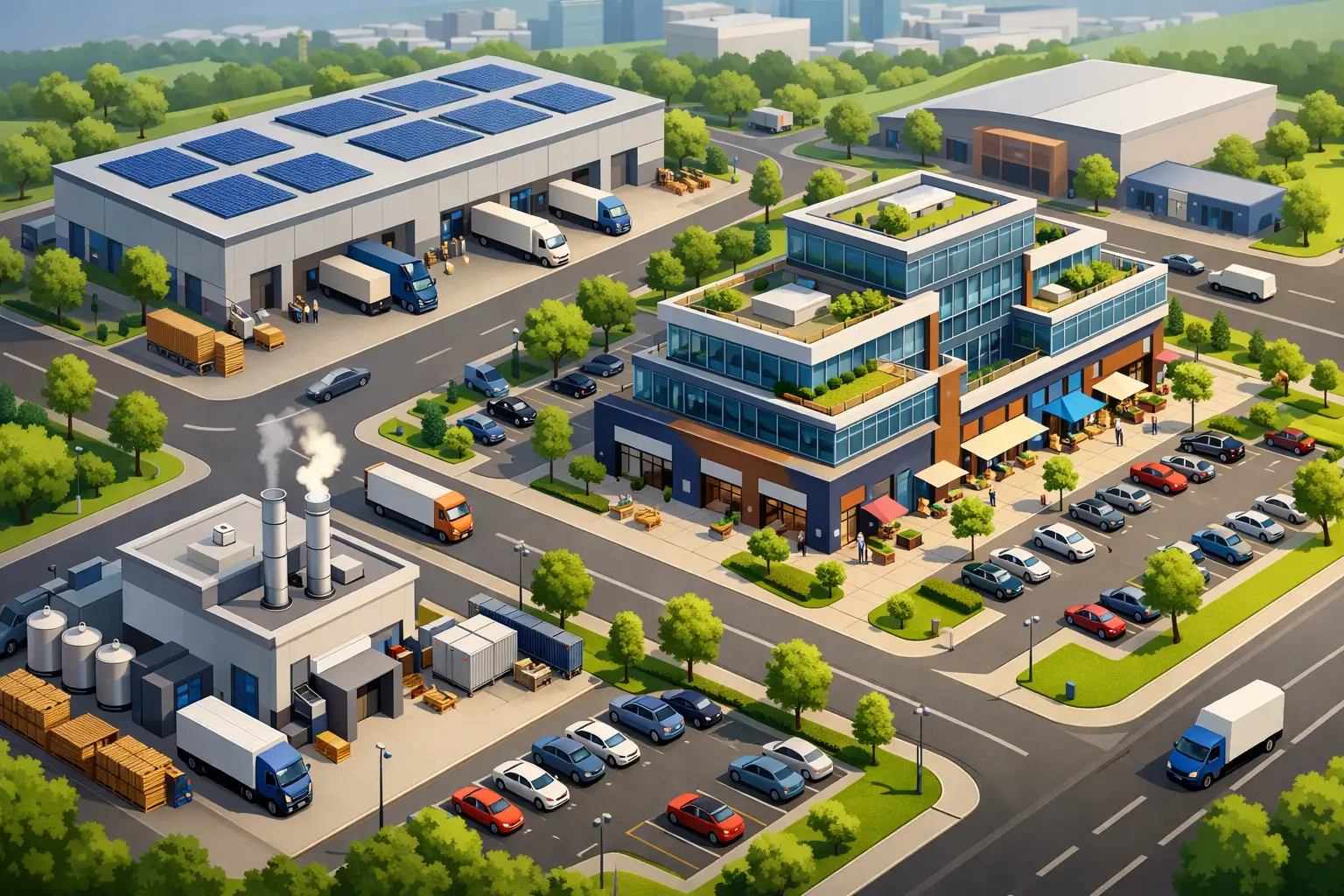
A factory can be built in months. An industrial economy takes far longer. That is the real lesson behind any serious industrial mixed use development case study: production capacity alone does not create durable growth. The winning model combines manufacturing infrastructure with the housing, services, logistics, talent systems, and innovation assets that keep industrial operations productive over time.
For investors and occupiers, this is no longer a design preference. It is an operational requirement. Advanced manufacturing sectors such as EVs, semiconductors, hydrogen mobility, aerospace-adjacent production, and renewable energy systems need more than warehouse space and utility access. They need a location that can support workforce retention, supplier coordination, R&D activity, ESG expectations, and long-term expansion without forcing the business into fragmented real estate decisions.
What this industrial mixed use development case study shows
The strongest industrial mixed-use projects are built around a simple premise: industry performs better when it is planned as part of an ecosystem rather than isolated as a land use category. That sounds obvious, but many developments still separate factories from residential communities, education providers, healthcare services, hospitality assets, and research capacity. The result is often predictable – labor friction, commuting inefficiency, weak tenant stickiness, and rising operating costs over the life of the project.
A more strategic model brings these components together from the beginning. In practice, that means purpose-built industrial facilities sit alongside logistics infrastructure, workforce accommodation or nearby residential options, training environments, retail and service amenities, and space for technical collaboration. The value is not aesthetic. It is economic.
When a manufacturer can recruit talent into a district where people can live, access healthcare, upskill, and work close to suppliers and partners, time-to-productivity improves. When that same district is designed for sector clustering, innovation moves faster because engineers, operators, and adjacent firms are not spread across disconnected sites. This is where mixed-use industrial development stops being a planning concept and becomes a competitive advantage.
The core problem traditional industrial parks fail to solve
Conventional industrial zones were often designed for a previous era of manufacturing. Land was zoned, roads were laid, utilities were connected, and occupiers were expected to solve the rest themselves. That model still works for some low-complexity operations, especially where labor requirements are modest and supply chains are stable. But it becomes less effective as manufacturing grows more technical, more regulated, and more dependent on specialized talent.
Take workforce as one example. A high-value manufacturer may have access to land and power, yet still struggle because qualified staff face long commutes, limited housing options, or a lack of supporting community infrastructure. Retention suffers. Training costs rise. Operating continuity weakens. None of that shows up in an initial land acquisition headline, but it shows up quickly in EBITDA.
The same pattern applies to innovation and supplier coordination. If prototyping, production, testing, and technical partnerships are distributed across multiple disconnected locations, growth slows. Companies spend more time managing movement, compliance, and coordination than building products. The deeper issue is not geography alone. It is the absence of a master-planned industrial ecosystem.
The case for integrated industrial ecosystems
A credible industrial mixed use development case study typically reveals four drivers of outperformance.
First, integrated planning reduces hidden operating friction. Shared logistics access, sector-specific infrastructure, and proximity to workforce-supporting services help occupiers avoid the expensive patchwork that often follows site selection.
Second, mixed-use environments improve labor resilience. People are more likely to join and stay in industrial districts that offer a livable environment rather than a single-purpose employment zone. For employers facing technical hiring constraints, that matters as much as rent or land cost.
Third, the model supports sector clustering. Advanced industries rarely thrive in isolation. They benefit from suppliers, testing capabilities, mobility infrastructure, technical education, and adjacent R&D capacity. A mixed-use industrial hub can be designed to create these adjacencies intentionally.
Fourth, it strengthens long-term asset value. Investors increasingly evaluate industrial developments not just on initial leasing potential, but on ecosystem durability. Projects that support innovation, workforce stability, and ESG alignment are better positioned to attract institutional capital and global tenants over time.
A practical framework for evaluating any industrial mixed use development case study
Not every project that uses the term mixed-use delivers strategic value. Some simply place light commercial assets next to industrial land and call it integration. Serious investors should test the model more rigorously.
Start with infrastructure specificity. Does the development offer facilities aligned with actual industrial demand, such as modular manufacturing units, heavy-power capacity, logistics assets, cleanroom-ready environments, or specialized clusters for sectors like EVs or semiconductors? If the industrial component is generic, the ecosystem claim is usually overstated.
Then assess whether the non-industrial uses genuinely support industrial performance. Residential, healthcare, education, retail, and hospitality assets only matter if they reduce friction for occupiers, workers, and partners. A mixed-use plan should answer a business problem, not just fill a master plan.
Governance is equally important. Industrial ecosystems perform best when they are curated, not loosely assembled. Developers and operators need a clear strategy for tenant mix, infrastructure phasing, ESG standards, mobility planning, and utility resilience. Without that, the project can drift into a collection of unrelated uses.
Finally, examine expansion logic. The best developments are built for industrial growth over time. That means phased delivery, room for scale-up, and the ability to accommodate future technologies that may not yet be fully commercialized but are clearly shaping policy and capital flows.
Why this matters now for advanced manufacturing
Timing matters. Global manufacturing is being reshaped by energy transition targets, supply chain regionalization, industrial policy, and the need for more resilient production footprints. Companies entering the Middle East, the United States, or India are not just comparing lease rates. They are asking whether a location can support strategic growth for the next decade.
That changes the development equation. A site with lower headline costs but weak ecosystem support may look efficient at entry and become expensive in operation. By contrast, an integrated industrial hub may require more disciplined planning upfront, yet create better outcomes in labor access, tenant retention, investor confidence, and production continuity.
This is especially relevant for sectors with high compliance and infrastructure sensitivity. Semiconductor-related manufacturing needs cleanroom-readiness, technical talent, and utility reliability. EV and hydrogen mobility players need room for assembly, testing, logistics, and collaboration with adjacent component ecosystems. Renewable energy manufacturers benefit from locations aligned with policy momentum and export pathways. In each case, the project works best when industrial real estate is part of a broader operating platform.
What leading developments are doing differently
The most ambitious projects are moving beyond the idea of an industrial park and toward a full live-work-innovate model. That shift is not cosmetic. It reflects a clearer understanding of what global manufacturers now require from a destination.
In these next-generation hubs, the development logic starts with industrial productivity and expands outward. Facilities are built to meet advanced sector needs. Logistics and port connectivity are treated as core infrastructure, not supporting features. Workforce accommodation, education pathways, and healthcare access are planned as retention tools. Retail and hospitality are included because business districts need to function daily for employees, visiting partners, and international leadership teams.
When done well, the result is a more investable platform. Tenants gain operational readiness and expansion flexibility. Investors gain a stronger story around resilience and long-term demand. Governments gain a vehicle for economic diversification, export growth, and national industrial strategy. That alignment is why this model is gathering momentum.
One example of this broader approach can be seen in how Rana Group positions advanced industrial development – not as standalone real estate, but as infrastructure for future industries, workforce ecosystems, and long-range economic capacity. That framing is increasingly where the market is heading.
The trade-offs investors should keep in view
None of this means every mixed-use industrial project will outperform automatically. Integrated developments are more complex to plan, phase, and govern. They require stronger capital coordination, clearer infrastructure sequencing, and a more disciplined view of tenant curation. If the industrial strategy is weak, adding mixed-use components does not fix the project.
There is also a timing question. Some occupiers need immediate low-cost space and may not value the full ecosystem on day one. Others, especially multinational manufacturers making long-term bets, will see the advantage quickly. It depends on the sector, growth horizon, workforce profile, and operational complexity of the business.
That is why the real test is not whether a project is mixed-use. It is whether the integration measurably improves industrial outcomes.
The developments that will matter most in the next cycle are the ones that understand a simple truth: manufacturing competitiveness is built not only inside the factory, but across the surrounding ecosystem. For leaders deciding where future production will scale, that is the question worth asking first.
