
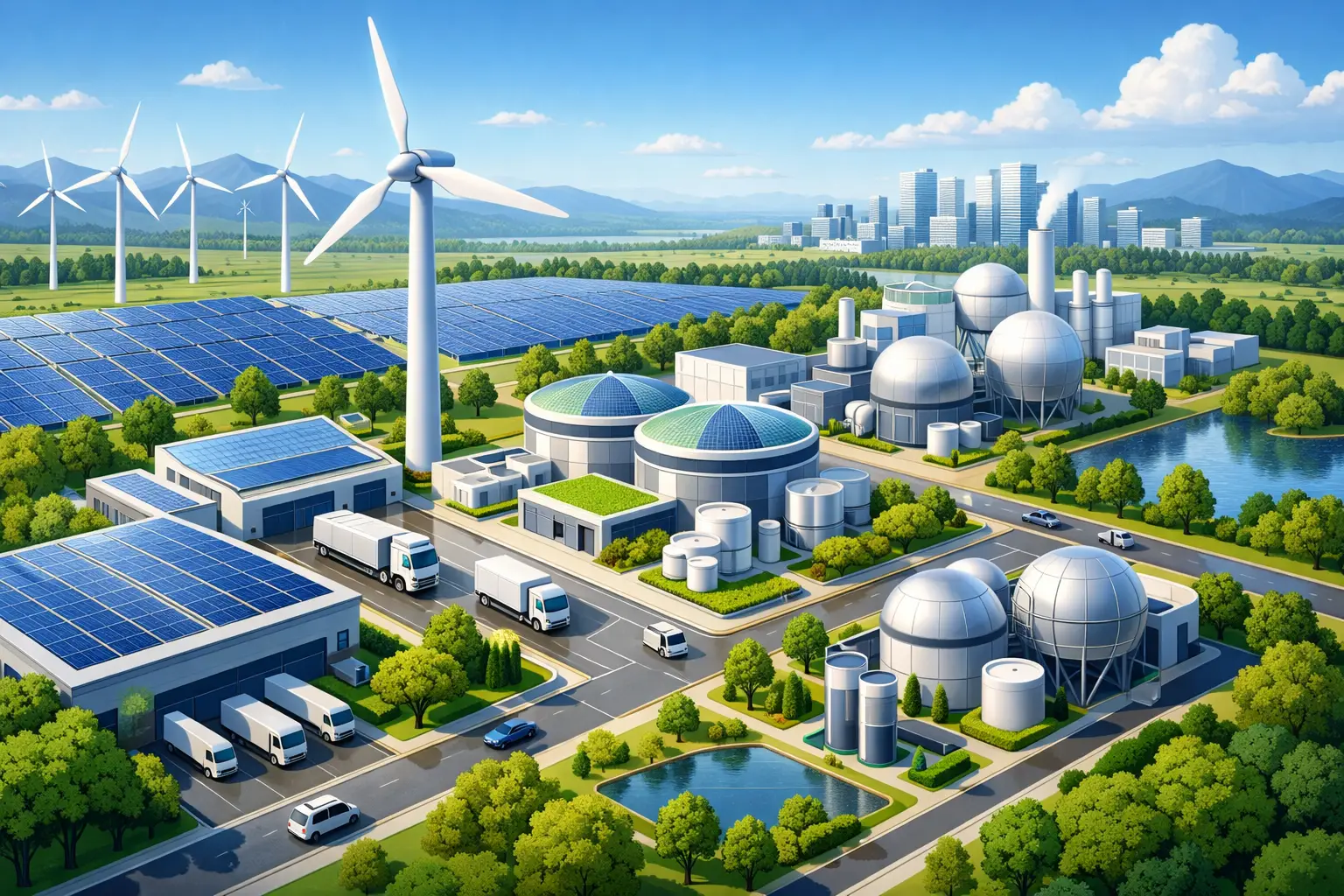
A manufacturer choosing its next production base is no longer comparing land prices alone. The real calculation now includes grid resilience, embodied carbon, logistics emissions, workforce retention, water security, permitting speed, and the credibility of an ESG strategy under investor scrutiny. That is why the net zero industrial parks future has moved from concept to competitive requirement.
For industrial investors and multinational operators, this shift is not about optics. It is about protecting margins, reducing long-term operating risk, and securing a foothold in regions that will lead the next cycle of advanced manufacturing growth. The industrial park of the past was designed to host factories. The industrial park of the future is designed to improve how those factories perform.
Why the net zero industrial parks future matters now
Industrial real estate is entering a new phase. Occupiers in sectors such as EVs, hydrogen mobility, semiconductors, renewable energy, and aerospace-adjacent manufacturing need more than serviced plots and warehouse shells. They need ecosystems that can support energy-intensive, compliance-heavy, export-driven operations over decades.
That raises the standard for what counts as strategic infrastructure. A net zero-aligned industrial park is not simply a site with solar panels on rooftops. It is a coordinated system where power, water, mobility, buildings, utilities, logistics, and community services are planned together to reduce total emissions while improving operational efficiency.
This matters because industrial tenants are facing pressure from several directions at once. Customers want lower-carbon supply chains. Regulators want measurable disclosure. Capital markets are pricing sustainability risk into financing. At the same time, energy volatility, shipping disruption, and labor competition are making inefficient industrial locations more expensive to operate.
In that environment, net zero becomes a business model question. The parks that win investment will be the ones that lower friction across the full operating stack, not just the electricity bill.
Net zero industrial parks future depends on systems, not slogans
The strongest industrial ecosystems will be defined by systems thinking. There is a major difference between a park that markets sustainability and one that is structurally built for it.
A credible net zero industrial park starts with energy architecture. That can include onsite renewables, district-scale energy management, battery storage, smart metering, demand-response capability, and readiness for future fuels where relevant. For some tenants, especially in high-load manufacturing, the path will include a phased energy mix rather than immediate full decarbonization. That is not a weakness. It is realism.
Water is the next pressure point. Many advanced industries require stable, high-quality water systems, and climate variability is making supply risk harder to ignore. Parks designed for the future will increasingly integrate water recycling, monitoring, treatment, and circular utility planning from the beginning.
Logistics design also plays a central role. Proximity to ports, highways, and export corridors reduces both costs and transport emissions. Internal mobility matters too. Electrified fleets, optimized truck circulation, shared logistics services, and cluster-based supplier adjacency can cut inefficiencies that traditional industrial layouts simply accept.
Then there is the built environment itself. Factory shells, modular units, cleanroom-ready spaces, and specialized manufacturing facilities must be designed for high performance, expansion flexibility, and lower lifecycle emissions. It is cheaper to build these capabilities into the master plan than to retrofit them under production pressure later.
The live-work model is becoming an industrial advantage
One of the least discussed drivers of net zero performance is workforce design. A park can install efficient infrastructure and still underperform if the labor ecosystem is weak, fragmented, or dependent on long, carbon-intensive commutes.
That is why integrated industrial development is gaining ground. When residential, healthcare, education, retail, hospitality, and R&D functions sit within the broader ecosystem, the result is not just better convenience. It can produce measurable industrial value. Commute patterns improve. Worker retention strengthens. Talent attraction becomes easier for technical and managerial roles. Collaboration across suppliers, operators, and innovation partners becomes faster.
For advanced manufacturers, this is especially relevant. Semiconductor, EV, hydrogen, and precision engineering operations do not just need square footage. They need stable teams, specialist services, and a location that supports long-term organizational growth. A park that functions as a true live-work-innovate environment is better positioned to deliver that outcome than a conventional site built around isolated industrial zoning.
This is where the conversation becomes more strategic. The future of net zero industrial parks is not only about reducing environmental impact. It is about creating industrial environments that are harder to disrupt and easier to scale.
What investors and occupiers should look for
Not every project marketed as sustainable will deliver industrial-grade performance. Sophisticated occupiers should evaluate whether a development can support real production complexity.
The first question is readiness. Is the infrastructure already planned for sector-specific requirements such as cleanrooms, heavy utility loads, hazardous material handling, testing facilities, or advanced mobility assembly? Generic infrastructure can slow expansion and increase capital outlay later.
The second question is economics. Net zero alignment should improve long-term cost stability, but the capital structure matters. Some parks will front-load investment into sustainability systems in ways that make tenant economics less attractive. Others will phase upgrades intelligently, pairing immediate operational wins with long-range decarbonization. The right approach depends on sector, energy intensity, and time horizon.
The third question is governance. Investors need to know how emissions, utilities, waste, and environmental performance will actually be measured and managed. Ambition without transparent operating frameworks is not enough, particularly for public companies and institutional capital partners.
The fourth question is ecosystem depth. Can suppliers, workforce, research partners, and service providers operate within the same platform? Industrial parks that create cluster effects tend to outperform isolated sites because they shorten time to production and reduce coordination risk.
The Middle East has a real opening
The next generation of industrial growth will not be distributed evenly. Regions that can combine competitive operating costs, modern logistics, investor-friendly regulation, and sustainability alignment will attract disproportionate interest.
The Middle East has a strong opportunity here, especially where industrial policy, infrastructure investment, and export ambition are moving in the same direction. For global manufacturers, the appeal is clear: access to regional demand, connectivity to Asia, Africa, and Europe, and the ability to establish production in jurisdictions actively shaping future-focused industrial capacity.
That opportunity will go to the platforms that understand scale. Advanced manufacturing tenants are not looking for symbolic green zones. They are looking for fully planned environments where production, logistics, utilities, talent, and compliance can work together from day one.
This is why ecosystem-led models are gaining attention. Developments such as the Erisha Smart Manufacturing Hub reflect a more mature industrial proposition – one that treats sustainability, sector specialization, and community infrastructure as core operating requirements rather than optional enhancements.
What the next decade will likely bring
Over the next ten years, net zero industrial parks will become more specialized, more digital, and more integrated into national economic agendas. Energy systems will become smarter and more decentralized. Utility data will become a central management tool, not a back-office report. Parks will increasingly be designed around sector clusters, because EV assembly, semiconductor packaging, hydrogen systems, and aerospace components do not share identical infrastructure needs.
There will also be trade-offs. Full net zero achievement will not happen at the same pace across every industry. Heavy manufacturing, process heat requirements, and supply chain dependencies make some decarbonization pathways more complex than others. The stronger parks will acknowledge that reality and build flexible roadmaps instead of making claims they cannot support.
What will not change is the direction of travel. The market is moving toward industrial environments that can prove resilience, efficiency, and carbon performance in the same breath. That changes how land is valued, how infrastructure is financed, and how tenants choose expansion locations.
The companies that move early will have an advantage. They will secure better sites, shape stronger partnerships, and build operations in places designed for where manufacturing is going, not where it has been.
The future will not be won by industrial parks that promise sustainability in marketing language. It will be built by industrial ecosystems that make advanced manufacturing cleaner, faster, more cost-stable, and more investable from the ground up.
