
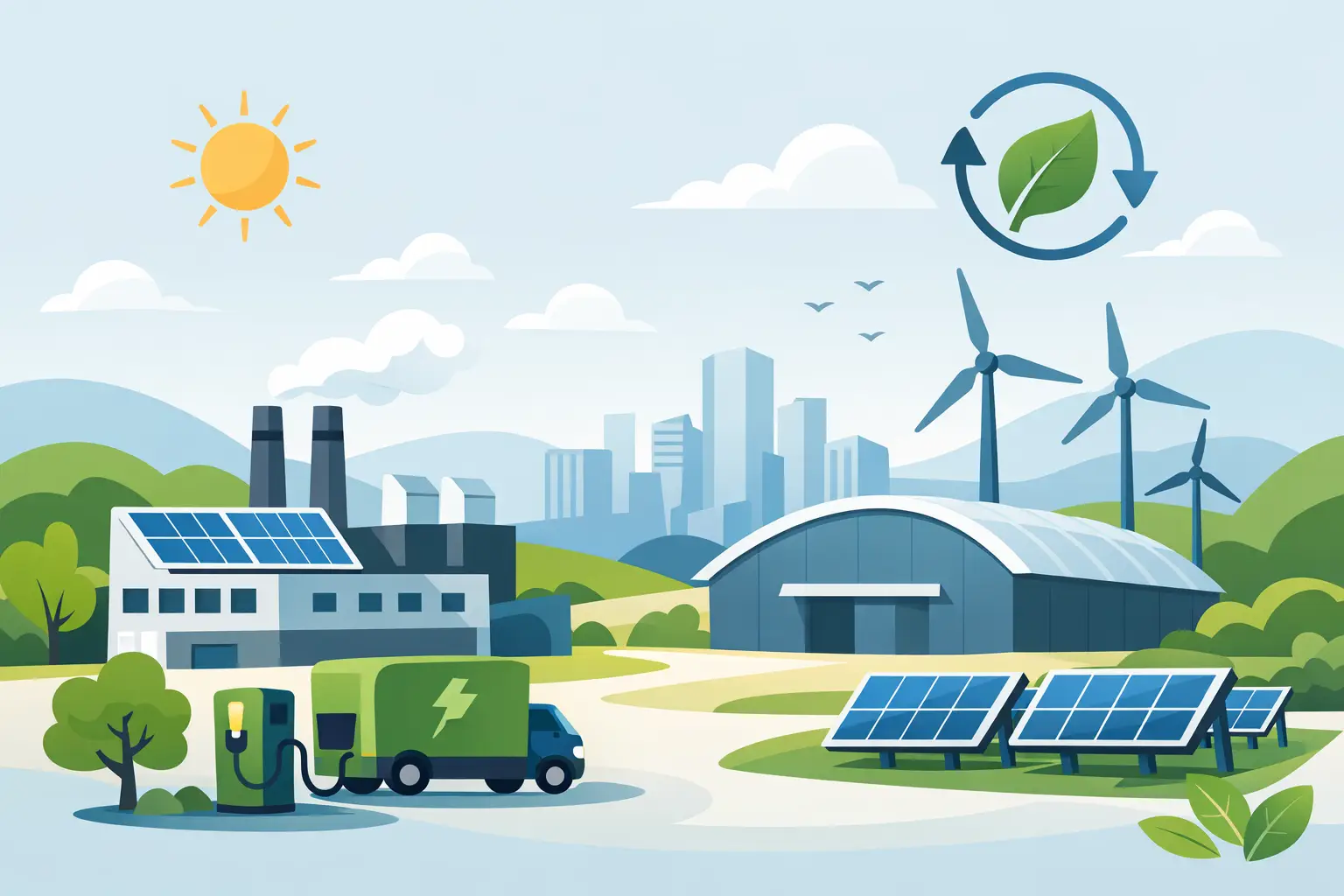
Industrial expansion decisions are being made under a different set of pressures than they were even five years ago. Energy costs are less predictable, reporting obligations are tighter, supply chains are being redesigned for resilience, and investors are asking tougher questions about carbon exposure. In that environment, net zero ready industrial buildings are not a branding exercise. They are a strategic infrastructure choice.
For manufacturers, logistics operators, and advanced technology companies, the issue is straightforward. A facility built for yesterday’s operating model can become expensive long before the end of its physical life. A building that is net zero ready is designed so it can move toward net zero operations without major structural compromise, costly disruption, or avoidable redesign. That distinction matters when capital is being deployed at scale.
What net zero ready industrial buildings actually mean
A net zero ready building is not automatically a net zero building. The difference is important. Net zero means a facility’s annual energy use and associated emissions are addressed through a combination of deep efficiency, electrification, renewable energy, and in some cases high-quality offsets or broader energy procurement strategies. Net zero ready means the asset is planned and constructed so that transition is technically and financially viable.
In industrial real estate, that usually starts with the fundamentals: a high-performance envelope, efficient HVAC and process cooling systems, advanced controls, LED lighting, low-leakage construction, and infrastructure sized for future electrification. It also means planning roof structures for solar loading, reserving plant space for battery storage or upgraded electrical systems, and configuring utilities so future retrofits do not interrupt production more than necessary.
The practical advantage is clear. If a building is expected to serve EV manufacturing, cleanroom production, hydrogen mobility components, or high-value assembly, its energy profile will evolve. The question is not whether requirements will change. It is whether the building can absorb that change without becoming a stranded asset.
Why the market is moving toward net zero ready industrial buildings
The shift is being driven by economics as much as policy. Industrial occupiers are under pressure to reduce Scope 1, 2, and increasingly Scope 3 emissions. Global customers are setting procurement standards. Export-oriented manufacturers are watching carbon-related trade measures. Lenders and institutional investors are factoring transition risk into underwriting. At the same time, many industrial users still need facilities that deliver speed to market and competitive operating costs.
That is why net zero readiness has become more compelling than broad sustainability claims. Decision-makers want to know whether a site can support lower energy intensity, renewable integration, electric fleets, smart metering, and future compliance requirements. They also want to avoid overbuilding today for systems they may not fully use on day one.
This is where trade-offs matter. A fully net zero facility from the outset may be achievable for some occupiers, especially where energy loads are predictable and on-site generation is feasible. For others, particularly in advanced manufacturing with specialized process loads, the better path is phased readiness. The goal is to reduce lock-in, preserve flexibility, and make each future decarbonization step less expensive.
The design decisions that separate ready from unprepared
The strongest net zero ready industrial buildings are shaped by integrated planning, not bolt-on upgrades. Site orientation affects solar gain and roof performance. Building dimensions influence daylighting, ventilation strategy, and material use. Utility corridors determine whether future expansion is efficient or disruptive. These are early-stage decisions, and they have long operational consequences.
Electrification readiness is one of the clearest markers of future preparedness. Many industrial buildings still rely on gas-based systems because they appear cheaper in the initial budget. But if local regulations tighten, carbon pricing expands, or corporate standards shift, those systems can create retrofit exposure. Designing with electrical capacity, switchgear planning, and equipment pathways in mind gives occupiers options.
Digital infrastructure matters just as much. Advanced metering, building management systems, and equipment-level monitoring are not simply operational conveniences. They are the basis for energy optimization, carbon reporting, predictive maintenance, and real-time performance management. A building cannot be managed toward net zero if no one can see how it is actually performing.
Water and heat should not be ignored either. In many industrial environments, process water, cooling demand, and thermal recovery shape both cost and emissions. Net zero readiness often depends on whether waste heat can be reused, whether cooling systems are intelligently designed, and whether water infrastructure supports efficient long-term operation in the local climate.
Why this matters for industrial investors and occupiers
Industrial investors tend to focus on location, tenant quality, lease profile, and infrastructure access. All of that remains essential. But building readiness is now part of risk assessment. A facility that cannot meet future performance standards may face weaker tenant demand, lower pricing power, and higher capex requirements later.
For occupiers, the business case is more immediate. A future-ready building can lower energy use, reduce retrofit downtime, strengthen ESG reporting, and support customer qualification processes. It can also help recruit and retain talent. That last point is often underestimated. Manufacturers competing in advanced sectors need environments that reflect modern operational standards, not outdated industrial assumptions.
There is also a strategic timing issue. Retrofitting a live industrial operation is rarely simple. Production interruptions, permitting complexity, contractor coordination, and equipment compatibility can turn a sensible sustainability goal into an expensive operational problem. Designing for readiness at the beginning is usually cheaper than rebuilding under pressure later.
The regional advantage of building right from the start
In high-growth industrial markets, the pace of development can tempt stakeholders to prioritize speed over long-term performance. That is understandable, especially when regional demand is accelerating and industrial land is being absorbed quickly. But fast delivery and future readiness do not need to be in conflict.
In fact, regions positioning themselves as hubs for advanced manufacturing need net zero ready infrastructure more than conventional industrial markets do. Companies in semiconductors, electrified mobility, aerospace-adjacent production, and renewable energy manufacturing are not simply looking for sheds with power and loading bays. They are evaluating whether an industrial base can support next-generation operations over a multi-decade horizon.
That is where ecosystem planning becomes decisive. A standalone factory can improve its building systems, but an integrated industrial platform can align energy strategy, logistics performance, workforce access, mobility planning, and ESG compliance at a broader scale. This is especially relevant in growth corridors where industrial development is expected to support national diversification, export expansion, and strategic sector clustering.
At Rana Group, this is the larger lens through which industrial infrastructure should be understood. Future-ready facilities are strongest when they sit inside a master-planned environment designed for advanced industry, not when they are isolated assets expected to solve every challenge independently.
What decision-makers should ask before committing
For executives evaluating a new industrial base, the real question is not whether a developer uses the language of sustainability. It is whether the asset is technically prepared for transition. Can the roof and structure support solar deployment? Is the electrical backbone designed for future load growth and electrification? Are controls and meters built in from day one? Is the building envelope good enough to avoid preventable energy waste? Can production scale without forcing a complete utilities redesign?
They should also ask how the building fits into the wider operating environment. A net zero ready factory in a disconnected location may still face logistics inefficiencies, labor challenges, and infrastructure limitations that undermine its value. Readiness is not only about the building shell. It is about whether the surrounding ecosystem supports efficient, compliant, and resilient industrial growth.
This is why the most durable industrial developments are being planned with a broader view of competitiveness. Carbon performance, energy resilience, logistics access, talent ecosystem, and sector-specific infrastructure are converging into one site-selection decision.
The next generation of industrial winners will not be defined only by what they can produce. They will be defined by where they can produce it efficiently, credibly, and at scale. Net zero ready industrial buildings are becoming part of that equation because they reduce future friction at the exact moment when industrial growth is accelerating. For companies building for the next decade rather than the next quarter, that readiness is not a premium feature. It is part of the foundation.
