
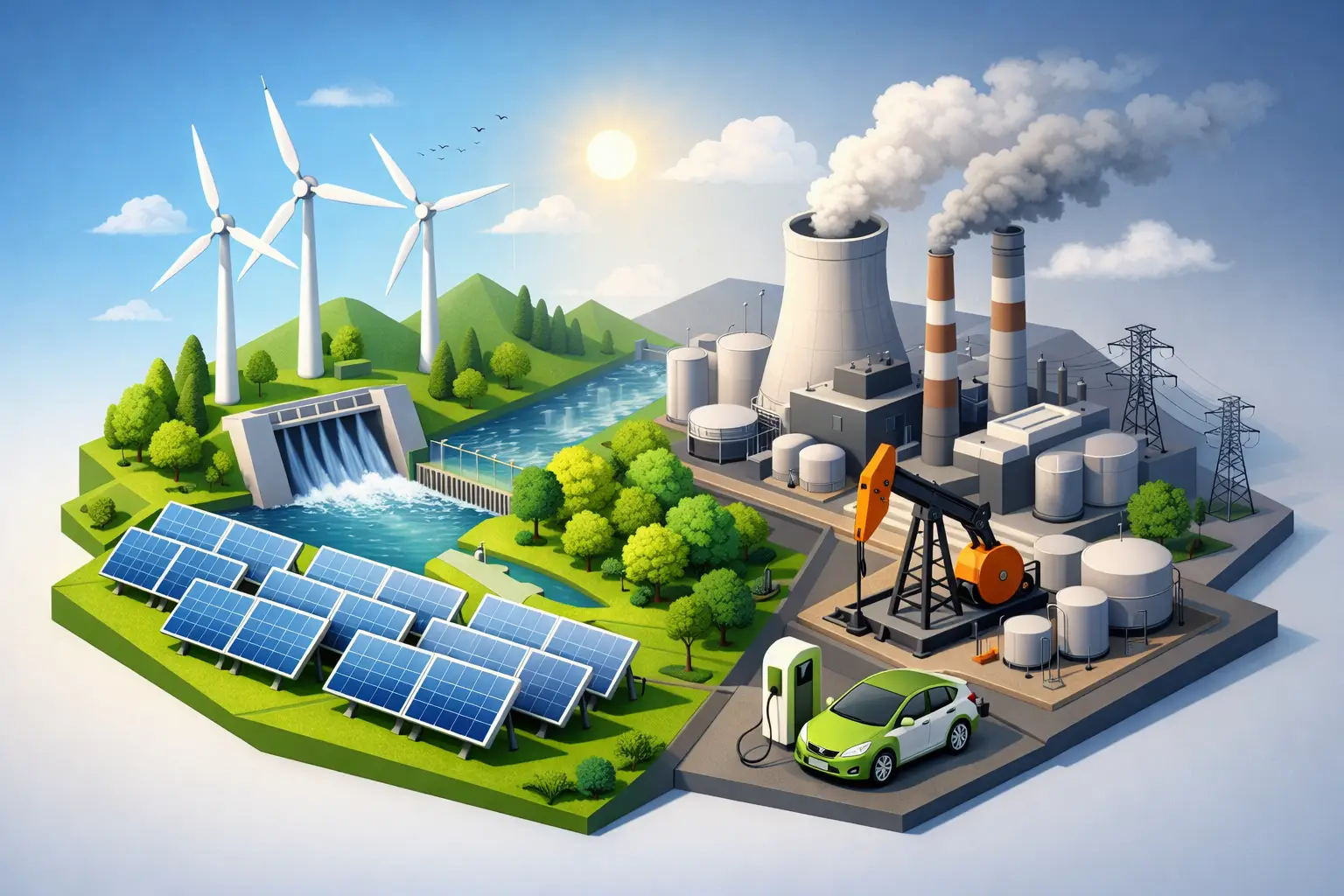
Energy strategy now sits on the investment committee agenda for one reason: ESG is no longer a branding exercise. It is a financing issue, a customer requirement, a procurement filter, and increasingly a condition of industrial competitiveness. In that context, partially green energy production in house will help Erisha Smart Manufacturing Hub as ESG compliant by reducing exposure to carbon-heavy grids, improving operational resilience, and creating a more credible sustainability profile for advanced manufacturers.
For industrial tenants and strategic partners, the real question is not whether a hub should pursue cleaner power. The question is how far in-house generation should go, and what a partial green energy model actually delivers in commercial terms. The answer is practical, not ideological. A mixed energy strategy gives manufacturers a realistic path to stronger ESG performance without compromising uptime, cost discipline, or expansion speed.
Why partial in-house green energy matters now
A fully renewable industrial estate sounds attractive, but most serious operators know the trade-offs. Base-load reliability, storage economics, process heat requirements, peak demand management, and capex timing all shape what is feasible. For a manufacturing hub serving sectors such as EVs, semiconductors, hydrogen mobility, and aerospace-adjacent production, the energy model has to be bankable before it is marketable.
That is why partial in-house green generation is the stronger position. It allows a hub to integrate solar, energy storage, microgrid architecture, and smart load management while still retaining conventional backup and grid connectivity. This is the difference between sustainability theater and industrial-grade ESG execution.
A partial model immediately improves the carbon intensity of site operations. It also creates measurable data points that investors, tenants, insurers, and regulators can evaluate. Energy generated on-site is easier to track, easier to attribute, and easier to report within ESG disclosures than broad claims tied only to future ambitions.
Partially green energy production in house will help Erisha Smart Manufacturing Hub as ESG compliant
ESG compliance in an industrial setting depends on evidence. Boards and institutional partners want to see infrastructure that supports emissions reduction, resource efficiency, and resilience. In-house green generation does exactly that because it turns ESG from a policy statement into a physical operating system.
On the environmental side, partial on-site renewable power cuts dependence on higher-emission sources and supports lower Scope 2 emissions for occupiers. That matters for multinational manufacturers under pressure from parent companies, export markets, and customers who are tightening supply chain reporting expectations.
On the social side, cleaner energy contributes to a better live-work environment. Erisha Smart Manufacturing Hub is positioned as an integrated ecosystem rather than an isolated industrial zone. That distinction matters. Cleaner power planning supports healthier communities, strengthens workforce attraction, and aligns with the broader expectation that modern industrial districts should be more livable, not just more productive.
On the governance side, a partial in-house energy framework creates stronger operational transparency. Metering, allocation, monitoring, and reporting can be designed into the hub from the outset. That is especially relevant for tenants that need auditable ESG data across multiple facilities and jurisdictions.
The commercial case is stronger than the marketing case
The best reason to invest in partial green energy production is not image. It is operational control.
Industrial energy prices move. Grid constraints happen. Carbon costs, direct or indirect, are rising across value chains even when local regulation is still evolving. Large occupiers understand that energy volatility can distort margins, weaken forecasting, and affect location decisions. A hub with in-house renewable capacity is better positioned to smooth part of that risk.
This does not mean green power will replace every energy source or suit every load profile. Heavy process manufacturing may still require hybrid arrangements. Some advanced production lines need reliability standards that exceed what intermittent generation can support on its own. But partial generation can still offset daytime loads, support common-area infrastructure, reduce peak purchases, and strengthen business continuity planning.
That is where value compounds. Lower purchased power during key operating windows improves cost predictability. Better resilience supports uptime. A more credible ESG position can improve tenant acquisition, partner confidence, and access to sustainability-linked capital. The return is not only in kilowatt-hours. It is in strategic optionality.
What a serious partial green model looks like
Not every renewable setup deserves to be called infrastructure. For an advanced manufacturing hub, the model has to be engineered around industrial realities.
The most obvious component is rooftop and site-integrated solar, especially across factories, logistics assets, parking structures, and support buildings. In a master-planned environment, solar can be designed into the architecture instead of added later as an afterthought. That improves installation economics and long-term performance.
Storage is the next layer. Without some battery support, renewable contribution is limited by timing. With storage, the hub can shift a portion of generation into more valuable periods, reduce demand charges, and provide an added resilience buffer for critical systems.
Then comes energy management. A hub serving diverse tenants needs smart metering, load balancing, and demand forecasting across multiple unit types. Semiconductor-ready spaces, EV assembly, clean-tech fabrication, and logistics operations do not consume power the same way. Intelligent energy orchestration is what turns partial green generation into a system rather than a symbolic feature.
Finally, there is the hybrid backbone. Grid access, backup generation, and redundancy planning remain essential. ESG-compliant infrastructure does not ignore reliability. It improves sustainability without gambling with production continuity.
Why this matters for advanced manufacturing tenants
Manufacturers choosing a base in the Middle East are not only comparing land and lease terms. They are evaluating whether a location can support future customer expectations, investor scrutiny, and internal decarbonization commitments.
That is particularly true for sectors already under ESG pressure. EV companies cannot afford to build products associated with carbon-intensive production environments. Semiconductor and electronics firms face rising scrutiny from global buyers. Hydrogen mobility businesses need location credibility if they want to present themselves as part of a clean industrial transition rather than simply a new transport category.
A hub that incorporates partial green energy in-house offers a practical advantage. Tenants can move into an environment where part of the ESG infrastructure is already built. That shortens the gap between operational launch and sustainability reporting readiness. It also reduces the burden on individual occupiers to solve everything at the factory level.
This ecosystem logic is central to the future of industrial planning. It is one reason integrated models are gaining momentum, as discussed in Future of Integrated Factory Communities. When energy, logistics, workforce amenities, and innovation assets are planned together, the result is not just efficiency. It is long-term industrial stickiness.
The UAE context makes the case even sharper
The regional opportunity is not abstract. The UAE is becoming a more serious platform for new-technology manufacturing, export-oriented production, and cross-border industrial investment. As that shift accelerates, ESG quality will help distinguish future-ready zones from those built on yesterday’s assumptions.
That is why partial green energy production should be viewed as baseline strategic infrastructure, not an optional upgrade. The market is moving toward greater ESG scrutiny, and industrial hubs that prepare early will be better placed to attract stronger occupiers. This broader direction is already clear in UAE Needs More ESG-Compliant Industries.
There is also a location logic here. Industrial platforms in the UAE compete not only on tax efficiency and port access, but on whether they can support manufacturers serving the Gulf, Africa, and Europe from one base. Companies planning for those corridors need infrastructure that will still look credible five and ten years from now. That is part of why the country’s role in next-generation production keeps expanding, as explored in Why the UAE Is Strategic for New Tech Manufacturing.
ESG compliance is not a checkbox. It is a market signal.
For Erisha Smart Manufacturing Hub, partial in-house green energy is valuable because it signals discipline. It shows that sustainability has been translated into land use, power planning, and tenant readiness. That matters to investors looking for asset quality. It matters to manufacturers looking for risk-adjusted expansion. And it matters to strategic partners that want proof a hub is designed for the next industrial cycle, not the last one.
There are limits, of course. Partial green generation will not eliminate all emissions. It will not solve every tenant’s energy profile. It requires capex, technical integration, and a governance framework that can handle allocation and reporting fairly across users. But those are execution questions, not reasons to avoid the model.
The smarter position is to build a hub where cleaner energy capacity is present, scalable, and tied to real industrial outcomes. That is how ESG moves from aspiration to infrastructure. And in a market where credibility increasingly shapes capital, occupancy, and long-term industrial value, that shift is not a side benefit. It is part of the core proposition.
