
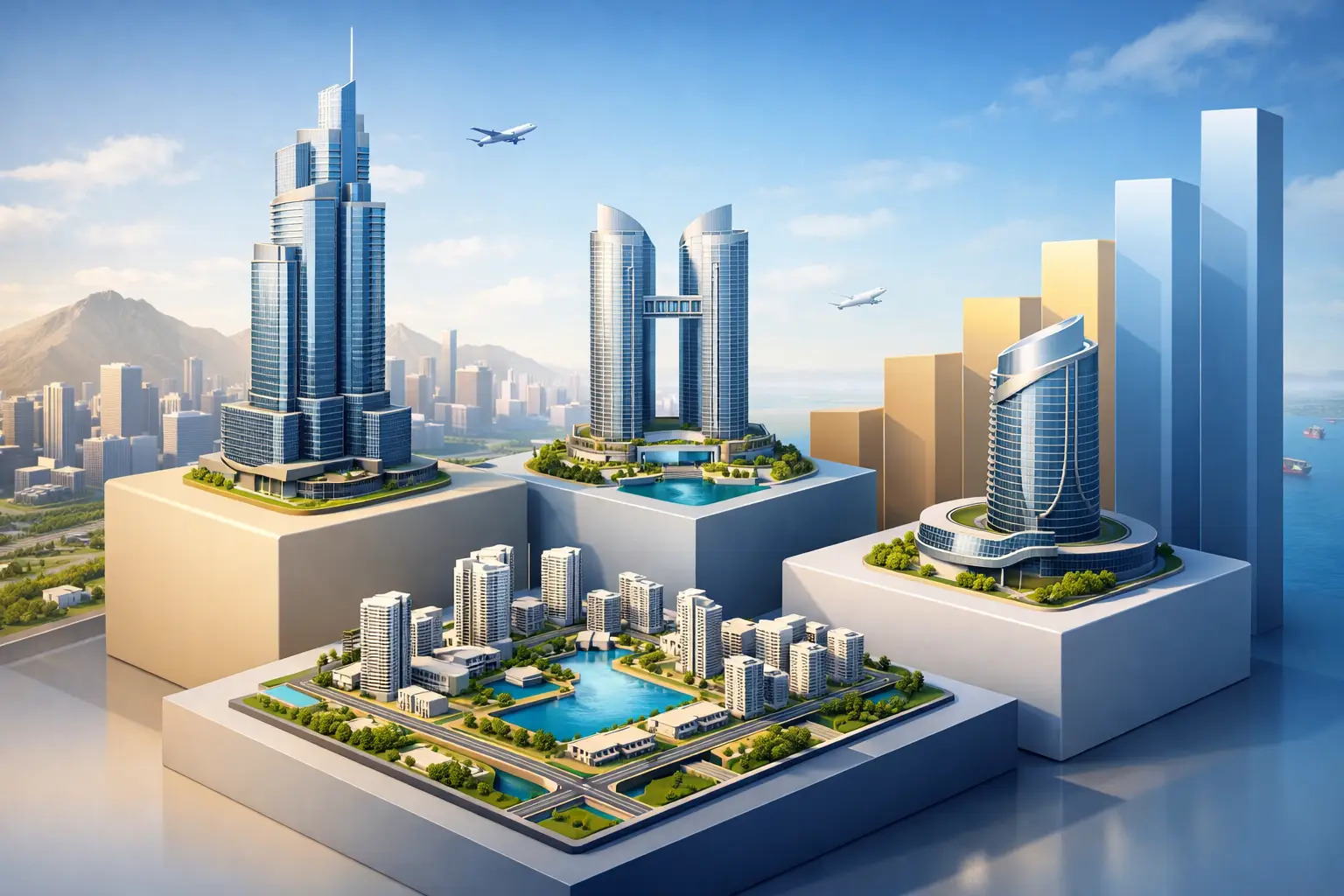
A USD 10 billion industrial announcement is not simply a headline. It is a statement about where capital, manufacturing capacity, supply chains, and future technologies are expected to converge. The Rana Group’s USD 10 billion project has been officially recognized as the 3rd world largest greenfield project announcement in Developing Asia for 2025. According to the United Nations Conference on Trade and Development (UNCTAD) World Investment Report 2026, the massive industrial undertaking stands out globally as the single largest India-to-UAE greenfield investment listed.
For industrial investors and global manufacturers, this recognition places the project in a category that demands attention. It validates the scale of the ambition behind a next-generation manufacturing ecosystem in Ras Al Khaimah, while reinforcing the UAE’s role as a destination for long-term industrial capital, advanced technology, and high-value production.
What the UNCTAD Recognition Means
UNCTAD’s World Investment Report is one of the most closely watched global references for international investment trends. Its greenfield project data tracks announced investments that establish new operations, facilities, and productive capacity, rather than the acquisition of an existing business or asset.
Recognition as the third-largest greenfield project announcement in the world for 2025 carries weight because greenfield investment is a forward-looking signal. It indicates where companies and investors intend to build, employ, produce, export, and create lasting industrial capability. In an environment where manufacturers are reassessing supply-chain resilience, energy economics, trade access, and geopolitical exposure, the location of major greenfield commitments matters.
The ranking also places Rana Group’s industrial undertaking among the region’s defining investment announcements. Developing Asia encompasses some of the world’s most competitive manufacturing and investment destinations. Standing third across that field reflects an industrial proposition designed at a scale beyond conventional real estate development.
At the same time, investors should understand the distinction between an announced greenfield project and capital already deployed. Announcements represent investment intent and strategic direction. Delivery depends on phased execution, tenant commitments, infrastructure development, regulatory processes, financing, and market conditions. That distinction does not diminish the significance of the ranking. It clarifies why the recognition should be viewed as a major strategic milestone and a platform for disciplined implementation.
The Largest India-to-UAE Greenfield Investment Listed
The UNCTAD report’s identification of the project as the single largest India-to-UAE greenfield investment listed adds a significant cross-border dimension. India and the UAE are strengthening economic ties through trade, investment, technology collaboration, logistics integration, and industrial partnerships. A project of this magnitude creates a physical expression of that relationship: Indian-origin capital and industrial ambition connecting with the UAE’s infrastructure, market access, policy environment, and global trade corridors.
For Indian manufacturers, the UAE can serve as more than an export destination. It can be an operating base that places production closer to GCC demand, African markets, Europe, and international shipping routes. For UAE stakeholders, large-scale India-to-UAE investment supports economic diversification and expands the country’s role as a platform for globally connected manufacturing.
This is particularly relevant for companies in sectors where speed, specialization, and reliability shape competitive advantage. Electric vehicles, hydrogen mobility, renewable energy systems, semiconductors, aerospace-adjacent production, and advanced materials all require far more than industrial land. They require purpose-built facilities, logistics access, energy planning, skilled talent, compliance readiness, and an ecosystem that can support scale.
A Different Model for Industrial Growth
The strategic value of the project lies in its ecosystem model. The Erisha Smart Manufacturing Hub is being developed as an integrated industrial environment, not as a collection of warehouses or disconnected factory plots. Its proposition combines advanced manufacturing infrastructure with logistics capacity, cleanroom-ready spaces, modular industrial units, turnkey factory options, research and development capability, and community-supporting assets.
That integrated design addresses a recurring expansion problem for manufacturers. A company may identify a favorable site, but still face delays caused by utility coordination, workforce housing gaps, supplier distance, limited testing facilities, or inadequate logistics connections. Those constraints turn a promising location into a costly operating challenge.
A master-planned industrial hub is intended to reduce that fragmentation. The objective is to create an environment where industrial operations can be established with greater certainty and where employees, technical partners, suppliers, and investors can operate within a more connected system. Residential, healthcare, education, retail, hospitality, and R&D components are not peripheral additions. For labor-intensive and knowledge-intensive industries alike, they help determine whether a site can retain talent and sustain growth over time.
Why Ras Al Khaimah Strengthens the Investment Case
Industrial location decisions are increasingly measured against total operating economics, not just land cost. Ras Al Khaimah offers a compelling combination of lower operating-cost potential, access to port infrastructure, investor-oriented regulations, and connectivity to regional and global markets. For manufacturers under pressure to improve margins while meeting ESG and localization expectations, these factors can materially influence the business case.
The UAE’s broader industrial agenda also matters. National strategies focused on advanced manufacturing, clean energy, technology adoption, export growth, and knowledge-based economic development provide a policy context that sophisticated investors evaluate closely. A facility should not only be operationally viable on opening day. It should be aligned with the direction of the market and the country in which it operates.
For some businesses, Ras Al Khaimah may offer an alternative to higher-cost locations while preserving proximity to the UAE’s commercial ecosystem. For others, it may be a complementary production and logistics base within a wider regional footprint. The optimal model will depend on product type, supply-chain requirements, workforce composition, energy needs, and target markets. The core advantage is optionality: a scalable industrial base positioned within a globally connected UAE economy.
Sector Clusters Turn Ambition Into Operating Capability
Large industrial developments create the greatest value when their infrastructure matches the technical requirements of the industries they seek to attract. A generic facility can accommodate basic production. Advanced sectors need more.
For electric vehicle and hydrogen mobility companies, the requirements may include specialized assembly space, testing capability, safety protocols, component logistics, and adjacency to suppliers. Semiconductor and electronics businesses may require cleanroom-ready environments, highly controlled utilities, and stringent quality systems. Renewable energy manufacturers need room for large-format production, efficient inbound and outbound logistics, and access to regional project demand. eVTOL and aerospace-adjacent companies require a development environment built around precision manufacturing, engineering collaboration, and evolving certification pathways.
Dedicated clusters help concentrate those requirements. They can support supplier relationships, shared services, technical talent pools, and collaboration between manufacturers, research institutions, and investors. Cluster strategy is not a guarantee of commercial success. It must be supported by real infrastructure, credible tenant attraction, and disciplined operational management. When executed well, however, it can shorten the distance between a company’s site selection decision and a functioning production ecosystem.
The Signal for Global Investors and Occupiers
The UNCTAD ranking gives prospective partners a clear signal: the Rana Group project is being assessed in the context of globally significant investment activity. That level of recognition can increase visibility among multinational occupiers, institutional investors, technology partners, and public-sector stakeholders who evaluate projects through the lens of scale and strategic relevance.
Visibility alone is not enough. Industrial decision-makers will still ask direct questions about development phasing, facility specifications, utility availability, logistics performance, commercial terms, ESG standards, regulatory support, and workforce access. Those are the questions that convert interest into commitments.
The opportunity is to build the future with answers already embedded in the platform. A manufacturer should be able to assess a factory solution in relation to its production process. An investor should be able to evaluate the hub’s sector strategy, infrastructure logic, and long-term demand drivers. A strategic partner should see where its technology, services, or capital can contribute to an industrial ecosystem with regional and global relevance.
From Recognition to Industrial Delivery
Being named among Developing Asia’s largest greenfield announcements establishes a powerful starting point. The next measure of success will be execution: infrastructure delivered to specification, high-value tenants brought into operation, clusters developed with commercial discipline, and an ecosystem that helps companies scale beyond their first facility.
For organizations considering a Middle East manufacturing base, the central question is no longer whether the region can support advanced industry. It is which platform can turn expansion plans into productive capacity with the least friction and the strongest long-term economics. Rana Group’s recognition in the UNCTAD World Investment Report 2026 puts that question squarely on the agenda.
