
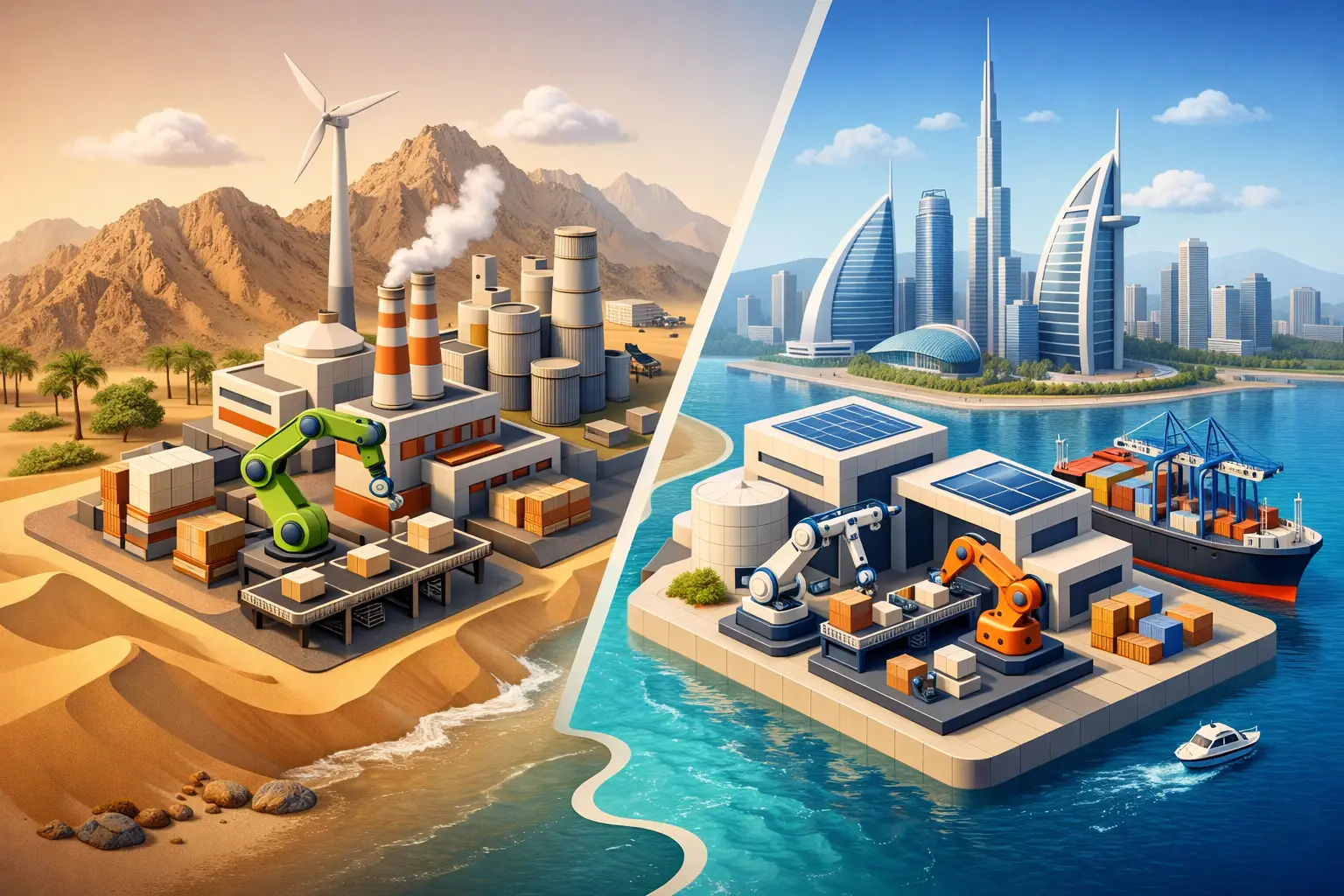
When a manufacturer chooses between Ras Al Khaimah and Dubai, the real question is not prestige. It is operating logic. The Ras Al Khaimah vs Dubai manufacturing decision comes down to what your business needs most: brand proximity and commercial density, or lower-cost scale with room to build a serious industrial platform.
Both emirates matter. Both offer access to the UAE, the GCC, and global shipping lanes. But they serve different manufacturing models, and treating them as interchangeable can lead to expensive mistakes in land strategy, labor planning, logistics design, and long-term expansion.
Ras Al Khaimah vs Dubai manufacturing: what changes in practice
Dubai is the UAE’s best-known commercial gateway. It offers unmatched visibility, mature business services, deep aviation connectivity, and a strong concentration of regional headquarters. For manufacturers with high client interaction, premium brand requirements, or a need to stay close to financial decision-makers, Dubai carries weight.
Ras Al Khaimah plays a different role. It is increasingly attractive to industrial operators that care about production economics, footprint flexibility, infrastructure-led growth, and a more efficient path to scaling. For companies building in advanced manufacturing, clean technology, mobility, engineered materials, or export-led industrial production, that difference is not cosmetic. It affects margins and execution.
This is why the comparison should be framed around fit, not status. A factory is not a showroom. The right location is the one that improves throughput, reduces friction, and protects expansion capacity over a 10- to 20-year horizon.
Cost structure is usually the deciding factor
For many industrial occupiers, Dubai becomes harder to justify once the numbers are modeled beyond year one. Land, lease rates, labor accommodation, logistics staging, and ancillary service costs generally put greater pressure on operating budgets. That may be manageable for light assembly, high-margin specialty output, or businesses where customer-facing access is central. It becomes less attractive for manufacturers that need larger footprints, utility-heavy operations, or phased buildouts.
Ras Al Khaimah offers a different cost equation. Lower land and occupancy costs can free capital for production lines, automation, quality systems, and inventory buffers. That is especially relevant for manufacturers entering the region with a greenfield strategy, or for multinationals creating a GCC production base rather than a sales office with limited industrial activity.
The savings are not only about rent. They often extend to the total ecosystem around the plant: worker housing, support services, yard space, warehousing, and future expansion land. Over time, those variables can matter more than headline lease comparisons.
That said, lower cost should not be confused with lower ambition. The strongest industrial locations are the ones that combine affordability with sector-ready infrastructure. This is where advanced, master-planned industrial environments in Ras Al Khaimah become strategically relevant.
Land and expansion capacity separate long-term winners from short-term fixes
A manufacturer rarely regrets taking enough room. It often regrets taking too little.
Dubai offers excellent infrastructure, but industrial space can be constrained by pricing, plot availability, and competing land priorities. For companies with compact operations, or for those testing the market before scaling, that may be acceptable. For businesses that anticipate multiple production phases, specialized facilities, or integrated supplier ecosystems, constrained land can create future bottlenecks.
Ras Al Khaimah has a stronger value proposition for growth-oriented manufacturing because it can support larger-format industrial planning. That includes purpose-built factories, modular units, logistics support, and sector clustering that allows related industries to operate near each other. When a business expects future needs in cleanrooms, testing areas, storage yards, mobility assembly, or utility-intensive lines, the ability to design for scale from day one is a serious competitive advantage.
This matters most in sectors where industrial development is not static. Electric vehicle components, hydrogen systems, aerospace-adjacent manufacturing, renewable energy equipment, and semiconductor-support activities often evolve quickly. The factory you need in three years may not look like the facility you launch with today.
Logistics is not just about being closest to a major city
Dubai has obvious logistics strengths. Its ports, airports, freight networks, and business services ecosystem are world-class. For high-value, time-sensitive goods, or operations that depend heavily on air cargo and frequent executive mobility, Dubai remains compelling.
But logistics efficiency is more nuanced than raw visibility. Many manufacturers need dependable port access, road connectivity into the UAE and wider GCC, and lower-cost movement of goods at industrial scale. In those cases, Ras Al Khaimah can be highly effective, especially for businesses that are less dependent on premium urban positioning and more focused on production-to-market efficiency.
If your inputs arrive in volume, your outputs move regionally, or your operations need warehousing and transport staging without city-cost distortion, Ras Al Khaimah deserves serious attention. It offers a practical balance of access and industrial efficiency that can outperform a more expensive urban base once full supply-chain costs are modeled.
The key is to examine your product profile. If speed to boardroom matters more than speed through an industrial corridor, Dubai may win. If your business lives or dies by manufacturing economics, freight handling, and scalable throughput, Ras Al Khaimah often becomes the stronger operating choice.
Talent strategy goes beyond hiring
Dubai has a broad and visible talent pool, particularly for management, engineering support, corporate functions, and international business services. That depth is valuable, especially for organizations that want to colocate executive leadership, sales, and manufacturing in one emirate.
Yet modern manufacturing requires more than talent acquisition. It requires retention, livability, training access, and an environment where skilled workers can sustain long-term productivity. This is where the traditional industrial park model starts to show limitations.
Manufacturers increasingly need ecosystems, not isolated plots. When industrial operations are integrated with housing, healthcare, education, R&D, and daily-life infrastructure, workforce stability improves. That matters for advanced manufacturing, where technical labor continuity and operational discipline directly affect output quality.
An integrated industrial ecosystem in Ras Al Khaimah can offer a more durable workforce proposition than a fragmented setup where employees commute long distances or operate without supporting amenities. For investors and operators planning serious capacity, that is not a lifestyle benefit. It is an operating advantage.
Sector fit matters more than broad business friendliness
Dubai is broadly business-friendly. That is part of its strength. But broad business friendliness does not always equal manufacturing specialization.
In the Ras Al Khaimah vs Dubai manufacturing comparison, sector fit should be central. Companies in traditional light industry, packaging, and general assembly may find viable options in both emirates. But advanced sectors need more specific conditions: utility planning, specialized compliance environments, cleanroom readiness, cluster logic, testing support, and room for supplier adjacency.
This is where purpose-built industrial ecosystems create differentiation. A location that is intentionally designed for EVs, hydrogen mobility, semiconductors, renewable energy production, and aerospace-adjacent manufacturing is not simply offering space. It is offering a platform built around the operating realities of next-generation industry.
That distinction is becoming more important as UAE industrial policy continues to support diversification, technology-led production, and high-value export capability. Manufacturers that align with this direction are not just choosing a site. They are positioning within a larger national growth strategy.
So which emirate makes more sense?
If your manufacturing model depends on premium market visibility, close access to regional headquarters, strong corporate services density, and a compact operational footprint, Dubai can still be the right answer. It works particularly well for businesses where manufacturing is closely tied to client engagement, executive convenience, or fast-moving commercial networks.
If your priority is land efficiency, lower operating cost, industrial scalability, sector-specific infrastructure, and a better foundation for long-term production growth, Ras Al Khaimah is often the more strategic choice. That is especially true for manufacturers entering capital-intensive sectors where the wrong real estate decision can limit future competitiveness.
For many investors, the most disciplined answer is not to ask which emirate is more famous. It is to ask which one gives the factory room to grow, the workforce room to stay, and the balance sheet room to perform.
That is why serious industrial players are looking harder at integrated manufacturing platforms in Ras Al Khaimah, including models advanced by developers such as Rana Group, where infrastructure, livability, logistics, and sector specialization are planned as one system rather than delivered in pieces.
The future of UAE manufacturing will not be built only in the busiest locations. It will be built where industrial ambition can scale without friction. Choose the emirate that matches the factory you intend to become, not just the address others already recognize.
