
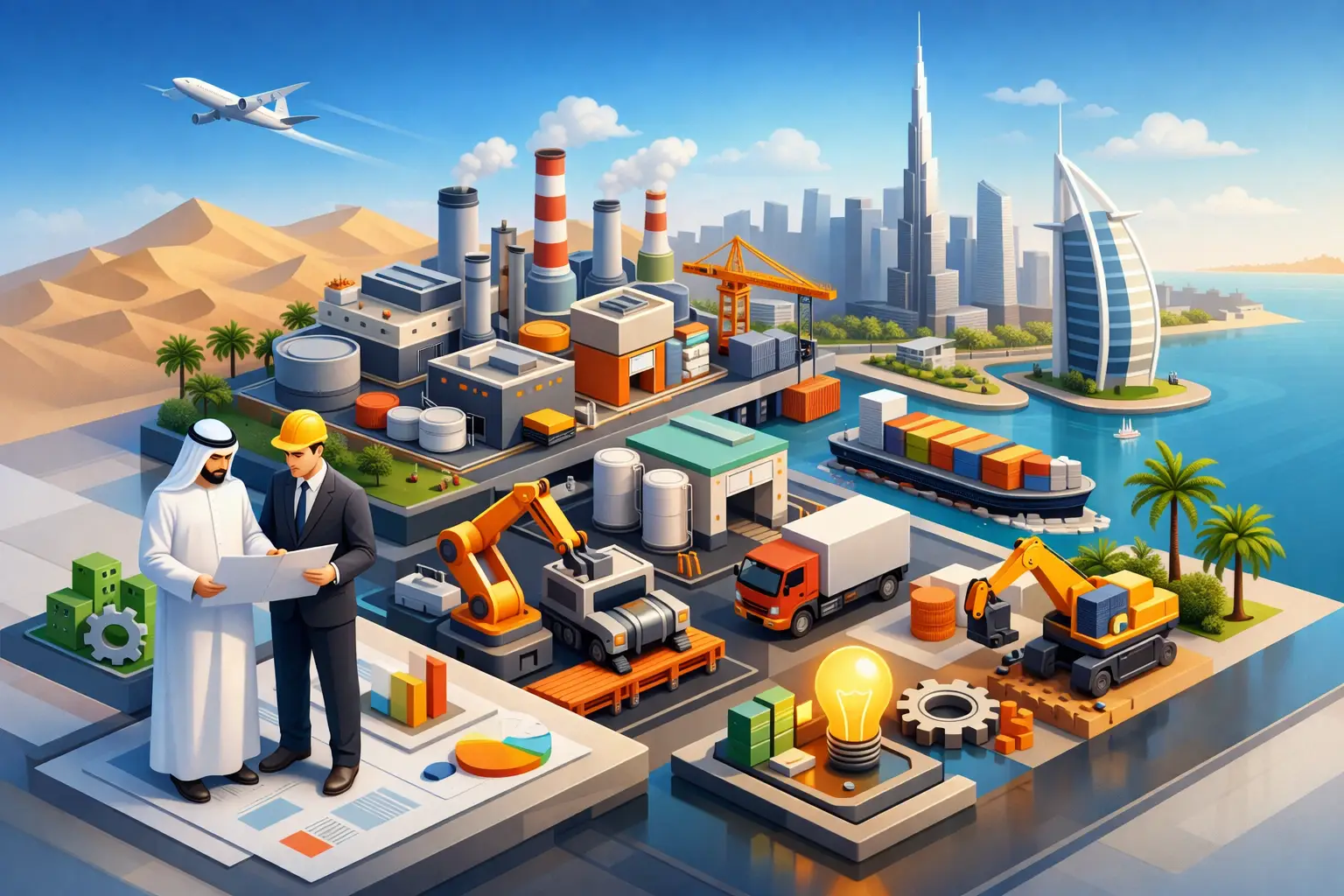
A factory strategy can fail long before production starts. Not because demand was weak, but because the site could not scale, utilities were constrained, the workforce had nowhere to live, or the regulatory path did not match the operating model. That is the real context for setting up industry in UAE. The opportunity is substantial, but serious industrial expansion depends on making the right structural decisions at the beginning.
For manufacturers, clean-tech operators, and advanced technology firms, the UAE offers a rare combination of market access, export connectivity, investor-friendly regulation, and national commitment to industrial growth. But this is not a one-size-fits-all environment. The right setup for a light assembly operation is not the right setup for a semiconductor-related facility, an EV component plant, or a hydrogen mobility value-chain player. The difference between a workable entry and a future-ready industrial base comes down to alignment.
Why setting up industry in UAE is gaining momentum
The UAE has moved beyond being seen only as a trading and logistics gateway. It is positioning itself as a manufacturing and innovation platform with long-term industrial ambition. That matters to investors because industrial policy, infrastructure investment, and sustainability goals are increasingly moving in the same direction.
For global manufacturers, the attraction is straightforward. The UAE provides access to Gulf markets, strong port and airport connectivity, competitive operating structures in the right locations, and a business environment designed to attract foreign capital. For advanced industries, there is another layer of value: the country is actively building sectors linked to energy transition, smart mobility, aerospace-adjacent production, precision engineering, and high-value technology manufacturing.
Still, momentum alone is not enough. A company may be attracted by tax efficiency or geography, then run into constraints around land configuration, cleanroom readiness, power reliability, hazardous material requirements, or worker accommodation. That is why industrial location strategy in the UAE needs to be treated as an operating decision, not a real estate transaction.
Start with the operating model, not the license
Many market-entry conversations begin with legal structure. That is necessary, but it should not come first. The better starting point is the industrial operating model.
A manufacturer should define what will actually happen on site over the first five to ten years. Will the facility begin with assembly and move into full production? Will it require heavy power loads, process cooling, clean manufacturing controls, bonded logistics, or integrated warehousing? Will there be imported inputs and regional re-export, or local market distribution? These questions shape the right jurisdiction, plot type, building format, and infrastructure requirements.
This is where expansion leaders often underestimate complexity. A standard industrial unit may appear cost-effective at the outset, but become expensive when retrofits, utility upgrades, process compliance, or land limitations start affecting output. A purpose-built facility usually requires more planning upfront, yet it can reduce execution risk and preserve growth options.
The strongest industrial setups in the UAE are designed around operational intent. That means licensing, customs treatment, facility design, logistics planning, and workforce needs are considered together.
Choosing the right location for industrial growth
Not every UAE industrial location serves the same type of investor. Some are optimized for trading activity, some for light manufacturing, and some for larger-scale industrial operations with room for vertical integration. The right choice depends on cost structure, utility access, proximity to ports, labor strategy, and how much future expansion is expected.
For industrial occupiers with long investment horizons, lower occupancy cost is only one factor. What matters more is whether the location can support production continuity and ecosystem depth. Can suppliers co-locate nearby? Is there enough land or modular capacity to expand? Are logistics assets integrated or fragmented? Is the surrounding environment attractive enough to support talent retention for technical roles?
These questions are especially relevant for sectors such as EVs, hydrogen mobility, renewable energy systems, and aerospace-adjacent manufacturing. Such industries rarely operate efficiently in isolated plots without supporting infrastructure. They benefit from clustered environments where production, testing, storage, mobility links, and innovation functions are designed to work together.
That is why next-generation industrial hubs are gaining attention. They are not simply leasing land. They are creating industrial ecosystems that combine manufacturing space with logistics, R&D support, and the wider live-work environment needed to sustain a skilled workforce.
Infrastructure is the real investment filter
When companies evaluate setting up industry in UAE, infrastructure should be treated as the decisive filter. Industrial performance is shaped by what the site can actually deliver, day after day, under production pressure.
Power capacity, water availability, road access, loading efficiency, ceiling heights, fire and safety compliance, digital infrastructure, and process adaptability all affect operating outcomes. For advanced manufacturing, the list becomes even more specific. Cleanroom-readiness, vibration control, energy resilience, environmental compliance, and secure logistics become strategic requirements rather than technical preferences.
This is also where trade-offs become clear. Retrofitting a conventional asset may lower initial capex, but it can slow commissioning and create design compromises. A turnkey or modular industrial solution can accelerate market entry, but only if it has been built around the tenant’s process requirements rather than generic warehouse logic.
Sophisticated investors increasingly look for environments where infrastructure planning has already anticipated sector-specific needs. That includes dedicated clusters for emerging industries, integrated support services, and enough flexibility to accommodate technology upgrades over time.
ESG, workforce, and the new industrial baseline
Industrial expansion is now judged by more than production output. Boards, investors, and multinational customers are paying closer attention to emissions, land use, labor conditions, and long-term resilience. In the UAE, that shift is creating a new baseline for what credible industrial development looks like.
An ESG-compliant industrial environment is no longer a branding layer. It affects financing, tenant quality, procurement eligibility, and reputation. Companies entering the region need to consider how facility design, mobility patterns, energy strategy, and community infrastructure support broader sustainability commitments.
The workforce question is just as important. Advanced manufacturing needs technicians, engineers, operators, and management talent that can stay productive over time. If housing, healthcare, retail access, education, and daily-life infrastructure are disconnected from the industrial site, labor stability becomes harder to maintain. The result is higher churn, longer commutes, and weaker operating continuity.
This is where integrated industrial ecosystems carry a structural advantage. A live-work-innovate model is not just attractive on paper. It solves a real industrial problem by bringing workforce support closer to production assets. For manufacturers building regional headquarters or long-duration production programs, that matters.
What serious investors should evaluate before committing
The strongest investment decisions usually come from pressure-testing five areas before site selection is finalized. First, determine whether the facility type matches the production roadmap, not just the launch phase. Second, test utility availability against peak operational demand, not average consumption. Third, model logistics flows around actual inputs and export routes. Fourth, assess whether the surrounding ecosystem can support workforce recruitment and retention. Fifth, evaluate whether the location aligns with the company’s ESG and future technology requirements.
This process often reveals that the lowest-cost option is not the most competitive option. A cheaper unit in the wrong environment can create hidden costs through delayed scale-up, fragmented logistics, or weak talent support. On the other hand, a well-planned industrial base can improve speed to market, operational reliability, and long-term expansion economics.
For companies entering sectors linked to the next industrial cycle, that distinction is critical. Facilities for semiconductors, EV supply chains, renewable components, and hydrogen-linked manufacturing need more than space. They need an ecosystem built for industrial precision and future growth.
One reason strategic developers are becoming more relevant in this market is that they can align infrastructure, sector planning, and community assets into a single industrial proposition. That is the logic behind platforms such as Rana Group’s vision for smart manufacturing ecosystems: not industrial land in isolation, but coordinated infrastructure for where the future works.
The right setup creates options later
The UAE remains one of the most compelling markets for industrial expansion in the region, but only for companies that approach it with operational discipline. Setting up a factory, technology production site, or clean-tech facility here is not just about market entry. It is about establishing a base that can scale with regulation, sector growth, workforce needs, and global supply-chain shifts.
The best time to think about expansion, resilience, and workforce fit is before the first facility decision is signed. Get that part right, and the UAE becomes more than a location. It becomes a platform for long-term industrial leadership.
