
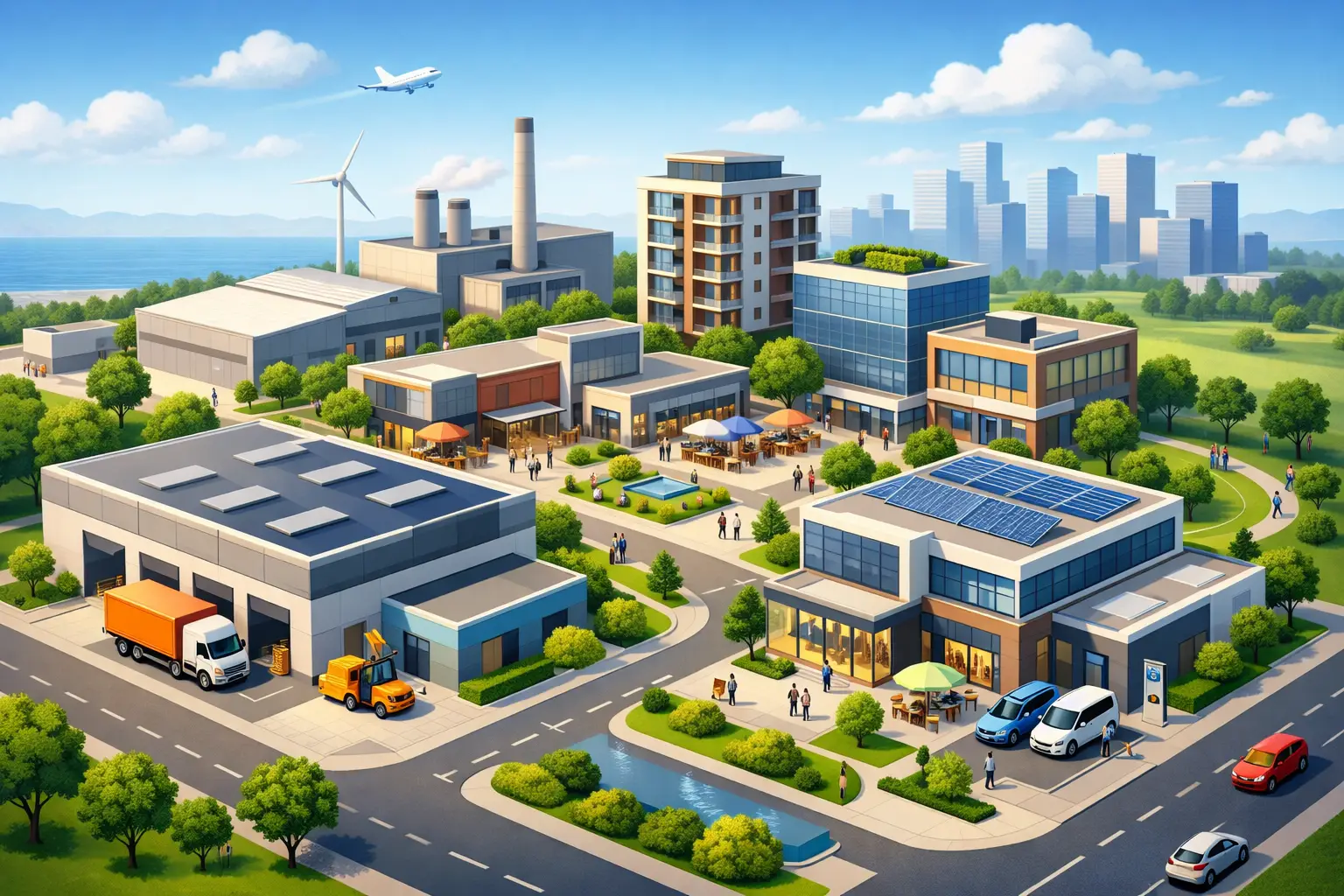
The strongest industrial projects no longer win on land alone. They win on operating logic. That is why top mixed use industrial developments are pulling ahead of conventional industrial parks: they reduce friction across the full value chain, from site readiness and logistics to workforce retention, R&D access, and ESG performance.
For manufacturers, investors, and strategic partners, the shift is not cosmetic. It changes the economics of expansion. A facility that sits beside housing, healthcare, technical education, retail, hospitality, and specialized industrial infrastructure creates a more durable operating base than a standalone warehouse district ever could. The right mixed-use industrial model is not about adding amenities for appearances. It is about building an environment where advanced industry can scale with fewer constraints.
Why top mixed use industrial developments matter now
Industrial occupiers are making decisions in a different market than they were even five years ago. Labor mobility is tighter. Supply chains are being redesigned for resilience. Capital is moving toward ESG-aligned assets. Governments are prioritizing domestic and regional industrial capacity in strategic sectors such as semiconductors, EVs, aerospace-adjacent manufacturing, and clean energy.
In that context, the old industrial park model has limits. It can provide plots, roads, and utility connections, but often leaves tenants to solve every surrounding issue on their own. That means longer ramp-up times, harder talent attraction, fragmented logistics planning, and rising operating friction. Mixed-use industrial development answers a more demanding brief. It treats industrial real estate as economic infrastructure, not just inventory.
The best projects recognize a simple truth: factories do not operate in isolation. They depend on people, suppliers, testing environments, freight systems, services, and regulatory clarity. When those pieces are master-planned together, the result is not only better occupancy. It is stronger industrial output over time.
The defining traits of top mixed use industrial developments
The phrase gets used broadly, but not every project deserves it. Some developments add a retail strip or a hotel and call themselves mixed use. Serious industrial ecosystems go much further.
First, they are sector-aware. A light industrial estate designed for generic storage is fundamentally different from an ecosystem built for battery assembly, hydrogen mobility, cleanroom manufacturing, aerospace components, or advanced materials. Top developments create infrastructure matched to target industries, whether that means heavy power, cleanroom-ready space, testing facilities, high-clearance logistics assets, or specialized utility systems.
Second, they plan for the workforce as a strategic input, not an afterthought. Residential options, healthcare access, education and technical training, food and retail services, and hospitality all support business performance. This matters even more for companies hiring skilled engineers, technicians, and globally mobile leadership teams. If the surrounding environment cannot support talent, the site is weaker than it looks on paper.
Third, they compress time to operation. Investors and occupiers value speed as much as scale. Turnkey factories, modular industrial units, clear development phasing, predictable approvals, and integrated infrastructure can materially reduce commissioning timelines. In advanced manufacturing, a delayed launch is not merely inconvenient. It can mean lost market share.
Fourth, they are built around logistics reality. Port access, highway connectivity, customs efficiency, and links to regional and export markets shape total cost more than headline lease rates alone. A lower-cost site far from efficient freight channels can become expensive very quickly. The strongest projects connect production to movement.
What investors and occupiers should evaluate
A top-tier mixed-use industrial project should be judged less by presentation and more by operating evidence. The first question is whether the development has a real industrial thesis. Which sectors is it designed to serve? What infrastructure is already in place or contractually planned? What utilities, floor loads, servicing standards, environmental specifications, and logistics assets support those sectors?
The second question is whether the non-industrial components are economically relevant. Housing, retail, education, healthcare, and hospitality should strengthen industrial performance, not distract from it. If those assets help a manufacturer recruit, retain, train, and host talent or partners, they add real value. If they exist only to improve the brochure, they do not.
The third question is whether the location supports long-term competitiveness. Lower operating costs matter, but so do trade access, labor pools, regulation, tax efficiency, and expansion headroom. Some sites work well for early-stage assembly but cannot support later scaling. Others have strategic geography but insufficient ecosystem depth. It depends on the occupier’s sector, capex profile, and export model.
Investors should also examine phasing discipline. A development can be ambitious without being credible. The strongest projects have a visible roadmap, anchor uses, utility sequencing, and capital logic that supports long-horizon growth. Scale is valuable only when it is executable.
Why the live-work-innovate model is outperforming old industrial formats
The live-work-innovate model is gaining traction because it addresses the hidden costs that often sit outside a lease agreement. Workforce commute burdens, limited nearby services, fragmented supplier access, and weak innovation linkages all erode productivity. Over time, these become strategic liabilities.
A more integrated model creates advantages that compound. Employees stay longer when daily life is easier. Technical partnerships develop faster when R&D and education are nearby. International customers and suppliers engage more easily when hospitality and business services are built into the district. ESG performance improves when transport distances, utility systems, and land use planning are better coordinated.
There are trade-offs, of course. Mixed-use industrial developments are more complex to plan and finance. They require patient capital, stronger governance, and deeper stakeholder coordination than conventional parks. They also need clear operational zoning so industrial performance is never compromised by adjacent uses. But when the planning is disciplined, complexity becomes a source of resilience rather than a weakness.
The sectors shaping the next generation of industrial ecosystems
Not all industries need the same environment, which is why the most credible projects increasingly organize around clusters. EV manufacturing and battery supply chains benefit from logistics integration, testing support, and access to specialized suppliers. Hydrogen mobility requires safety planning, storage considerations, and a policy-aware infrastructure framework. Semiconductor and cleanroom-dependent activities need precision-ready space and highly controlled operating conditions.
Renewable energy manufacturing and aerospace-adjacent production bring their own demands around large-format components, engineering talent, and quality assurance. These sectors are not looking for generic industrial land. They are looking for ecosystems that can support both current production and future iteration.
That is where next-generation hubs stand apart. They are not merely places to install machinery. They are platforms for industrial growth. In a competitive region, that distinction matters.
A development such as the Erisha Smart Manufacturing Hub reflects this shift by combining purpose-built industrial infrastructure with residential, healthcare, education, retail, hospitality, and R&D assets in a single planned environment. For occupiers evaluating the Middle East, that model speaks directly to the real requirements of advanced industry: speed, specialization, talent support, and room to scale.
What top mixed use industrial developments signal about the future
The rise of top mixed use industrial developments signals a broader change in how industrial value is being created. The conversation is moving beyond square footage and into ecosystem performance. Can a site support innovation? Can it attract skilled labor? Can it shorten supply chains, align with ESG mandates, and maintain cost discipline? Can it serve as a stable regional base for global production?
Those questions are now central to board-level decision-making. Industrial real estate is no longer a background function. In strategic sectors, it has become a competitive instrument.
That is especially true in markets positioning themselves as gateways for advanced manufacturing and clean technology. The winners will not be the developments that promise everything to everyone. They will be the ones with a clear industrial identity, integrated infrastructure, and a model built for long-term relevance.
For investors and manufacturers, the takeaway is straightforward. The best industrial opportunities will increasingly be found in places designed as ecosystems rather than estates. The future will favor developments that make production easier, talent stickier, logistics faster, and growth more sustainable. Choose the platform that does more than house operations. Choose the one built to strengthen them.
