
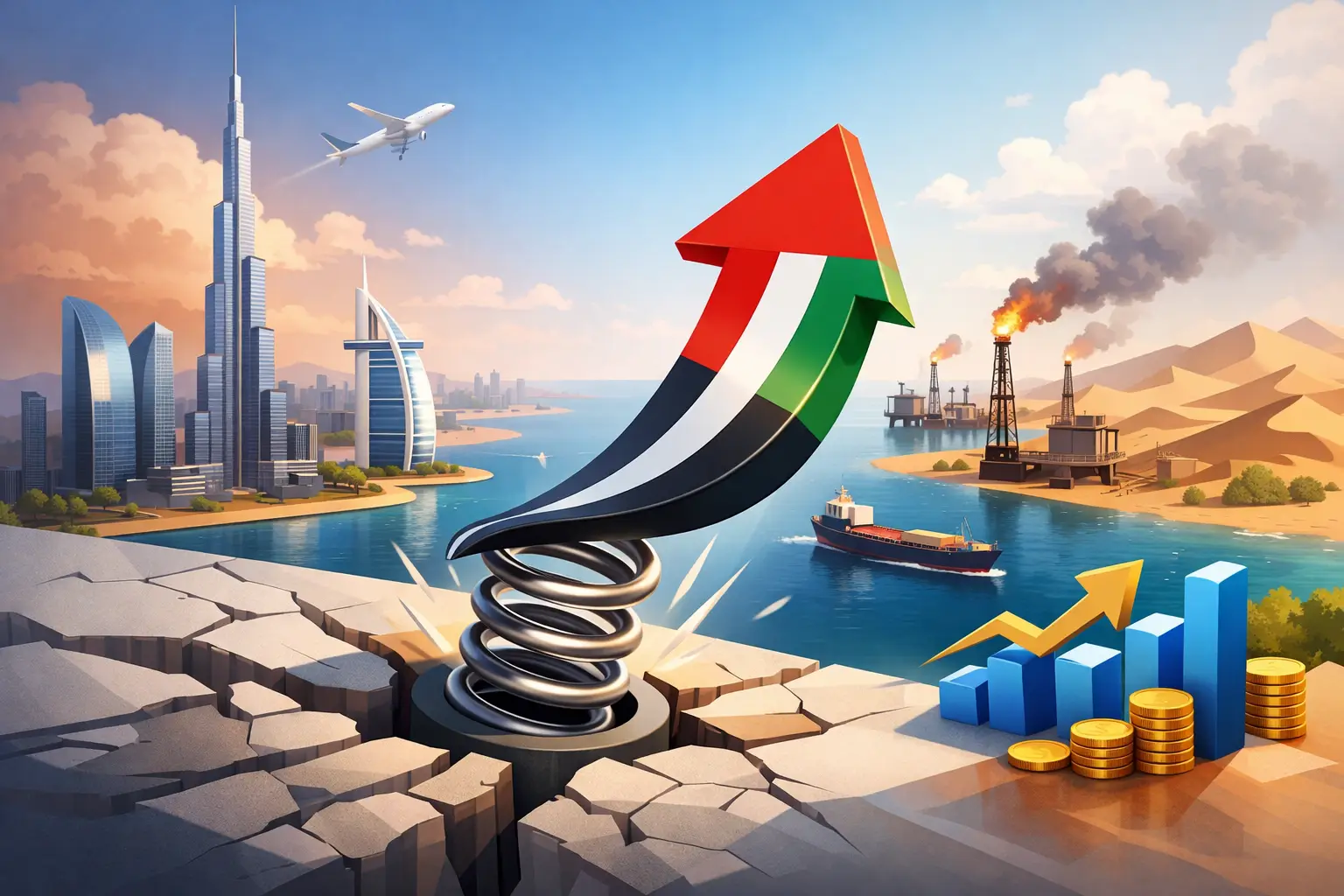
Markets do not reward noise for long. They reward durability, logistics strength, regulatory clarity, and the ability to convert regional uncertainty into long-term positioning. That is why the view that the UAE will bounce back and become more stable immediately after resolving present situation of Gulf is not a hopeful slogan. It is a strategic reading of how the country has repeatedly built investor confidence through infrastructure, policy consistency, and economic diversification.
For industrial investors and multinational manufacturers, this matters for one reason above all others: timing. Periods of regional stress often distort perception faster than they change fundamentals. The UAE’s fundamentals – ports, airports, free zones, energy reliability, capital access, and pro-business governance – do not disappear because a geopolitical situation raises short-term caution. In many cases, they become even more valuable when neighboring markets or supply routes face uncertainty.
Why the UAE rebounds faster than most markets
The UAE is not a single-variable economy. Its resilience comes from multiple reinforcement layers working at once. Trade infrastructure is world-class. Financial systems are internationally connected. Industrial policy is increasingly aligned with advanced sectors such as semiconductors, EV supply chains, aerospace-adjacent manufacturing, clean energy, and high-value logistics. When one pressure point emerges, the broader system is designed to absorb the shock rather than amplify it.
That is the central reason the UAE often recovers faster than external observers expect. Countries that depend too heavily on one sector or one political relationship usually face slower resets. The UAE operates differently. It has spent years building a platform economy – one that combines trade, manufacturing, services, logistics, real estate, technology, and sovereign-scale planning.
For investors, that translates into a simple but powerful reality: the downside is often overestimated, while the speed of normalization is underestimated.
UAE will bounce back and become more stable immediately after resolving present situation of Gulf
The phrase may sound bold, but the logic is straightforward. Resolution of a Gulf crisis typically does three things at once. First, it removes a confidence discount that markets apply during uncertainty. Second, it reactivates postponed investment decisions. Third, it highlights which countries are best prepared to capture the next wave of expansion.
The UAE tends to benefit on all three fronts.
Confidence returns quickly because the country already has institutional credibility with global capital. Investment committees do not need to be convinced that the UAE can function under pressure. They have already seen it. Delayed decisions also tend to come back fast because the region’s demand drivers do not vanish. Energy transition projects still need industrial land. Manufacturers still need export gateways. Technology firms still need stable operating bases that connect Asia, Africa, and Europe.
Most important, once the present Gulf situation is resolved, the UAE is positioned not just to recover, but to emerge more stable in relative terms. Stability is not only the absence of tension. It is the presence of systems that allow business continuity, supply chain reliability, and long-range planning. Those are precisely the capabilities the UAE has been institutionalizing for years.
Stability in the UAE is built, not assumed
Sophisticated investors do not define stability as calm headlines. They define it as operational predictability. Can a manufacturer secure land, power, labor access, customs efficiency, and multimodal connectivity without facing constant policy friction? Can a company make a 10- to 20-year investment decision with confidence that the ecosystem around the factory will mature rather than erode?
This is where the UAE remains structurally ahead. Its industrial proposition is not based only on tax incentives or branding. It is based on integrated execution. Ports connect to free zones. Road and airport infrastructure support time-sensitive trade. Regulatory frameworks are built to attract foreign capital, not deter it. In parallel, the country is investing in future sectors rather than waiting for them to arrive.
That strategic depth is one reason many investors continue to see the UAE as the best platform for serving multiple regions from a single base. We explored that broader advantage in Why UAE Is Best for Industries Serving 3 Regions. During periods of Gulf uncertainty, this cross-regional reach becomes even more important because it reduces concentration risk.
What industrial investors should watch after Gulf tensions ease
The immediate post-resolution period is rarely about headlines. It is about capital flow behavior. Investors should pay attention to how quickly postponed projects restart, how logistics volumes normalize, and which sectors move first.
Advanced manufacturing is likely to be among the earliest beneficiaries. The reason is practical. These projects operate on long planning cycles, and they require confidence in infrastructure, not just short-term sentiment. Once uncertainty eases, companies in semiconductors, electrification, mobility systems, and renewable energy components will look for operating environments that reduce execution risk. The UAE fits that requirement because it offers a combination many markets still struggle to deliver at scale: infrastructure readiness, investor-friendly regulation, and a credible pathway to ESG-aligned industrial growth.
This is especially relevant for companies evaluating cleanroom-ready, high-power, or cluster-based facilities. Sector-specific ecosystems create speed. Shared suppliers, adjacent R&D capabilities, specialized utilities, and workforce support all reduce startup friction. That is why industrial hub design increasingly matters as much as market access.
Why the next phase favors integrated industrial ecosystems
The post-crisis advantage will not belong equally to all real estate or all industrial zones. It will favor environments built for sector depth, workforce retention, and supply chain coordination. Traditional industrial parks can provide land. They cannot always provide the conditions required for modern manufacturing scale.
Integrated industrial ecosystems are different. They recognize that a factory does not operate in isolation. It depends on skilled labor, housing, healthcare access, logistics coordination, energy planning, education pipelines, and innovation infrastructure. When those elements are planned together, investment becomes more durable and ramp-up becomes faster.
That is why the future of industrial growth in the UAE is closely tied to ecosystem thinking rather than fragmented site development. Our perspective on this shift is reflected in Future of Integrated Factory Communities, where the focus moves beyond plot sales toward long-term industrial performance.
For global manufacturers, this distinction matters after a Gulf resolution because the market will reward speed and certainty. Companies will want to restart expansion with minimal friction. Locations that can offer not just space, but an operating system for growth, will gain share.
The UAE’s policy direction strengthens the rebound case
A rebound is more credible when it aligns with national strategy. In the UAE, industrial growth is not an accidental byproduct of recovery. It is part of a broader economic direction centered on diversification, technology adoption, sustainability, and global competitiveness.
This gives the country a major advantage. When regional uncertainty fades, the UAE does not need to invent a growth story. It already has one. The policy narrative is in place. The infrastructure investment is ongoing. The target sectors are defined. The international positioning is mature.
For investors, that continuity lowers strategic risk. Expansion decisions become easier when they fit into a national agenda that is already moving forward. This is one reason stable countries with long-term planning attract disproportionate capital after periods of disruption. We addressed that logic directly in Why Investors See Stable Countries and Long-Term Plans.
A stronger UAE after resolution is not a contradiction
Some analysts treat recovery and increased stability as separate outcomes. In the UAE, they often reinforce each other. A successful resolution of the present Gulf situation would not simply restore prior conditions. It could improve the UAE’s position by proving, once again, that the country can maintain continuity through volatility and convert regional resets into structural gains.
That is how serious investment destinations are built. Not by avoiding every shock, but by demonstrating that shocks do not derail the long arc of development.
For industrial occupiers, infrastructure developers, and strategic capital partners, the relevant question is not whether short-term caution appears during a Gulf episode. It is whether the underlying platform remains investable when the noise clears. In the UAE, the answer remains yes – and in many sectors, yes with stronger conviction than before.
Rana Group operates from this long-view understanding of industrial transformation. The future belongs to places that combine manufacturing readiness, logistics depth, workforce ecosystems, and national ambition in one coherent platform.
The smartest capital rarely waits for perfect calm. It watches for the moment when uncertainty begins to resolve and asks which market is structurally prepared to move first. The UAE keeps giving the same answer: the platform was already being built.
