
A battery line can stall over one delayed component. A vehicle launch can slip because utilities were sized for yesterday’s production plan, not tomorrow’s expansion. For electric vehicle manufacturing companies, growth is no longer defined only by product demand. It is defined by whether the operating environment can keep up with industrial ambition.
That is the real competitive divide in EV manufacturing. The market often focuses on brands, model pipelines, and battery breakthroughs. Serious manufacturers know the harder question sits underneath all of that: where can production scale with cost discipline, logistics certainty, workforce stability, and long-term policy alignment?
Why electric vehicle manufacturing companies are rethinking location strategy
For years, many EV players concentrated on headline issues such as battery chemistry, vehicle range, and capital raises. Those still matter, but the center of gravity has shifted. As production moves from high-growth experimentation to industrial execution, location strategy becomes a board-level decision.
A factory is not just a building. It is a long-duration operating platform. If the platform creates friction through land constraints, high utility costs, fragmented supplier access, or labor turnover, margins narrow quickly. If the platform is designed for advanced manufacturing from the start, companies gain something far more valuable than incentives alone. They gain operating control.
This is why electric vehicle manufacturing companies are increasingly evaluating industrial ecosystems rather than isolated plots of land. The question is not simply where to place an assembly line. The question is where an entire value chain can function with fewer interruptions and a clearer path to expansion.
The EV manufacturing model is getting more complex
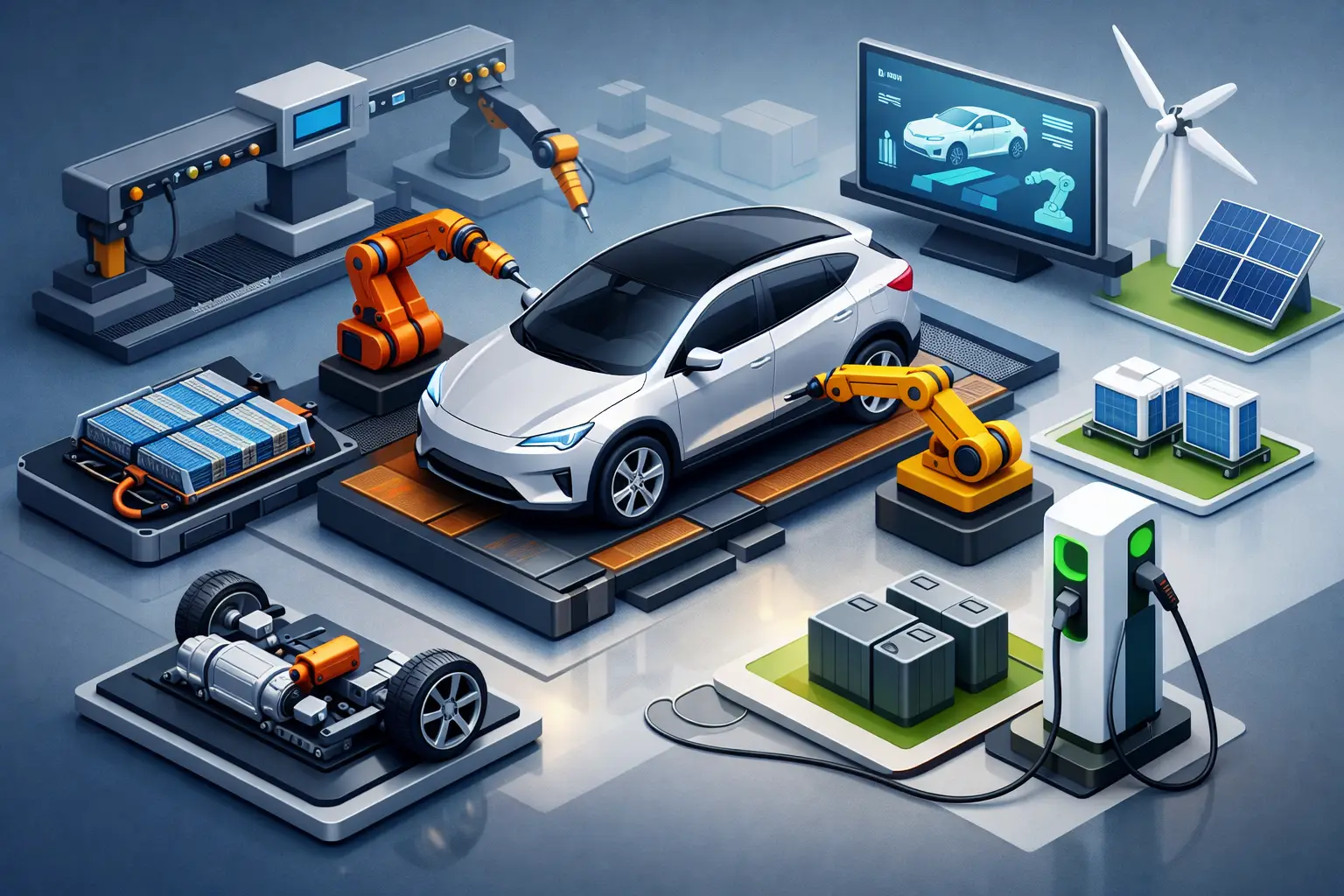
The phrase EV manufacturing can sound straightforward until the actual requirements are mapped. Vehicle assembly is only one layer. Around it sit battery pack integration, power electronics, thermal systems, charging components, software-enabled diagnostics, warehousing, testing, aftersales parts distribution, and in some cases localized supplier production.
That complexity changes the site selection equation. A location that works for light industrial occupancy may fail under the demands of clean production zones, heavy power loads, hazardous materials protocols, multimodal logistics, or phased capacity growth. An EV company may launch in one footprint, then need adjacent space for modules, pilot lines, or regional distribution sooner than expected.
This is where many industrial strategies break down. They solve for entry, not scale. They accommodate the first factory but not the second, third, or integrated supplier cluster that follows.
Infrastructure is now a strategic asset, not a background detail
The strongest industrial platforms do not treat infrastructure as a commodity. They treat it as a competitive advantage. For EV manufacturers, that distinction matters.
Reliable power is an obvious requirement, but the issue goes beyond uptime. Manufacturers need utilities that support process stability, future load increases, and specialized production conditions. The same applies to water, waste handling, road access, and logistics design. A site may look cost-effective at signing and become expensive once operational workarounds start piling up.
Purpose-built infrastructure changes that equation. Turnkey factories, modular industrial units, logistics facilities, and sector-ready spaces reduce lead time and reduce the need to retrofit conventional assets for highly specific industrial use. That has direct implications for speed to market and capital efficiency.
For investors and operators, this is not a branding point. It is a production point. The fewer compromises embedded into the physical environment, the faster a manufacturer can move from installation to output.
Cost matters, but total cost matters more
The EV sector has learned a hard lesson over the last several years: demand growth does not protect manufacturers from margin pressure. Battery inputs fluctuate. Financing costs move. Pricing competition intensifies. In that environment, site economics need to be viewed through a total operating lens.
Lower land and lease costs are useful, but they are only part of the picture. Companies also need to assess labor availability, workforce retention, transport efficiency, permitting clarity, export logistics, and the hidden cost of fragmented operations. A lower headline rate can be offset by poor supply-chain coordination or repeated downtime.
The better question is whether a location lowers the cost of manufacturing at scale over time. That includes how quickly materials can move, how easily the workforce can live near operations, and how much capital will be required to adapt facilities as production evolves.
This is one reason integrated industrial ecosystems are gaining ground. When manufacturing, logistics, housing, healthcare, education, and commercial services exist within one master-planned environment, the operating model becomes more resilient. Workforce stability improves. Commuting friction declines. Expansion planning becomes more predictable.
The Middle East is becoming more relevant to EV production
For multinational manufacturers looking beyond traditional hubs, the Middle East is becoming harder to ignore. Not because it is trendy, but because it solves a practical set of expansion challenges.
The region offers strategic access to GCC demand, export corridors into Africa and Asia, and growing alignment with industrial diversification agendas. The UAE, in particular, has built a strong case around investor-friendly regulation, logistics connectivity, and support for future-facing sectors such as clean mobility, advanced manufacturing, renewable energy, and industrial innovation.
For electric vehicle manufacturing companies, that mix can be compelling. A well-positioned base in the UAE can support regional assembly, parts manufacturing, charging hardware production, battery-adjacent operations, and cross-border distribution. It also offers a useful hedge against overconcentration in a single geography.
That said, not every location in the region delivers the same value. Manufacturers still need to distinguish between generic industrial land and ecosystems built for advanced production. The winning sites will be the ones that combine export access, cost efficiency, future-ready utilities, and room for a supplier network to form around anchor tenants.
What serious EV manufacturers should evaluate before committing
A credible expansion decision should test more than brochure claims. The due diligence process needs to examine whether the environment supports the full industrial lifecycle.
First, assess scalability. Can the site support phased growth without forcing relocation? Adjacent land, modular capacity, and supplier co-location options matter. EV programs rarely stay static.
Second, look at infrastructure readiness. Is the facility genuinely suited to advanced manufacturing, or will extensive retrofitting be required? Timelines and capex assumptions often shift here.
Third, evaluate logistics with discipline. Port access, road connectivity, customs efficiency, and regional distribution routes will shape both cost and responsiveness. This is especially relevant for companies balancing imported components with local assembly.
Fourth, examine workforce conditions. Talent strategy is not just about hiring. It is about retention, training, quality of life, and whether the surrounding environment can support a stable industrial workforce.
Finally, test strategic fit. Does the location align with public policy, ESG targets, and the company’s medium-term manufacturing roadmap? A site may work operationally while falling short strategically.
Why ecosystems outperform industrial parks
There is a meaningful difference between an industrial park and an industrial ecosystem. An industrial park provides space. An ecosystem provides momentum.
For EV manufacturing, momentum is created when infrastructure, logistics, suppliers, talent, R&D, and community support are designed to work together. That model reduces friction across the entire operating chain. It supports innovation, not just occupancy. It also creates stronger conditions for long-term capital deployment because the manufacturer is not carrying every ecosystem gap alone.
This is the logic behind next-generation hubs such as the Erisha Smart Manufacturing Hub by Rana Group. The value proposition is not limited to land or buildings. It is the creation of an ESG-aligned, sector-focused environment where advanced manufacturing can scale with supporting residential, healthcare, education, retail, hospitality, and innovation assets built into the wider platform.
For EV companies entering a new region, that matters. It shortens the distance between industrial planning and operational reality.
The next advantage will belong to companies that build where the future works
The EV sector will continue to reward product innovation, but manufacturing leadership will be shaped just as much by industrial positioning. Companies that choose environments built for advanced production will move faster, absorb shocks better, and scale with more confidence.
That does not mean every manufacturer needs the same footprint or the same geography. Some will prioritize supplier localization. Others will optimize for exports, pilot manufacturing, or multi-sector adjacency with hydrogen, battery systems, or aerospace-grade electronics. It depends on the business model.
What is becoming clear, however, is that electric vehicle manufacturing companies can no longer afford to treat infrastructure as a secondary decision. The production environment is part of the product strategy now.
The next generation of industrial winners will not simply manufacture EVs more efficiently. They will choose to grow in places designed for industrial ambition from day one.
