
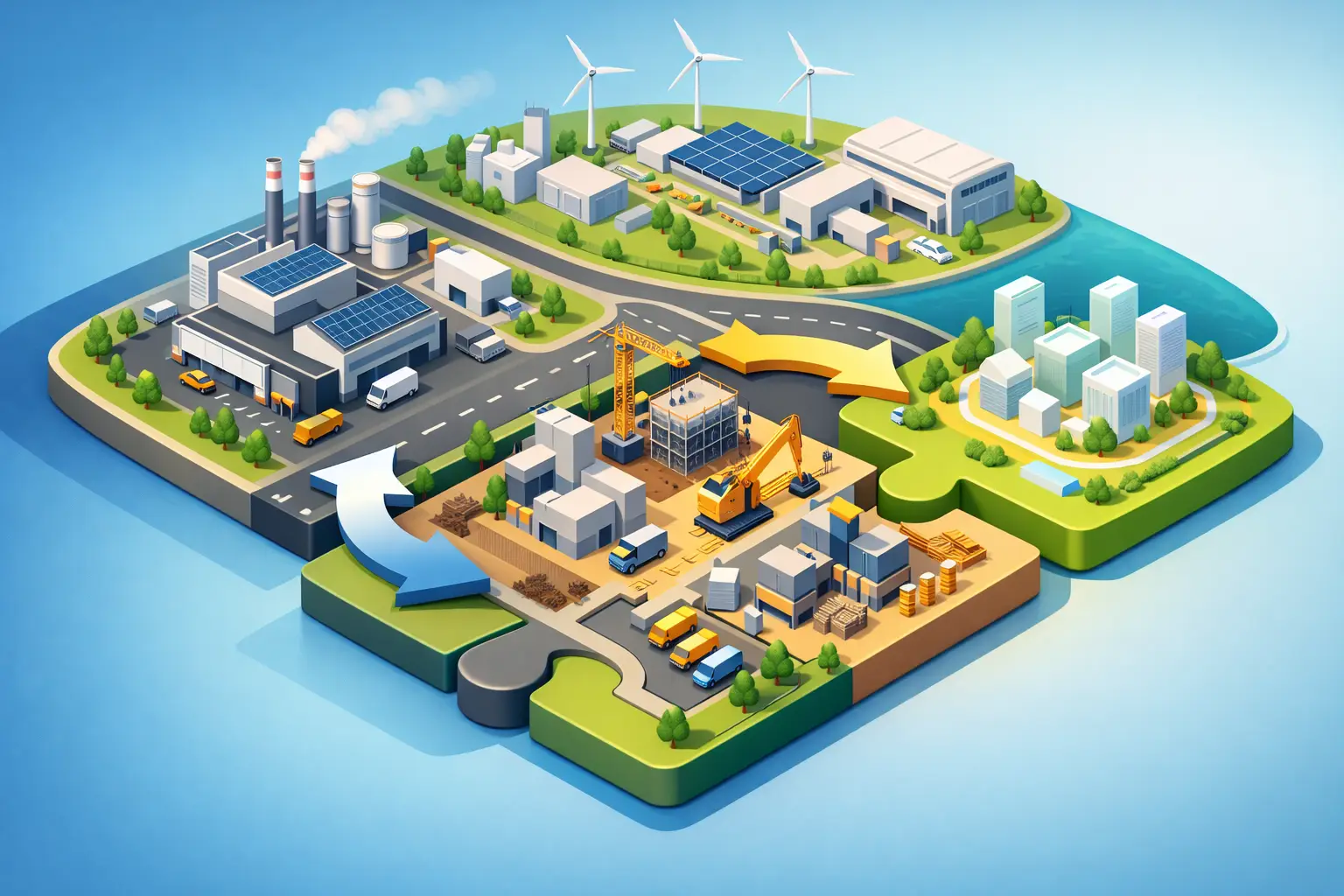
Industrial projects rarely fail because the vision was too small. They fail because delivery outruns demand, infrastructure arrives in the wrong order, or the site is built for a market that has already moved on. That is why phased industrial masterplanning has become a defining discipline for serious industrial development. It gives investors, occupiers, and strategic partners a way to build at scale without forcing all capital, utilities, workforce assets, and logistics capacity into the ground on day one.
For advanced manufacturing, that matters more than ever. Sectors such as EVs, semiconductors, hydrogen mobility, and clean energy do not expand in a straight line. They scale through supplier clustering, regulatory milestones, technology upgrades, and customer commitments. A static industrial park model cannot keep pace with that reality. A phased plan can.
What phased industrial masterplanning actually does
At its core, phased industrial masterplanning is a framework for sequencing land use, infrastructure, buildings, and ecosystem assets over time. The objective is not simply to break a large project into smaller construction packages. The objective is to align each phase with market absorption, utility demand, tenant mix, transport flows, and workforce growth.
That distinction is critical. A site can be built in phases and still be poorly masterplanned. If the first phase lands tenants that later conflict with clean manufacturing requirements, if road geometry cannot support future logistics intensity, or if early utility sizing limits later expansion, the cost of correction compounds quickly. Strong masterplanning protects the long game from short-term decisions.
For industrial investors, this approach improves capital discipline. For occupiers, it creates confidence that expansion space, power, water, compliance standards, and community support will not disappear as the hub grows. For governments and institutional partners, it provides a clearer path to economic diversification and industrial resilience.
Why phased industrial masterplanning matters now
The industrial market has changed. Manufacturers are no longer choosing sites based only on land price or warehouse availability. They are evaluating grid capacity, ESG alignment, labor access, customs efficiency, multimodal connectivity, and the presence of adjacent sectors that can strengthen their supply chain. They also want optionality. Many expansion decisions begin with one line, one assembly program, or one specialized facility, with room to scale only if performance justifies it.
Phased industrial masterplanning responds to that reality by treating the industrial hub as a living system rather than a fixed real estate product. Early phases establish the operational core – roads, utility corridors, logistics access, and a first set of industrial assets. Later phases deepen specialization through sector clusters, support services, R&D capacity, housing, education, healthcare, and commercial amenities.
That sequencing is especially powerful in mixed-use industrial ecosystems. If workforce housing arrives too late, labor retention becomes harder. If logistics yards are undersized, internal congestion starts to affect productivity. If social infrastructure is ignored, high-value employers may struggle to attract technical talent. A serious industrial platform has to stage all of these components with intent.
The strongest phased plans begin with infrastructure logic
A credible industrial masterplan does not start with a marketing map. It starts with infrastructure hierarchy. Power, water, wastewater treatment, data connectivity, freight access, and plot servicing determine what kinds of tenants can be supported and when.
This is where trade-offs become real. Oversizing utilities in phase one can preserve long-term flexibility, but it ties up capital early. Undersizing them improves near-term efficiency, but can delay tenant onboarding later. The right answer depends on the sector profile. Semiconductor-related uses, cleanrooms, advanced materials, and energy-intensive manufacturing place very different demands on a site than light assembly or general logistics.
The same principle applies to road networks and freight planning. It is tempting to build just enough access for current demand. That often creates bottlenecks when later phases add suppliers, container traffic, heavy goods movement, and employee commuting at scale. Good phased industrial masterplanning designs the backbone first, even if some capacity is not fully utilized immediately.
Sector clustering should shape each phase
Not every industrial tenant belongs everywhere. One of the biggest strategic advantages of phased masterplanning is the ability to place sectors in a sequence that strengthens the entire ecosystem.
Early phases often benefit from occupiers that activate the site quickly and establish operational credibility. Those tenants create baseline traffic, utility usage, and investor confidence. But later phases should not be treated as generic spillover. They should be designed around complementary sector clusters that share suppliers, workforce capabilities, testing needs, and logistics infrastructure.
For example, EV manufacturing, battery systems, and power electronics can benefit from adjacency. Hydrogen mobility requires a different safety, handling, and infrastructure framework. Aerospace-adjacent and eVTOL production may need cleaner environments, specialized assembly layouts, and tighter quality support. If those requirements are not embedded from the start, future cluster development becomes constrained.
This is where Rana Group’s ecosystem-led model reflects the direction serious industrial development is taking. The value is not only in delivering factories or plots. It is in creating a master-planned environment where high-growth sectors can scale within an integrated platform built for manufacturing, logistics, talent, and innovation together.
Phasing reduces risk, but only if governance is strong
There is a tendency to present phased development as automatically safer. It is not. Phasing reduces risk only when each stage is governed by clear triggers, disciplined land release, and a firm understanding of what must be preserved for later expansion.
If a developer starts changing land uses to chase short-term occupancy, the masterplan loses strategic coherence. If support infrastructure is postponed repeatedly to protect margins, the site may fill up but underperform as an industrial ecosystem. If anchor tenants are accepted without regard to long-term cluster logic, future compatibility issues can erode value.
Strong governance means each phase is linked to measurable conditions. Utility thresholds, tenant commitments, transport volumes, workforce numbers, and sector demand should all inform the timing of the next release. That makes the development more responsive without making it reactive.
For investors and multinational occupiers, this matters because predictability matters. Expansion decisions are easier when the platform is managed with institutional discipline rather than parcel-by-parcel opportunism.
A phased masterplan must include the workforce equation
Industrial capacity is not only a land and buildings question. It is also a talent question. Advanced manufacturing depends on engineers, operators, technicians, logistics personnel, quality specialists, and support services. When workforce needs are treated as external to the industrial plan, growth slows.
That is why the strongest industrial hubs integrate live-work-support assets into the phasing strategy itself. Residential development, healthcare access, training institutions, retail, and hospitality are not cosmetic add-ons. They are operating infrastructure for talent attraction and retention.
This is especially relevant for manufacturers entering new markets. A site may look competitive on paper because of land costs or tax treatment, but if the broader ecosystem cannot support a stable workforce, hidden operating costs rise quickly. Commute times increase, turnover rises, and recruitment gets harder. A future-ready industrial hub plans for people with the same seriousness it plans for utilities.
The best plans stay flexible without becoming vague
Industrial markets move. Technologies change. Regulatory standards tighten. A good masterplan cannot be so rigid that it becomes obsolete, but it also cannot be so loose that it means nothing.
That balance comes from defining what should remain fixed and what can adapt. The fixed elements usually include infrastructure corridors, freight logic, environmental controls, buffer zones, and the long-term structure of sector clusters. The adaptable elements may include building typologies, plot combinations, tenant fit-outs, and the timing of certain support assets.
In practice, that means leaving room for modular expansion, future retrofits, and specialized facilities that may not yet be pre-leased. It also means planning for higher-spec uses before they are fully demanded. If the future target is advanced manufacturing, the site should not be locked into low-value layouts that are hard to reposition.
What investors and occupiers should look for
When evaluating an industrial hub built around phased industrial masterplanning, decision-makers should look past the site brochure. The real questions are more strategic. Is the infrastructure backbone sized for the intended sectors? Are future phases genuinely protected? Is the tenant mix being curated with long-term cluster logic in mind? Are workforce and community assets being delivered as part of the operating model, not as an afterthought?
They should also look at whether the development supports multiple forms of growth. Some occupiers need a turnkey factory now. Others need modular units, cleanroom-ready capacity, or land that can support a later build-to-suit expansion. A credible phased plan should accommodate those pathways without compromising the integrity of the whole.
That is the real strength of this model. It does not ask industrial growth to arrive all at once. It creates the conditions for growth to compound – phase by phase, sector by sector, investment cycle by investment cycle.
The future will not be built by industrial sites that simply add more square footage. It will be built by ecosystems that know what to build first, what to protect for later, and how to turn each phase into a stronger platform for the next move.
