
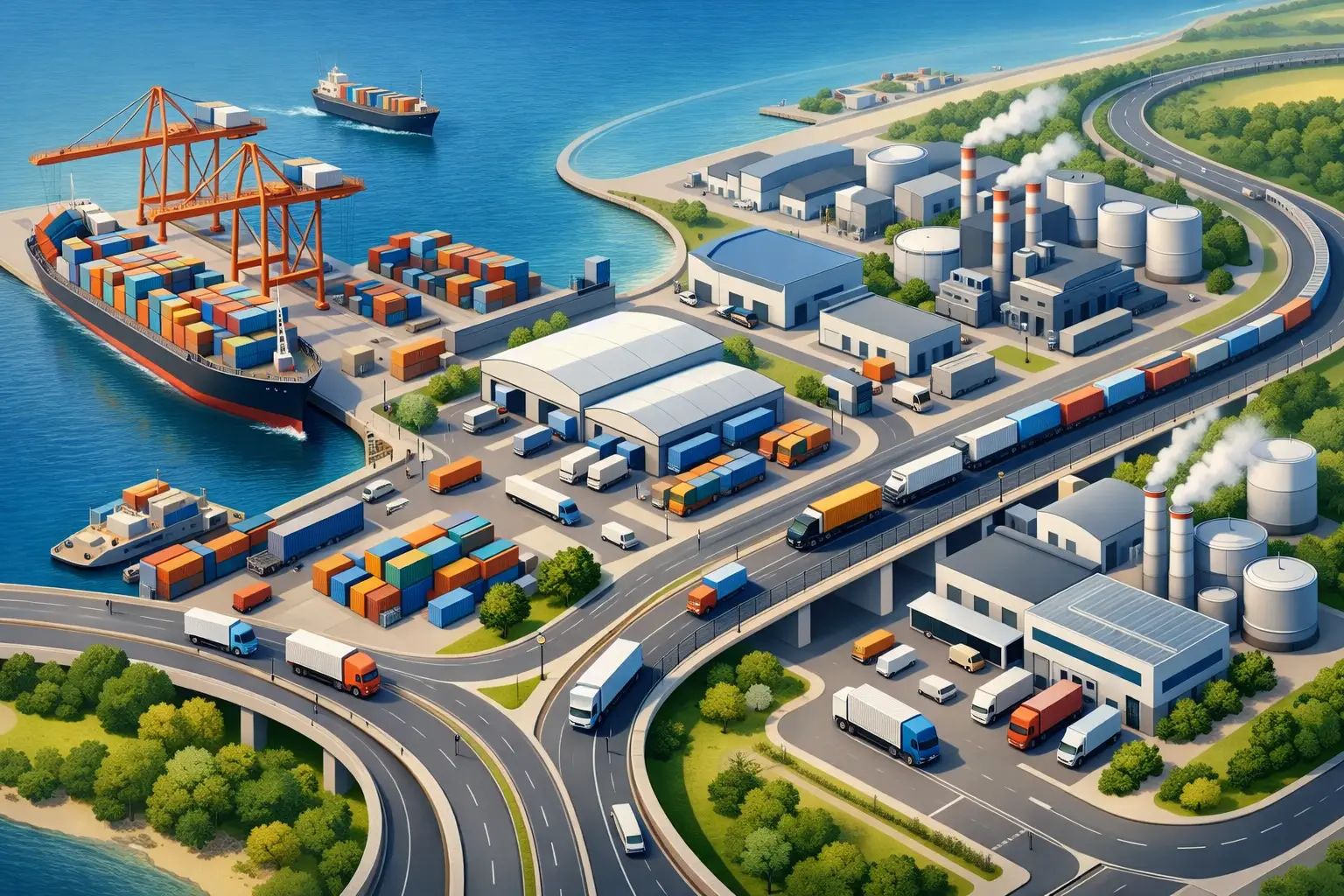
For a manufacturer shipping high-value components, every added truck movement, border handoff, and warehouse transfer shows up somewhere – in margin, lead time, or risk. That is why port connected industrial land has become a strategic filter for expansion decisions, not a secondary site preference. When industrial occupiers choose land with direct access to maritime logistics, they are not just buying acreage. They are securing a faster route to markets, a more stable operating model, and a location that can support growth at industrial scale.
What port connected industrial land really changes
A port-adjacent site reshapes the economics of production from day one. Raw materials arrive with fewer inland transfers. Finished goods move to export channels with less friction. Heavy equipment, oversized cargo, and containerized shipments can be handled closer to the point of manufacture, which matters even more for sectors where timing and logistics precision define competitiveness.
For advanced manufacturing, this advantage compounds over time. Electric vehicle systems, renewable energy components, semiconductor-related equipment, hydrogen mobility hardware, and aerospace-adjacent assemblies all depend on coordinated inbound and outbound flows. A location that shortens the distance between factory floor and port gate can reduce handling complexity, lower exposure to delay, and improve inventory planning.
The benefit is not simply speed. It is control. Executives evaluating regional expansion are increasingly looking for infrastructure that gives their operations teams more predictability across procurement, production scheduling, and customer delivery.
Why port connected industrial land matters more now
The old model treated logistics as a support function. The current market does not allow that luxury. Trade routes are under pressure, geopolitical volatility can disrupt sourcing patterns quickly, and industrial operators are being asked to meet tighter customer deadlines while maintaining cost discipline and ESG performance.
In that environment, port connected industrial land offers a practical form of resilience. It reduces dependence on extended inland transport corridors and creates optionality for import and export planning. If your production model depends on global suppliers and regional demand, proximity to a port can make the difference between absorbing disruption and escalating it.
There is also a capital allocation angle. Investors and boards are asking harder questions about location strategy. They want proof that a site can support long-term scale, not just short-term launch. Land that sits within an integrated logistics environment is easier to justify because it is tied directly to operational efficiency and market access.
The operational case for industrial occupiers
For operations leaders, the case starts with throughput. Fewer transport legs usually mean fewer failure points. That can support better on-time performance and lower the hidden costs tied to detention, demurrage, double handling, and buffer inventory.
But the strongest case appears when a site is designed for industrial use from the beginning. Port access alone is not enough if the surrounding infrastructure is weak, utilities are constrained, or the labor ecosystem is too thin to support specialized production. The right site combines maritime connectivity with power reliability, road access, warehousing capacity, regulatory clarity, and room for future buildout.
This is where many industrial land offers fall short. They market proximity to a port, but they do not provide the broader ecosystem needed for advanced industry. A serious manufacturing platform has to think beyond the gate line. It should support logistics, compliance, workforce retention, supplier coordination, and R&D adjacency in one location strategy.
Port connected industrial land and sector-specific advantage
Not every manufacturer benefits in the same way, and that distinction matters.
For heavy industry and large-format equipment producers, port connectivity supports oversized cargo handling and lowers dependence on long-haul inland movement. For clean-tech and EV manufacturers, it can improve access to imported inputs while supporting export-oriented regional distribution. For semiconductor and high-precision operators, the value may be less about volume and more about reducing delay risk for sensitive equipment and critical supply flows.
The trade-off is that highly specialized industries also need more than logistics. They need cleanroom-ready infrastructure, resilient utilities, secure environments, and zoning that anticipates future technical requirements. A port-adjacent site without those features may still create bottlenecks inside the operation even if it solves freight challenges outside it.
That is why the highest-performing industrial destinations are increasingly built as ecosystems rather than isolated plots of land.
What investors should look for beyond the port
Industrial investors often start with transport maps, but the smarter screen is broader. The question is not whether a site is near a port. The question is whether that proximity translates into sustained industrial performance.
A credible location should show evidence of master planning, sector alignment, and expansion logic. Can it accommodate modular growth? Are there facilities that shorten time to operation, such as turnkey factories or preconfigured industrial units? Does the environment support workforce needs through housing, services, education, and healthcare? If the answer is no, then port access may improve freight but do little to improve business continuity.
The strongest industrial platforms now integrate logistics infrastructure with a broader live-work-innovate environment. That model helps companies attract talent, reduce commuting friction, and support operational continuity over the long term. It also aligns with how multinational manufacturers are thinking about ESG, employee retention, and strategic resilience.
The GCC advantage in port-led industrial growth
For companies targeting the Middle East, the relevance of port connected industrial land is especially clear. The region sits at a strategic intersection of Asian, African, and European trade routes, making maritime access a direct lever for regional distribution and global reach.
In the GCC, this advantage becomes stronger when paired with investor-friendly regulation, competitive operating costs, and industrial policy support. A manufacturer entering the region is not only evaluating freight time. They are assessing whether a site can serve as a scalable export base, a regional assembly center, and a long-term production platform.
That is why integrated hubs in high-connectivity locations are gaining attention from global occupiers. In places like Ras Al Khaimah, the proposition is not limited to land supply. It extends to cost structure, access to industrial infrastructure, and a business environment increasingly aligned with advanced manufacturing and economic diversification. Within that context, platforms such as Rana Group’s ecosystem approach reflect where industrial development is heading – toward coordinated, future-ready environments rather than fragmented industrial estates.
Port connected industrial land is not automatically the right answer
There are cases where port proximity is less decisive. If a business serves mostly domestic inland markets, or if inputs and outputs move primarily by road or air, then the premium attached to port-adjacent land may not always justify itself. The same is true for lighter industrial uses with limited export intensity.
There can also be trade-offs around land pricing, congestion near established port corridors, and competition for industrial capacity. Some occupiers may find that a slightly inland site with stronger utilities, better labor access, or more flexible development conditions produces better overall economics.
That is why location strategy should be tied to the actual operating model. The best decision comes from balancing freight advantage with energy demand, workforce requirements, build speed, compliance needs, and expansion horizon.
What the next generation of industrial land looks like
The market is moving beyond basic industrial zoning. Next-generation industrial land will be defined by infrastructure depth, ecosystem design, and sector readiness. Port connectivity will remain central, but it will increasingly be judged alongside clean energy access, digital infrastructure, specialized facility formats, and the ability to support innovation-driven manufacturing.
This shift matters because industrial occupiers are not just choosing where to produce the next batch of goods. They are choosing where to anchor the next decade of growth. A site that combines maritime access with advanced infrastructure, talent-supportive planning, and room for technical evolution gives companies more than logistics efficiency. It gives them strategic momentum.
For decision-makers planning a regional base, the real value of port connected industrial land is simple. It places production closer to the flow of global trade while creating the conditions for scale. In a market where speed, resilience, and capital efficiency increasingly move together, that is not a convenience. It is an operating advantage worth building around.
The smartest industrial locations are no longer judged by what sits on the plot alone. They are judged by what the site makes possible five years from now.
