
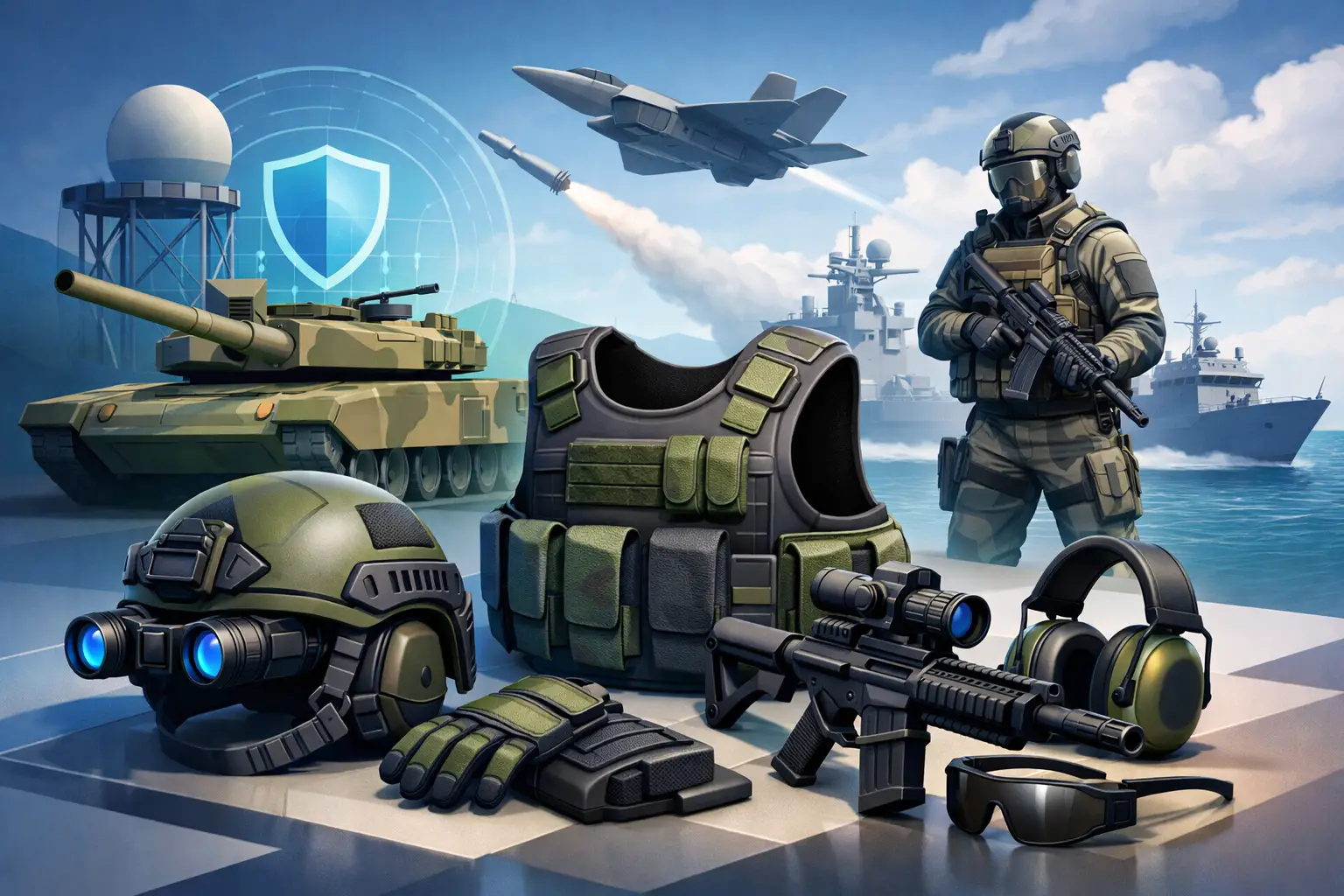
Markets reward clarity. In advanced manufacturing, few choices define a platform more clearly than deciding what it will build, attract, and scale. That is the real answer to why Rana Group promote only protective equipments of defence not the killing equipments in their smart manufacturing hubs: the decision is strategic, values-based, and fully aligned with the kind of industrial ecosystem serious investors want to back.
This is not a symbolic distinction. It shapes tenant quality, regulatory posture, ESG credibility, workforce appeal, insurance risk, institutional partnerships, and long-term asset resilience. For an ecosystem built around smart industry, clean technology, aerospace-adjacent manufacturing, mobility, semiconductors, and integrated live-work infrastructure, the line between protective systems and offensive weapons is a defining industrial policy choice.
Why protective defence equipment fits the hub model
A smart manufacturing hub is not a warehouse cluster looking for any occupier with demand. It is a curated industrial platform designed to attract sectors that can coexist, cross-pollinate, and compound value over time. Protective defence equipment sits naturally within that model because it overlaps with high-growth civilian and dual-use industries.
Think about what falls into the protective category: surveillance systems, air defence support technologies, personal protection systems, secure mobility platforms, sensor integration, emergency response equipment, shielding materials, aerospace safety systems, and command-and-control infrastructure that protects assets and people. These capabilities strengthen sovereign resilience without defining the hub around lethal output.
That distinction matters operationally. Protective manufacturing is easier to integrate with sectors such as aerospace systems, electronics, advanced materials, telecommunications, mobility platforms, and AI-enabled industrial technologies. It supports a broader tenant base and opens more pathways for collaboration across the ecosystem.
This is also why topics such as Surveillance and Air Defence Need Erisha Hub matter within the wider industrial thesis. Protection-led technologies fit an advanced manufacturing environment because they create spillover value across multiple sectors instead of narrowing the platform into a restricted weapons-production identity.
Why Rana Group promotes only protective equipment, not killing equipment
The shortest answer is that offensive weapons narrow strategic optionality, while protective systems expand it.
For a company building future-defining industrial infrastructure, the objective is not short-term transactional occupancy. The objective is to create an ecosystem that remains investable, financeable, and internationally relevant over decades. Promoting killing equipment would introduce constraints that many investors, technology partners, institutional collaborators, and advanced manufacturers do not want tied to a master-planned industrial community.
Protective equipment, by contrast, supports a wider coalition. Governments can support it. Institutional capital can understand it. ESG-minded manufacturers can operate alongside it. Families and talent can live near it. Universities, hospitals, logistics operators, and R&D institutions can collaborate around it. That compatibility is central to the live-work-innovate model.
A hub that includes residential, education, healthcare, retail, hospitality, and research assets cannot think like a single-use industrial zone. It has to think like a long-term economic city. Offensive arms manufacturing creates reputational and governance friction inside that model. Protective systems reinforce safety, resilience, and infrastructure security, which are far more consistent with a modern integrated development strategy.
The investor logic behind the decision
Institutional investors and multinational occupiers look beyond immediate demand. They assess headline risk, cross-border compliance, financing access, export complexity, sanctions exposure, insurance requirements, and future resale or refinancing conditions. A protective-defence positioning reduces several of these frictions.
It does not remove complexity. Defence-adjacent manufacturing still requires oversight, controls, and careful tenant selection. But there is a major difference between manufacturing technologies designed to protect airspace, infrastructure, industrial assets, and human life, and manufacturing systems built primarily for lethal use.
That difference affects who will enter the ecosystem.
A hub focused on protective systems is more likely to attract advanced materials companies, avionics firms, drone monitoring providers, thermal imaging specialists, clean-power integrators, industrial electronics manufacturers, and mobility innovators. Those companies can also connect with adjacent sectors already relevant to Erisha’s model, including eVTOL, semiconductor production, energy systems, and next-generation transport.
A hub known for killing equipment would attract a narrower universe, face more boardroom objections, and risk isolating itself from strategic sectors that depend on broad international collaboration.
ESG is not a side issue here
Many industrial developers treat ESG like a reporting layer. Serious ecosystem builders treat it like an investment filter. If a hub is positioned as ESG-compliant infrastructure with long-duration industrial relevance, then product mix matters.
Protective defence equipment is more defensible within ESG frameworks because its public-interest case is clearer. It is associated with safeguarding borders, infrastructure, airspace, critical supply chains, and civilian populations. That does not make every protective product automatically low-risk from an ESG perspective. It does, however, give investors and partners a rationale that is easier to evaluate and support.
Offensive weapons create a different ESG conversation. Some funds exclude them entirely. Some lenders price in additional risk. Some strategic partners avoid association even when the business case appears strong. For an industrial hub seeking diversified global participation, those barriers are not minor.
The point is not moral simplification. The point is industrial positioning. Rana Group is building an ecosystem meant to host future industries at scale. ESG alignment strengthens access to capital, partnerships, talent, and policy support. The product categories promoted inside that ecosystem must support that direction.
The ecosystem effect: who can coexist inside the hub
One of the clearest reasons behind this policy is coexistence. A mixed-use industrial ecosystem works only when different functions reinforce each other instead of creating permanent conflict.
That is why the broader platform includes logic around workforce life, education, and healthcare. The same thinking appears in Why Hospitals and Colleges Belong in Erisha Hub. An ecosystem designed for advanced industry needs technicians, engineers, families, researchers, training institutions, and service providers to operate in one coordinated environment.
Protective manufacturing can sit inside that vision because it is linked to resilience and systems security. It supports aerospace-adjacent operations, secure mobility, emergency readiness, and technology development. It can coexist with semiconductor spaces, EV manufacturing, hydrogen mobility, logistics assets, and R&D facilities.
Killing equipment changes the social and institutional chemistry of the site. It raises harder questions from partners, employees, nearby service providers, and some international stakeholders. Even when legally permissible, it can reduce the breadth of collaboration that a smart manufacturing hub depends on.
A smarter fit for dual-use innovation
The future of industrial value creation increasingly sits in dual-use technology. Sensors, composites, batteries, autonomous systems, guidance software, communication architecture, airspace monitoring, and advanced electronics often have both civilian and security applications.
Protective defence manufacturing preserves access to that dual-use frontier without forcing the hub into a narrow weapons-production category. This matters because many of the highest-value manufacturing ecosystems now depend on crossover innovation. Aerospace informs mobility. Semiconductors inform surveillance. Clean energy supports resilient infrastructure. AI improves monitoring, maintenance, and response systems.
That is also consistent with how expansion leaders think about site selection. They want flexibility, adjacent suppliers, infrastructure readiness, policy clarity, and the ability to serve more than one end market. Advanced Manufacturing Site Selection Guide reflects that wider logic. Industrial ecosystems win when they expand strategic options for tenants. Protective systems do that better than offensive arms manufacturing.
National alignment and global credibility
For industrial platforms operating in growth corridors such as Ras Al Khaimah, strategic alignment matters. Governments across the region are pursuing economic diversification, technology localization, advanced industry, logistics strength, and sustainability-linked growth. A hub that promotes protective technologies can align with national security resilience and industrial policy without undermining its attractiveness to international business.
That balance is essential. The strongest industrial ecosystems are not ideological abstractions. They are practical frameworks for attracting capital, technology, and high-value production while maintaining policy credibility.
Protective defence equipment supports that balance because it can be framed around safeguarding infrastructure, airspace, supply chains, and communities. It speaks the language of resilience, preparedness, and strategic capability. Killing equipment speaks a narrower language, and it often narrows the coalition willing to participate.
What this means for partners and tenants
For prospective partners, this positioning sends a useful signal. It says the hub is selective. It says governance matters. It says the platform is being built for long-term industrial credibility, not opportunistic tenant capture.
That matters to boards deciding where to place capital. It matters to manufacturers that need stable neighbors and reputational safety. It matters to institutions that want to collaborate on R&D, training, testing, and supply chain development. And it matters to global companies that need a base in the Middle East without exposing themselves to avoidable controversy.
There will always be trade-offs. A broader defence manufacturing strategy might create access to different revenue pools in the short run. But industrial ecosystems are judged over decades, not quarters. The stronger question is whether a category deepens the platform’s resilience, attractiveness, and cross-sector value.
Protective equipment does. Killing equipment usually fragments it.
That is why this policy is not a limitation. It is a filter. And in next-generation manufacturing, the right filter is often what turns industrial land into a durable economic engine.
