
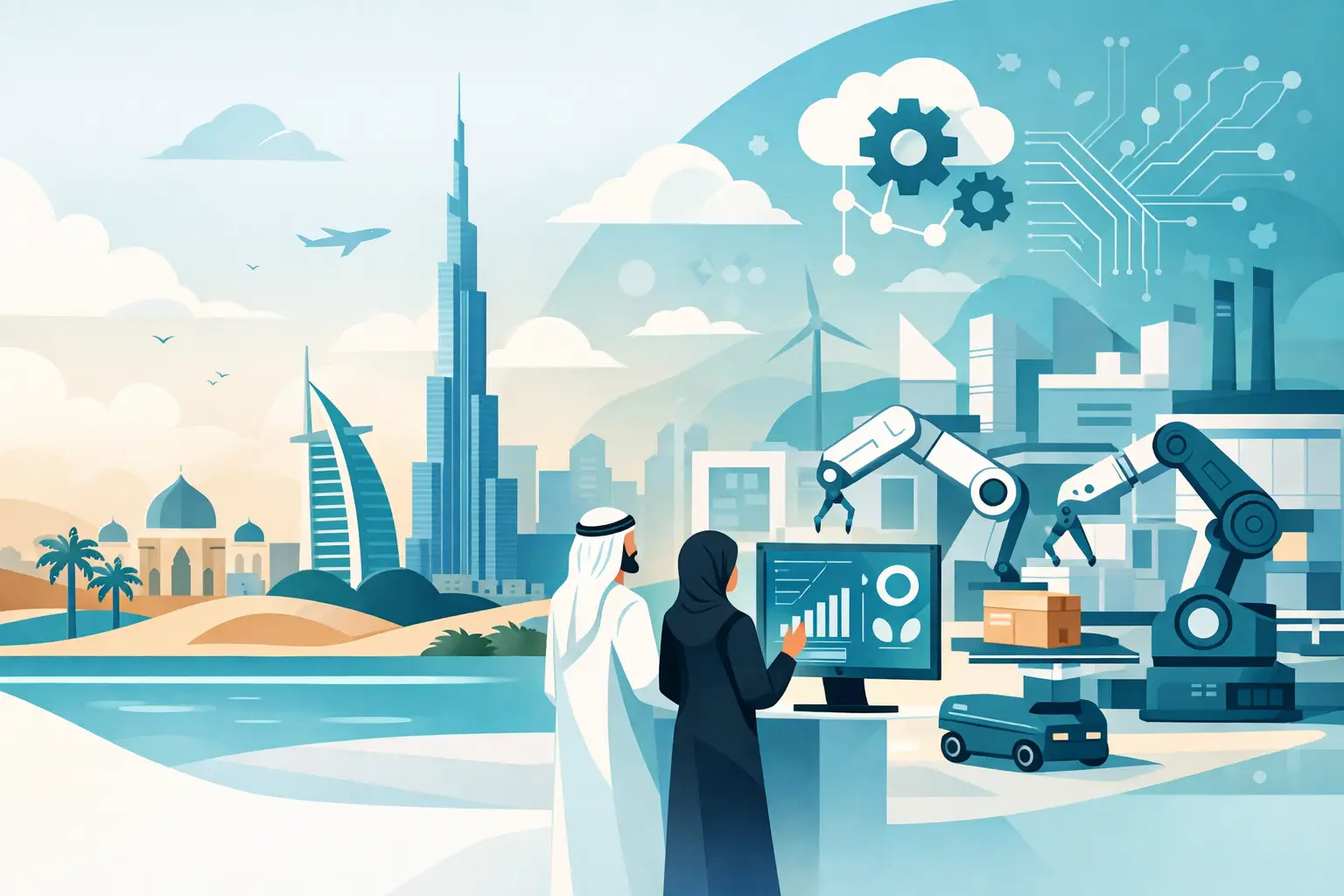
The next industrial advantage is not a factory – it is an ecosystem
For manufacturers assessing the Middle East, the question is no longer whether the UAE can support advanced industry. That case is already made. The real question is what kind of industrial platform will define the next decade of growth.
A single-site plant can solve for production. It does not solve for talent retention, R&D adjacency, logistics resilience, ESG pressure, or the speed required to enter regional markets without carrying unnecessary operating cost. That is where the idea of a smart manufacturing hub UAE strategy becomes decisive.
The UAE is moving beyond the old industrial park model. The future belongs to integrated environments built for high-value sectors, backed by infrastructure that is planned for scale from day one. For investors, operators, and multinational expansion teams, that distinction matters because the cost of choosing the wrong industrial base is rarely visible in the first year. It shows up later in staffing friction, transport inefficiencies, retrofit expenses, and missed market timing.
What a smart manufacturing hub UAE model really means
A smart manufacturing hub is often reduced to automation, sensors, and connected production lines. Those capabilities matter, but they are only one layer of the equation. At the strategic level, a smart manufacturing hub UAE model should combine digital production readiness with industrial land use planning, logistics integration, utility reliability, workforce support, and sector-specific infrastructure.
That means a hub must be able to accommodate different operating realities. A semiconductor-related tenant may require cleanroom-ready environments and precision utility control. An EV or hydrogen mobility manufacturer may need modular production space, heavy logistics access, and nearby supplier clustering. An aerospace-adjacent operator may prioritize testing support, high-spec facilities, and strong export connectivity. Calling all of these businesses “advanced manufacturing” is easy. Building for them properly is harder.
The UAE has a clear advantage here because it can align industrial development with national economic priorities, regulatory modernization, and export ambition. But success depends on whether the physical platform is designed around industrial performance rather than generic real estate absorption.
Why the UAE is positioned to lead
The UAE has become one of the region’s most credible industrial growth markets because it offers more than a pro-business headline. It combines infrastructure quality, policy consistency, global air and sea connectivity, and a serious push toward economic diversification.
For manufacturers, those factors reduce friction at a time when friction is expensive. Regional demand is growing, supply chains are being redrawn, and companies are under pressure to place production closer to end markets while maintaining margin discipline. The UAE answers that need with geographic reach across the GCC, Africa, South Asia, and broader global corridors.
There is also a less discussed advantage. The UAE understands that industrial competitiveness is now linked to national strategy. Manufacturing is not treated as an isolated asset class. It is connected to energy transition, technology development, logistics modernization, and long-term job creation. That policy context gives investors more confidence than a location that offers land but lacks industrial direction.
Still, not every UAE industrial location offers the same value. Some sites are effective for warehousing or light assembly. Others are better suited to heavy industry. The right platform depends on sector, utility profile, labor model, export ratio, and growth horizon.
The shift from plots to platforms
Industrial occupiers used to evaluate sites with a narrower checklist: land cost, lease terms, road access, and utility connection. That approach no longer holds up for advanced manufacturing.
A factory today is part of a wider operating system. If your production depends on specialized technicians, your location must help attract and retain them. If your investors have ESG requirements, your site must support sustainability targets in practical terms, not only in branding language. If your margins rely on throughput and proximity to ports, your logistics design cannot be an afterthought.
This is why a platform-led model is replacing the plot-led model. In a true hub, industrial operations are supported by logistics facilities, R&D capability, housing, healthcare, education, hospitality, and commercial services. That mix is not decorative. It affects workforce stability, operating continuity, and the attractiveness of the site to international partners.
There is a trade-off, of course. Integrated hubs require stronger planning discipline and greater upfront development ambition than conventional industrial estates. They are more complex to execute. But for serious manufacturers with multi-year expansion plans, that complexity often creates a better long-term operating outcome.
What investors should look for in a smart manufacturing hub UAE location
The strongest smart manufacturing hub UAE proposition is one that reduces operational drag while preserving room for growth. That starts with infrastructure readiness. Turnkey factories can accelerate entry for companies that need speed. Modular industrial units support phased growth. Logistics facilities matter when inbound materials and outbound shipments need to move with minimal delay.
Then there is sector relevance. Many industrial zones claim flexibility. Flexibility is useful, but specialization creates stronger industrial ecosystems. A hub built to support EVs, hydrogen mobility, semiconductors, renewable energy systems, or eVTOL-related manufacturing offers clearer strategic value because infrastructure, services, and partnerships can be shaped around actual industry needs.
Location economics remain central. Lower operating costs can materially improve the business case for regional manufacturing, especially for firms balancing capex intensity with uncertain ramp-up timelines. Access to ports, efficient regional transport links, and investor-friendly regulations all influence how quickly a site begins to outperform alternatives.
Workforce infrastructure is equally important. Many expansion plans underestimate the operational value of a live-work environment. If key staff face long commutes, limited services, or fragmented community support, the hidden cost appears in turnover and reduced productivity. A hub that integrates residential, healthcare, education, and retail assets can strengthen retention in ways a conventional industrial park cannot.
Why Ras Al Khaimah deserves closer attention
Ras Al Khaimah is increasingly compelling for advanced manufacturers because it combines strategic access with a more efficient cost profile than many companies expect from the UAE. For operators that need room to scale without absorbing premium urban cost structures, this matters.
The emirate’s location supports connectivity to ports and regional trade routes while offering an environment that is often better suited to large-format industrial planning. That is particularly relevant for sectors requiring phased expansion, supplier adjacency, and dedicated production clusters.
It also aligns with a broader market shift. More manufacturers are looking beyond prestige addresses and focusing on performance-based geography. They want a base that improves total operating efficiency, not simply one that looks strong on a map. Ras Al Khaimah has a credible case on that front.
Building for the sectors that will shape the next decade
The strongest industrial hubs are not neutral about the future. They are built around the sectors most likely to drive value creation over the next ten to twenty years.
That includes electric vehicles and battery-adjacent manufacturing, hydrogen mobility, renewable energy technologies, semiconductor and electronics-related production, and aerospace-adjacent systems such as eVTOL platforms. These sectors demand more than floor space. They require power planning, utility resilience, clean production environments, logistics coordination, and access to innovation networks.
A mixed-use industrial ecosystem can give these sectors a stronger base because it supports collaboration between manufacturing, research, technical services, and strategic partners. It also makes the site more resilient. Sector clustering can create spillover benefits in procurement, talent mobility, and knowledge transfer, though it only works if the master plan is disciplined enough to prevent fragmentation.
This is where Rana Group’s vision for an integrated industrial ecosystem in Ras Al Khaimah fits the moment. It reflects a more serious answer to what manufacturers and investors now need from the UAE: not just industrial space, but a scalable environment where production, logistics, innovation, and community are planned as one system.
ESG is now an operating issue, not a branding layer
For advanced manufacturers, ESG compliance is no longer handled at the edge of the decision-making process. It is now tied to financing, procurement qualification, customer requirements, and corporate risk management.
That changes what companies need from their industrial location. Energy efficiency, smarter land use, integrated mobility planning, and infrastructure that supports cleaner production all carry practical value. So does a development model that reduces fragmentation between work, living, and services.
Not every manufacturer will weigh ESG in the same way. A rapidly scaling firm may still prioritize speed to market above all else. A listed multinational may place heavier emphasis on reporting standards and long-term compliance exposure. But across both profiles, the direction is clear: future-ready industrial infrastructure needs to perform commercially and sustainably at the same time.
The next leaders in regional manufacturing will not win by finding cheaper space alone. They will win by choosing platforms that shorten ramp-up time, strengthen resilience, and support growth without forcing constant reinvestment in missing infrastructure. That is why the conversation around a smart manufacturing hub UAE model matters now. It is not about trend language. It is about where the future of industry can actually work at scale.
