
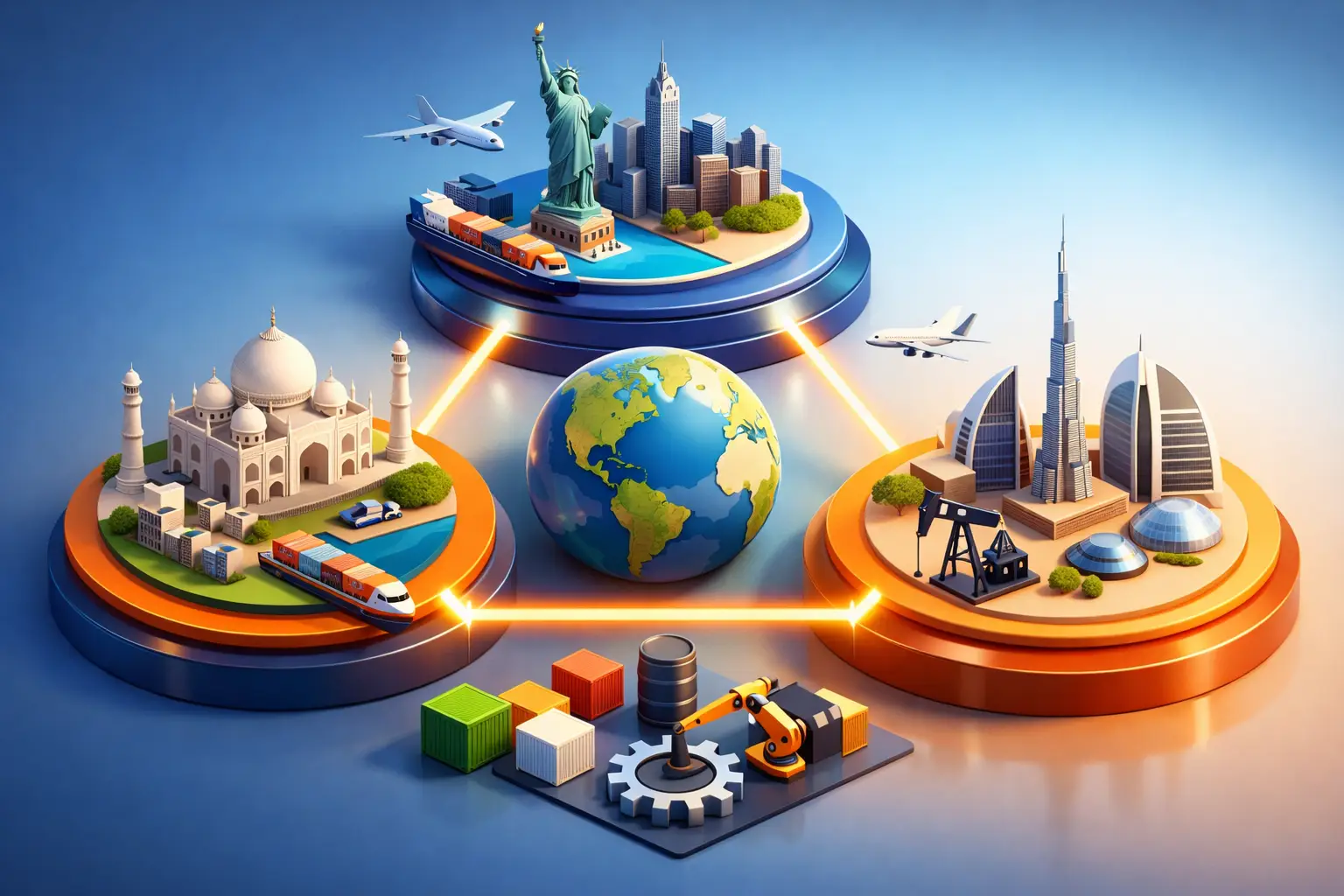
For manufacturers, the real constraint is no longer demand alone. It is where to build, how fast to scale, how to manage costs, and how to stay close to capital, talent, and markets at the same time. That is the reason the question – Will triangle of Erisha,s smart manufacturing hubs in India, USA and UAE help the Industries? – matters more than it first appears. For serious industrial operators, this is not a branding idea. It is a network design question.
The short answer is yes, but only if the triangle is understood for what it is: not three isolated industrial sites, but a coordinated platform for advanced production, market access, and long-term resilience. When manufacturing footprints are spread intelligently across India, the USA, and the UAE, companies gain options that a single-country strategy rarely delivers. They can diversify supply chain risk, align production with end markets, manage capital deployment more carefully, and create a stronger path from innovation to commercialization.
Why the Erisha triangle matters now
Global manufacturing is being rebuilt around regionalization. Boards are asking whether they should keep every critical process in one geography. Operations leaders are being pushed to shorten lead times, protect margins, and reduce exposure to geopolitical shocks. Investors want expansion strategies that are capital-efficient and ESG-aligned, not just large.
This is where a multi-hub model becomes strategically relevant. India offers scale, engineering depth, and manufacturing momentum. The USA offers advanced R&D, aerospace and defense adjacency, high-value customer proximity, and incentive-driven growth opportunities. The UAE offers a trade-friendly, logistics-centered, investor-oriented base connecting Asia, the Middle East, Africa, and Europe.
Together, these three geographies can function as a triangle of specialization rather than duplication. That matters because industrial value is rarely created by copying the same facility three times. It is created by placing the right capability in the right operating environment.
Will Erisha’s smart manufacturing hubs in India, USA and UAE help the industries?
They can help industries in a very practical way: by improving how companies sequence growth.
Many industrial groups make one of two mistakes. They either centralize too much and become vulnerable, or they expand too broadly and lose operational control. A triangle model creates a middle path. A business can place design-heavy, incentive-sensitive, or market-facing functions in the USA, scale production or component programs in India, and use the UAE as a cost-efficient, globally connected manufacturing and distribution base for regional and export markets.
That structure is especially powerful in sectors that do not operate on a simple linear supply chain. Electric mobility, hydrogen systems, semiconductors, aerospace-adjacent production, renewable energy components, and eVTOL manufacturing all depend on supplier ecosystems, talent pipelines, regulatory coordination, testing requirements, and market access. A single site may be excellent, but it cannot solve every one of those variables equally well.
The benefit, then, is not just capacity. It is strategic fit.
The industrial case for India, USA, and UAE as one operating system
India’s role in the triangle is straightforward. It brings manufacturing scale, engineering capability, and a deep workforce base. For companies that need component production, subassembly, process engineering support, or cost-competitive expansion, India remains a strong industrial engine. In many cases, it can support volume economics that improve the entire network.
The USA serves a different but equally important function. It remains one of the most powerful environments for innovation-led manufacturing, particularly where proximity to customers, certification ecosystems, institutional partnerships, and advanced technology talent matters. In sectors such as aerospace, clean technology, and high-value engineered products, a US presence can strengthen both commercial credibility and speed to market. Companies evaluating that angle may also find value in understanding How Tax Credit Supports Erisha Silicon Valley.
The UAE completes the triangle by offering what many expansion strategies lack: a neutral, efficient, globally connected production and logistics platform. For manufacturers serving GCC markets, African growth corridors, South Asia, and wider export destinations, the UAE is not just a location. It is a distribution logic. Lower operating friction, port connectivity, investor-friendly structures, and the ability to support integrated industrial ecosystems make it especially useful for companies that need a regional command base rather than a standalone factory.
This is why the Erisha model has strategic force. It is not trying to make every site do the same job. It is building a coordinated industrial footprint where each hub can do what it does best.
Where the model creates real value for industrial operators
The first value is supply chain resilience. When production, assembly, validation, or distribution can be divided across aligned hubs, the business is less dependent on one trade lane, one labor market, or one policy environment. That does not eliminate risk, but it changes risk from existential to manageable.
The second value is capital discipline. Not every stage of manufacturing needs to sit in the highest-cost geography. Companies can place sensitive, high-value, or customer-facing functions where they generate the greatest return, while using other hubs for scale and cost balance. That is a better use of capital than overbuilding in one market and underutilizing in another.
The third value is speed. Expansion delays usually come from fragmented planning: land in one place, talent elsewhere, logistics somewhere else, and approvals moving at a different pace entirely. A purpose-built ecosystem reduces those delays. This matters even more in sectors where product windows are tight and first-mover timing affects valuation.
The fourth value is workforce stability. Advanced manufacturing does not run on factories alone. It runs on housing, education, healthcare, mobility, and quality of life. Industrial ecosystems that integrate these elements can hold talent more effectively than isolated industrial zones. That principle is central to long-term occupancy and productivity, and it is one reason integrated development models are gaining attention. Readers interested in that structure can explore Why Erisha Smart Hubs Combine Living and Work.
Which industries stand to benefit most
Not every sector benefits equally from a three-country manufacturing strategy. Commodity manufacturing with very narrow margins may still prioritize a more concentrated footprint. But high-value and technology-driven sectors have a much stronger case.
EV and battery-adjacent manufacturers can use such a network to balance component sourcing, regional assembly, and market responsiveness. Hydrogen mobility companies often need demonstration ecosystems, cross-border partnerships, and industrial land configured for specialized infrastructure. Semiconductor and cleanroom-reliant operators benefit when they can separate innovation, supplier integration, and market access across locations with different strengths. Aerospace and eVTOL programs, in particular, gain from being close to advanced engineering environments while also having access to scalable production capacity and export-efficient logistics.
That is why a networked model is more relevant now than five years ago. Industrial value is moving toward sectors where design, regulation, infrastructure, and talent all matter at once.
The trade-offs investors and operators should consider
A triangle strategy is not automatically superior. It introduces coordination complexity. Management teams need tighter operating discipline, stronger digital oversight, and clear role definition between hubs. If the same process is duplicated without strategic purpose, costs rise and accountability weakens.
There is also the question of maturity. A multi-hub system works best when each site has a clearly defined sector role, infrastructure readiness, and ecosystem support. If one location is strong on paper but weak in execution, the network underperforms. Investors should ask direct questions about land readiness, utility planning, logistics integration, regulatory timelines, workforce pipelines, and partner ecosystem depth.
That is why the quality of the underlying development platform matters as much as the geography itself. A true industrial ecosystem is not just acreage. It is planned interoperability between manufacturing assets, logistics capacity, talent infrastructure, and long-term livability. For a broader look at that distinction, What Industrial Ecosystem Development Gets Right adds useful context.
Why this model aligns with the next decade of manufacturing
Manufacturing strategy is entering a more selective era. Companies are moving away from asking, “Where is labor cheapest?” and toward asking, “Where can we build a durable operating advantage?” That includes cost, but it also includes resilience, ESG compliance, access to customers, infrastructure quality, and the ability to recruit and retain specialized talent.
A triangle built across India, the USA, and the UAE speaks directly to that shift. It gives manufacturers a way to organize production around function, not habit. It opens a path to regional market access without overcommitting to a single geography. It also supports a more credible growth story for institutional investors who increasingly look for infrastructure-backed industrial strategies rather than speculative footprint expansion.
Rana Group’s larger proposition is relevant here because it treats industrial development as ecosystem building, not warehouse delivery. That difference matters to companies planning ten-year capacity, not just next-year occupancy.
So, will Erisha’s smart manufacturing hubs in India, USA, and UAE help industry? Yes – if industry uses them as a coordinated triangle of specialization, resilience, and growth. The manufacturers that win in the next cycle will not simply build more space. They will build smarter geography.
