
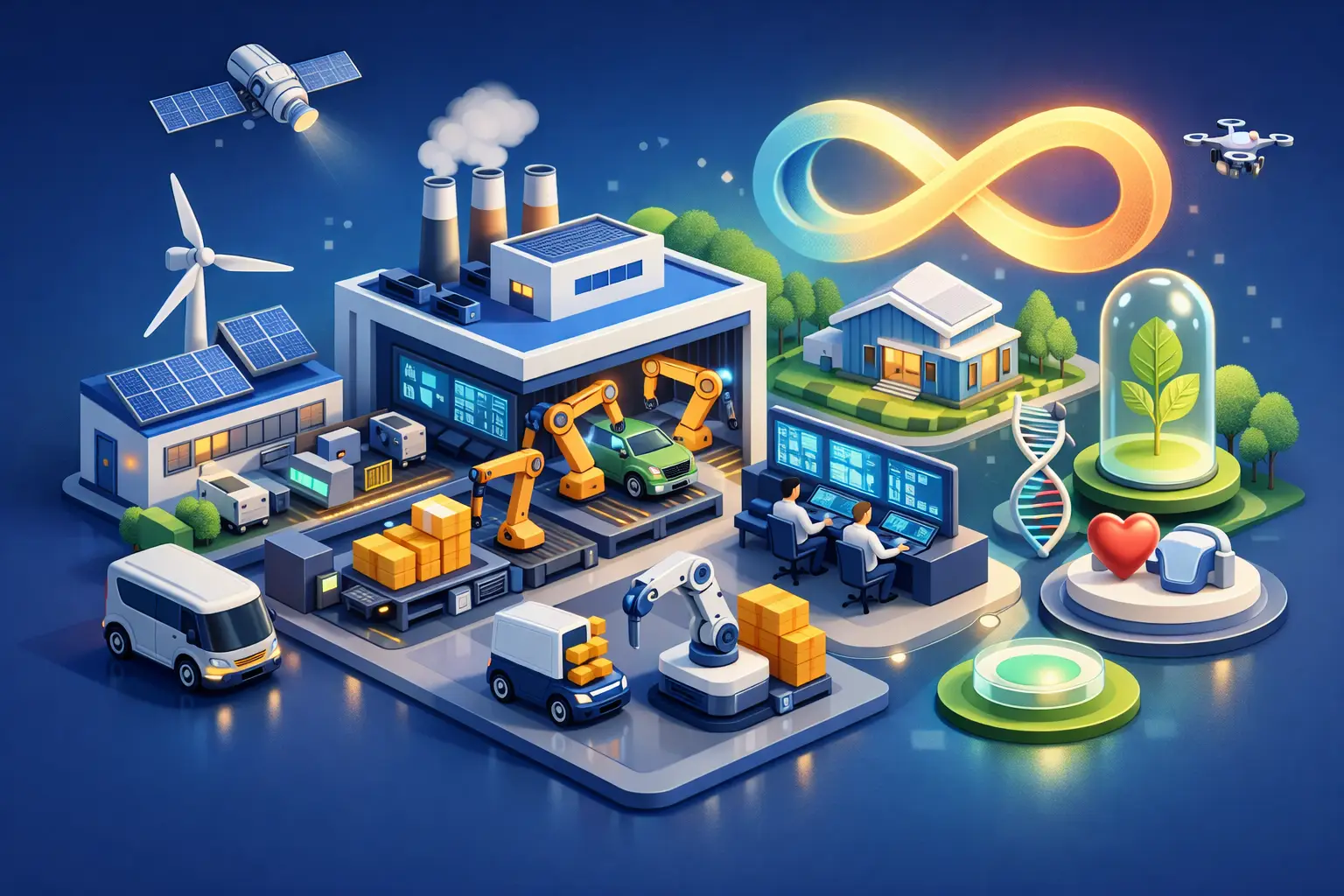
Most industrial projects are built to solve for speed. Very few are built to remain relevant for decades. That is the real answer to the question, Why Erisha Smart Manufacturing Hubs are aligned with Longevity? Because longevity in industrial development is not about how fast a site fills up. It is about whether the platform can continue attracting capital, talent, technology, and production demand as markets evolve.
For manufacturers, investors, and strategic partners, longevity is a hard business metric. It shows up in asset utilization, tenant retention, workforce stability, regulatory resilience, ESG readiness, and the ability to expand without rebuilding the operating model every few years. Erisha Smart Manufacturing Hubs are aligned with that reality because they are planned as integrated industrial ecosystems, not isolated real estate products.
Why Erisha Smart Manufacturing Hubs are aligned with longevity
The strongest industrial platforms share one trait: they are designed for endurance before they are designed for occupancy. That means infrastructure must outlast a single production cycle, a single tenant category, and even a single technology wave.
Erisha takes that view seriously. Its model brings together advanced manufacturing facilities, logistics capability, cleanroom-ready environments, innovation infrastructure, and a live-work ecosystem that supports the people behind production. This matters because industrial longevity depends on more than factory walls. It depends on whether the entire environment can support continuity at scale.
A conventional industrial park may perform well during a favorable cycle. But when labor markets tighten, ESG standards rise, logistics costs shift, or technology requirements change, fragmented sites begin to show their limits. A hub designed around integrated operations, sector specialization, and workforce retention has a better chance of remaining competitive through those transitions.
Longevity starts with the right industrial sectors
Not every industrial tenant contributes equally to long-term value creation. Low-complexity, low-barrier sectors can fill space quickly, but they do not always build durable economic ecosystems. Erisha’s sector focus points in a different direction.
By concentrating on advanced manufacturing categories such as EVs, hydrogen mobility, semiconductors, eVTOL-related production, and renewable energy, the hub aligns itself with sectors backed by long-term capital flows, national industrial strategies, and sustained global demand. These are not short-cycle industries chasing temporary cost arbitrage. They require infrastructure depth, technical workforce planning, regulatory support, and supply chain coordination.
That kind of sector mix improves longevity in two ways. First, it raises the strategic value of the hub itself. Second, it creates cross-sector reinforcement. A site that supports clean energy production, mobility technology, component manufacturing, and R&D functions becomes harder to displace because tenants benefit from being close to adjacent capabilities. That network effect is a long-term asset.
This is also why sector specialization matters more than general industrial positioning. A broad tenant strategy can create volume. A focused industrial thesis creates staying power.
ESG is not a branding layer. It is a lifespan advantage.
Industrial assets that ignore ESG pressure are already aging faster than their balance sheets suggest. Compliance expectations are moving upward. Capital is more selective. Multinational tenants are under pressure from boards, customers, and regulators to improve environmental performance and supply chain accountability.
That is why ESG alignment should be understood as a longevity issue, not a communications issue. Erisha’s framework is built around ESG-compliant development because future industrial demand will increasingly flow toward projects that reduce friction for occupiers. If a manufacturer can enter a hub that is already aligned with sustainability expectations, infrastructure planning, and responsible development standards, that reduces future retrofitting risk.
There is also a capital markets dimension here. Institutional investors and strategic manufacturing partners do not want to underwrite assets that may require major repositioning in a few years. They want environments that remain financeable, defensible, and aligned with policy direction. That is one reason ESG-led planning strengthens long-term relevance. It keeps the hub closer to where capital wants to go.
For a deeper view on that philosophy, see Why Dr Darshan Rana Rejects Non-ESG Business.
Industrial longevity depends on people, not just plants
Factories do not scale on infrastructure alone. They scale on whether skilled people can be recruited, retained, trained, and supported over time. This is where many industrial zones lose their long-term edge. They provide production space but fail to support the human ecosystem required for advanced manufacturing.
Erisha’s integrated model addresses this directly. By combining industrial infrastructure with residential, healthcare, education, retail, and hospitality components, the hub is designed to reduce one of the biggest structural risks in industrial expansion: workforce instability.
For operations leaders, this has practical implications. A better-supported workforce is easier to retain. Relocation becomes more attractive. Specialized talent is more willing to commit long term. International experts can transition more smoothly. Training pipelines become easier to sustain when education infrastructure is not treated as an afterthought.
This is especially important in sectors where quality control, technical precision, and continuity of know-how directly affect output. In semiconductor-adjacent production, clean-tech manufacturing, and aerospace-linked industrial environments, turnover is not just an HR issue. It is an operational issue.
That live-work model is examined further in Why Erisha Smart Hubs Combine Living and Work.
Flexibility is a core feature of long-life industrial assets
Longevity does not mean building something fixed. It means building something adaptable enough to stay relevant as demand changes.
That is one of the more strategic aspects of Erisha’s platform. Turnkey factories, modular industrial units, logistics facilities, and cleanroom-ready spaces create multiple pathways for tenant entry and expansion. A fast-scaling manufacturer does not have the same infrastructure needs as a mature multinational, and a hydrogen mobility player does not require the same build profile as an EV component producer. The hub’s value comes from accommodating those differences without losing planning coherence.
This flexibility lowers future friction. Tenants can scale in phases. New technologies can be integrated with less disruption. Production lines can evolve without forcing a full location reset. For investors, that improves the probability that the asset base remains commercially useful over time.
There is a trade-off, of course. Flexible infrastructure requires more disciplined master planning and stronger operational governance than a standard warehouse-led park. But that complexity is exactly what creates resilience. Simpler assets are easier to build. They are often easier to outgrow as well.
Location strategy matters when thinking in decades
Longevity also depends on geography. A hub can have strong internal planning and still fall short if it sits in a cost structure or logistics environment that becomes harder to justify over time.
Erisha’s positioning benefits from a practical location thesis: lower operating costs, proximity to ports, investor-friendly regulations, and connectivity to GCC and global markets. These are not short-term promotional points. They are structural advantages that support long-term industrial competitiveness.
For multinational manufacturers, that means the hub can serve as more than a local operating base. It can function as a regional production platform with export logic, supply chain flexibility, and room for future network integration. In a volatile trade environment, that kind of positioning matters.
This is one reason the Erisha model resonates beyond a single site. The broader multi-geography platform strengthens strategic optionality for companies evaluating how to serve the Middle East, India, and North America through connected industrial nodes. That cross-market logic is explored in Erisha Smart Manufacturing Hub in India, UAE, USA.
Longevity requires an ecosystem, not a landlord
The final reason Erisha aligns with longevity is that it operates from an ecosystem mindset. That sounds conceptual, but its implications are concrete.
An ecosystem-led industrial platform does more than lease space. It creates conditions for sustained industrial activity by aligning infrastructure, capital, talent, logistics, sector clustering, and quality-of-life assets. This reduces the fragmentation that often weakens long-term industrial projects.
It also changes how strategic partners evaluate risk. A manufacturer entering a standalone industrial site may need to solve workforce access, supplier proximity, ESG adaptation, and future expansion on its own. In a true ecosystem, more of those variables are already built into the platform. That does not remove complexity, but it changes the operating equation in a meaningful way.
For institutional decision-makers, this distinction matters because long-term value is created when ecosystems compound. The more capable the platform becomes, the more attractive it is to the next wave of tenants and partners. That compounding effect is difficult to replicate with conventional industrial development.
Rana Group is building around that principle. The goal is not simply to create occupancy. It is to establish industrial environments that stay investable, expandable, and globally relevant as advanced manufacturing moves into its next era.
Longevity is rarely the product of one feature. It comes from a set of disciplined choices made early – what sectors to back, what infrastructure to prioritize, how to treat ESG, how to support people, and how to build for adaptation instead of short-term fill. Erisha Smart Manufacturing Hubs align with longevity because they are making those choices at the foundation level, where durable industrial leadership is actually decided.
