
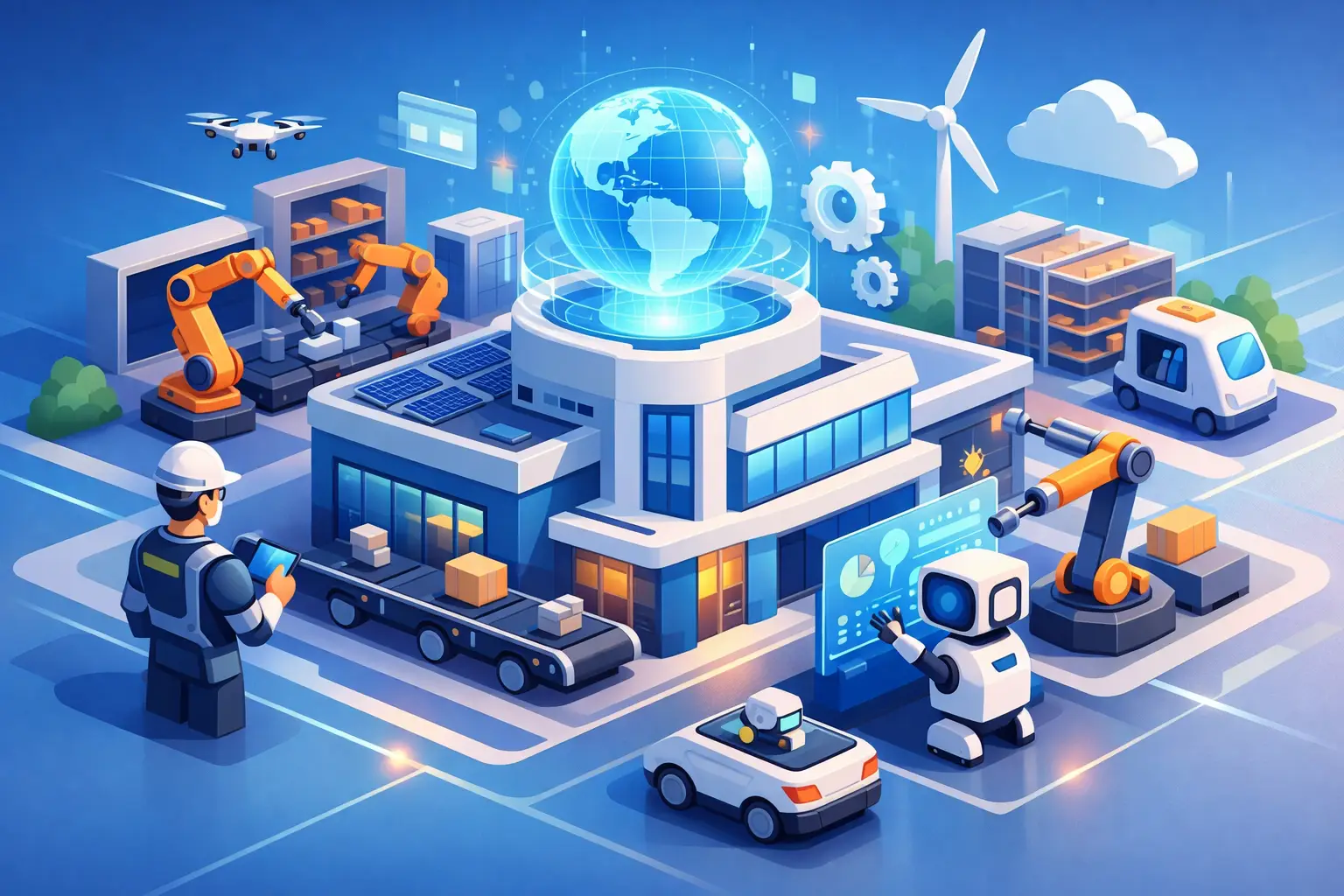
Most industrial projects solve one problem well. They offer land, or logistics, or incentives, or built space. Very few solve the full operating equation. That is the best part of Erisha Smart Manufacturing Hub: it is not designed as a standalone industrial park, but as a complete industrial ecosystem built for manufacturers, investors, and technology companies that need scale without fragmentation.
For serious occupiers, fragmentation is expensive. It shows up in worker attrition, supply chain delays, facility retrofits, compliance gaps, and long ramp-up periods that slow market entry. When an expansion strategy depends on advanced manufacturing, clean-tech production, or high-value assembly, those costs compound quickly. Erisha addresses that challenge by bringing industrial infrastructure, sector-specific facilities, logistics access, R&D potential, and a supporting community environment into one master-planned platform.
The best part of Erisha Smart Manufacturing Hub is integration
The real differentiator is not any single building type or amenity. It is the fact that industrial operations are planned alongside the systems that make those operations sustainable over time.
That means purpose-built factories and modular units exist within a wider environment that also includes housing, healthcare, education, retail, hospitality, and innovation-support assets. For many manufacturers, this changes the expansion model. Instead of solving site selection first and workforce support later, both are addressed together from the beginning.
This matters most in sectors where operational continuity depends on specialized talent, shift reliability, and long-term workforce retention. Semiconductor-adjacent manufacturing, EV components, hydrogen mobility systems, renewable energy equipment, and aerospace-linked production all require more than square footage. They require ecosystems that reduce friction.
A conventional industrial zone may still work for basic warehousing or low-complexity operations. But for companies building next-generation products, the cost of disconnected infrastructure is often hidden until after launch. Erisha is built to remove those gaps upfront.
Why integrated infrastructure creates stronger industrial outcomes
Industrial leaders do not choose a location based on headline costs alone. They assess whether the operating environment will support growth over five, ten, and twenty years. That is where Erisha gains strategic weight.
Turnkey factories can reduce setup time. Modular industrial units can support phased expansion. Cleanroom-ready environments can shorten the path for specialized manufacturing categories. Dedicated sector clusters can place related industries closer together, improving collaboration, supplier proximity, and operating efficiency.
But infrastructure becomes more valuable when it is embedded in a broader system. A manufacturer that can recruit talent, house teams, support families, host partners, and access nearby services is building on more stable ground than one operating in an isolated industrial pocket.
This integrated model also improves resilience. If a site can support workers beyond the factory gate, it is better positioned to handle scale, shift expansion, executive relocation, and international partnerships. That is one reason the live-work-innovate structure matters so much. It is not decorative. It is operational.
For a deeper look at this model, see Why Erisha Smart Hubs Combine Living and Work.
Sector focus is part of the advantage
Another reason the best part of Erisha Smart Manufacturing Hub is hard to reduce to one feature is that its value increases when viewed through sector strategy.
This is not a generic industrial land play. It is aligned with advanced manufacturing categories that are shaping the next industrial cycle: electric vehicles, hydrogen mobility, eVTOL aircraft, semiconductors, logistics innovation, and renewable energy production. That focus matters because sector specialization changes the quality of infrastructure planning.
A project built for broad industrial occupancy may offer flexibility, but it can lack the precision required by high-spec users. By contrast, a hub planned around advanced sectors can account for utility profiles, cleanroom potential, logistics patterns, compliance expectations, and future supplier ecosystems from the start.
That creates a different kind of opportunity for investors and occupiers. Instead of entering a location that must be adapted over time, they can enter one that already anticipates industrial evolution.
There is a trade-off, of course. Specialized ecosystems require clear strategic intent. They are less about short-term occupancy volume and more about attracting the right industries with the right growth trajectory. For institutional capital and serious manufacturing tenants, that is usually a strength, not a weakness.
The location strategy supports the model
Even the strongest infrastructure story can weaken if geography works against it. Erisha gains additional value because its model is supported by a location strategy tied to cost efficiency, connectivity, and market access.
For companies expanding into the Middle East or using the region as a production and distribution base, the fundamentals matter: access to ports, investor-friendly regulations, lower operating costs relative to more saturated markets, and connectivity to GCC and international trade routes. These are not secondary advantages. They shape margins, lead times, and board-level expansion decisions.
What makes Erisha stronger is that the geographic advantage is paired with a purpose-built industrial proposition. Companies are not forced to choose between strategic location and future-ready infrastructure. They can secure both in one platform.
That combination becomes especially compelling for firms balancing regional manufacturing, export logistics, and ESG-linked investment requirements.
ESG is not an add-on here
A growing number of industrial projects talk about sustainability in broad terms, but investors and multinational manufacturers increasingly need more than language. They need developments that align with ESG expectations in practical ways, from planning logic to infrastructure standards to long-term operational viability.
This is another answer to the question of the best part of Erisha Smart Manufacturing Hub. Its model is designed around ESG-compatible industrial growth rather than retrofitted sustainability claims.
That has strategic implications. It can strengthen investor confidence, improve alignment with procurement standards, support institutional partnerships, and help occupiers future-proof their manufacturing footprint as disclosure and compliance expectations continue to rise.
At the same time, ESG alignment only creates value if the underlying industrial proposition is commercially sound. Erisha appears to understand that balance. Sustainability does not replace competitiveness here. It reinforces it.
You can explore that dimension further in Is Erisha Smart Manufacturing Hub ESG and SDG Aligned?.
What decision-makers are really buying into
When C-suite leaders evaluate an industrial platform, they are rarely buying just a facility. They are buying speed to market, operational continuity, future expansion capacity, reputational fit, and confidence that the environment will still make sense as their industry changes.
That is why the best part of Erisha Smart Manufacturing Hub is not best understood as a feature checklist. It is better understood as reduced strategic compromise.
A manufacturer does not have to choose between specialized infrastructure and workforce quality of life. An investor does not have to choose between ambitious scale and sustainability alignment. A clean-tech company does not have to choose between regional access and ecosystem depth. The project is designed to compress those trade-offs.
Not every occupier will value every layer equally. A logistics operator may prioritize connectivity and built efficiency. A semiconductor-linked manufacturer may focus on facility readiness and talent support. A mobility innovator may care most about cluster synergies and long-term expansion optionality. The model has room for those different priorities because it is broad enough to support multiple industrial pathways without becoming generic.
That flexibility is one reason the platform stands apart from conventional alternatives. For more on that distinction, read How Erisha Smart Manufacturing Hub Is Different.
The strongest industrial hubs think beyond tenancy
Industrial real estate alone does not build an economic engine. The projects that matter most over the next decade will be the ones that shape industrial communities, attract innovation partners, support labor ecosystems, and create conditions for companies to stay and grow.
That is where Erisha makes its strongest case. The project positions itself as economic infrastructure, not just occupier inventory. That difference is significant for strategic partners and institutional stakeholders because it signals long-horizon thinking. It suggests the platform is being built to support industrial transformation, national diversification goals, and next-generation production capacity rather than simply absorb demand.
For a company evaluating where to establish a durable base, that is often the deciding factor. Short-term incentives can attract attention. Integrated, future-facing infrastructure earns long-term commitment.
If there is one answer to the question, it is this: the best part of Erisha Smart Manufacturing Hub is that it treats manufacturing as an ecosystem challenge and solves it at ecosystem scale. That is where serious industry gains an edge, and where the future works.
