
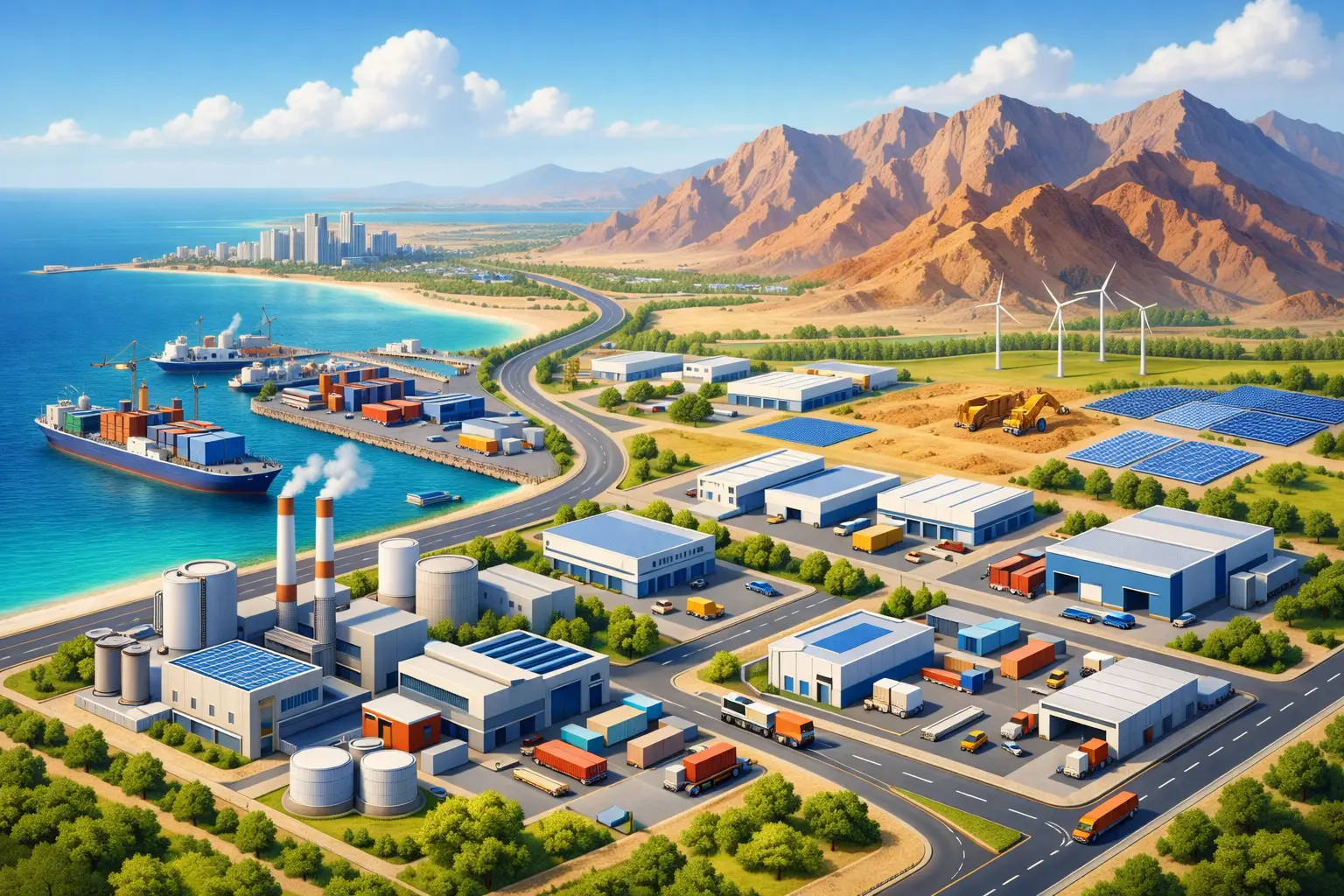
Industrial expansion fails long before the first foundation is poured. It fails at the land decision – when a site looks cost-effective on paper but creates friction in permitting, logistics, labor access, utilities, or future scale. That is why an Industrial Land Strategy Ras Al Khaimah matters far beyond plot pricing. For manufacturers and investors entering the UAE or expanding across the Gulf, land strategy is a direct driver of operating margin, production continuity, and long-term enterprise value.
Ras Al Khaimah has moved into a stronger position in the regional industrial map because it answers a problem many occupiers now face. High-value manufacturing needs more than zoned land. It needs land that is operationally usable, regulatorily clear, cost-competitive, infrastructure-linked, and capable of supporting sector-specific buildouts. That distinction is where strategic advantage is created.
Why industrial land strategy now matters more than land availability
A decade ago, industrial site selection often centered on one question: where can a company secure enough land at the right price? That question is no longer sufficient. Advanced manufacturers in EV systems, semiconductors, hydrogen mobility, renewable energy components, and aerospace-adjacent production are making far more demanding decisions.
They are assessing whether a site can support cleanroom readiness, heavy utility loads, hazardous material controls, multimodal logistics, supplier co-location, workforce retention, and ESG reporting. In many cases, the cost of getting these elements wrong will exceed the cost of the land itself.
This is where Ras Al Khaimah stands out. It offers a lower operating cost base than many competing jurisdictions in the region, while still connecting manufacturers to ports, road networks, and export corridors that matter. The real advantage, however, is not simply affordability. It is the ability to align industrial land with an actual production model rather than forcing production into a generic industrial zone.
The core pillars of an Industrial Land Strategy in Ras Al Khaimah
A serious industrial land strategy in Ras Al Khaimah should be built on five interdependent questions.
First, can the land support the production profile today? This includes plot dimensions, loading access, ceiling requirements, utility availability, and environmental suitability. A mobility manufacturer, for example, does not evaluate land the same way as a food processor or packaging operator. Sector fit matters from day one.
Second, can the site scale without operational disruption? Expansion is rarely linear. A manufacturer may launch assembly, then add testing, warehousing, battery integration, component machining, or regional distribution. Land strategy must anticipate that growth path. A site that works for phase one but blocks later expansion creates expensive fragmentation.
Third, does the land sit inside the right regulatory and commercial framework? For many investors, the right structure is tied to ownership rules, customs treatment, licensing flexibility, and speed to operation. Businesses comparing models should review the implications carefully, particularly when deciding between zone structures and wider market access. Our perspective on this is covered in Free Zone vs Mainland Manufacturing.
Fourth, is the surrounding environment built for workforce stability? Manufacturers do not succeed on factory infrastructure alone. Talent retention increasingly depends on housing, healthcare, education, retail, and quality-of-life factors near the production base. Industrial land that sits in isolation may look efficient initially, but over time it can increase labor churn and management complexity.
Fifth, does the location strengthen investor confidence? Institutional capital and multinational boards want more than industrial acreage. They want evidence of master planning, governance clarity, infrastructure sequencing, and long-term development logic. Land is not just a physical asset. It is a signal of strategic seriousness.
Ras Al Khaimah’s advantage is structural, not temporary
Many industrial markets can offer incentives. Far fewer can offer structural positioning. Ras Al Khaimah benefits from a combination of business-friendly regulation, connectivity to GCC demand centers, access to marine logistics, and a cost environment that supports manufacturing competitiveness over the long term.
That matters most in industries where margin discipline and capital intensity are both high. EV supply chain operators, hydrogen-related manufacturers, precision engineering firms, and renewable energy equipment producers are all under pressure to control fixed costs while preserving room for technical specialization. Land strategy in that context becomes part of the balance sheet, not just part of the real estate plan.
There is also a timing advantage. Companies entering growth markets often wait too long for perfect certainty, then face constrained options when demand accelerates. In emerging industrial corridors, the highest-quality land positions are usually secured by businesses that understand infrastructure direction early. They do not simply buy land. They secure future throughput, future labor access, and future strategic flexibility.
Industrial land strategy Ras Al Khaimah for advanced manufacturing
For advanced manufacturing, the wrong land decision creates hidden inefficiencies that compound over years. Utility retrofits delay commissioning. Poor logistics geometry increases internal transport time. Inadequate clustering separates suppliers from assembly. Limited expansion room forces duplicate management systems across multiple sites.
A stronger Industrial Land Strategy Ras Al Khaimah begins with matching land to sector architecture. Semiconductor-related occupiers need higher-spec technical environments and a path to contamination-controlled production areas. EV and hydrogen manufacturers need integrated industrial footprints that can accommodate assembly, storage, testing, and supply chain adjacency. Aerospace-adjacent firms often require exacting building specifications, secure movement protocols, and room for specialized support functions.
This is why generic industrial parks are becoming less persuasive for future-facing sectors. The market is moving toward ecosystem-based industrial planning – places where production, logistics, R&D capability, talent infrastructure, and livability are designed to work together. That model reduces friction at scale and improves resilience when companies add new production lines or supplier partners.
For decision-makers evaluating manufacturing locations, our Advanced Manufacturing Site Selection Guide explores the operational filters that matter most when comparing regional options.
What sophisticated investors should test before committing land capital
Not every attractive industrial plot is strategically investable. The right diligence process should test three layers at once: asset quality, ecosystem quality, and strategic timing.
At the asset level, investors should examine technical readiness, utility planning, access roads, logistics interfaces, environmental considerations, and the realism of construction sequencing. A land parcel with weak enabling infrastructure can consume capital well before it generates productive output.
At the ecosystem level, the more important question is whether the site sits inside a credible industrial vision. Is there a plan for supplier depth, sector clustering, workforce support, and adjacent services? Industrial tenants stay longer and invest more heavily when the surrounding environment reduces operating risk.
At the timing level, investors should ask whether the location is aligned with larger economic and policy trends. The UAE’s industrial direction is increasingly defined by diversification, higher-value production, export capacity, and sustainability-linked development. Land positioned within that trajectory carries stronger long-term relevance than isolated speculative holdings.
This is one reason integrated development models are drawing more attention from global manufacturers. A purpose-built industrial ecosystem can shorten setup time, improve retention, and create a better platform for strategic partnerships. Readers looking at Erisha’s positioning in that context may find Top 10 Reasons to Invest in Erisha Hub-RAKEZ useful.
The trade-off between low entry cost and long-term industrial performance
There is always a temptation to optimize for the cheapest available land. In some sectors, that works. In advanced industry, it often does not.
Low-cost land without power certainty, logistics integration, talent support, or compliance readiness can become expensive very quickly. The opposite is also true. Premium land with no realistic path to phased growth may tie up capital without delivering proportional operating value.
The more disciplined approach is to evaluate land based on total industrial performance. That means looking at speed to commissioning, cost to customize, efficiency of goods movement, workforce durability, and ability to expand within the same development logic. When those variables are considered together, the best land is not necessarily the cheapest. It is the land that protects operating continuity while enabling growth.
For industrial occupiers with multinational reporting obligations, ESG performance also belongs in this equation. Site design, energy planning, transport efficiency, and mixed-use workforce support are no longer peripheral issues. They increasingly shape financing conversations, customer requirements, and board-level approvals. That is especially true in clean-tech and advanced manufacturing categories where sustainability claims are scrutinized against physical infrastructure decisions.
Where the market is headed
The next phase of industrial competition in the Gulf will not be won by offering plots alone. It will be won by building environments where advanced industry can scale with confidence. Ras Al Khaimah is increasingly relevant because it offers the ingredients that serious manufacturers and strategic investors are looking for: cost discipline, regulatory clarity, infrastructure access, and room for purpose-built industrial ecosystems.
That is the real meaning of industrial land strategy. It is not a transaction. It is a decision about where future production will be anchored, where supply chains will consolidate, and where industrial value will compound over time. Companies that treat land as strategy, not inventory, tend to make better expansion moves – and they are the ones best positioned to build where the future works.
