
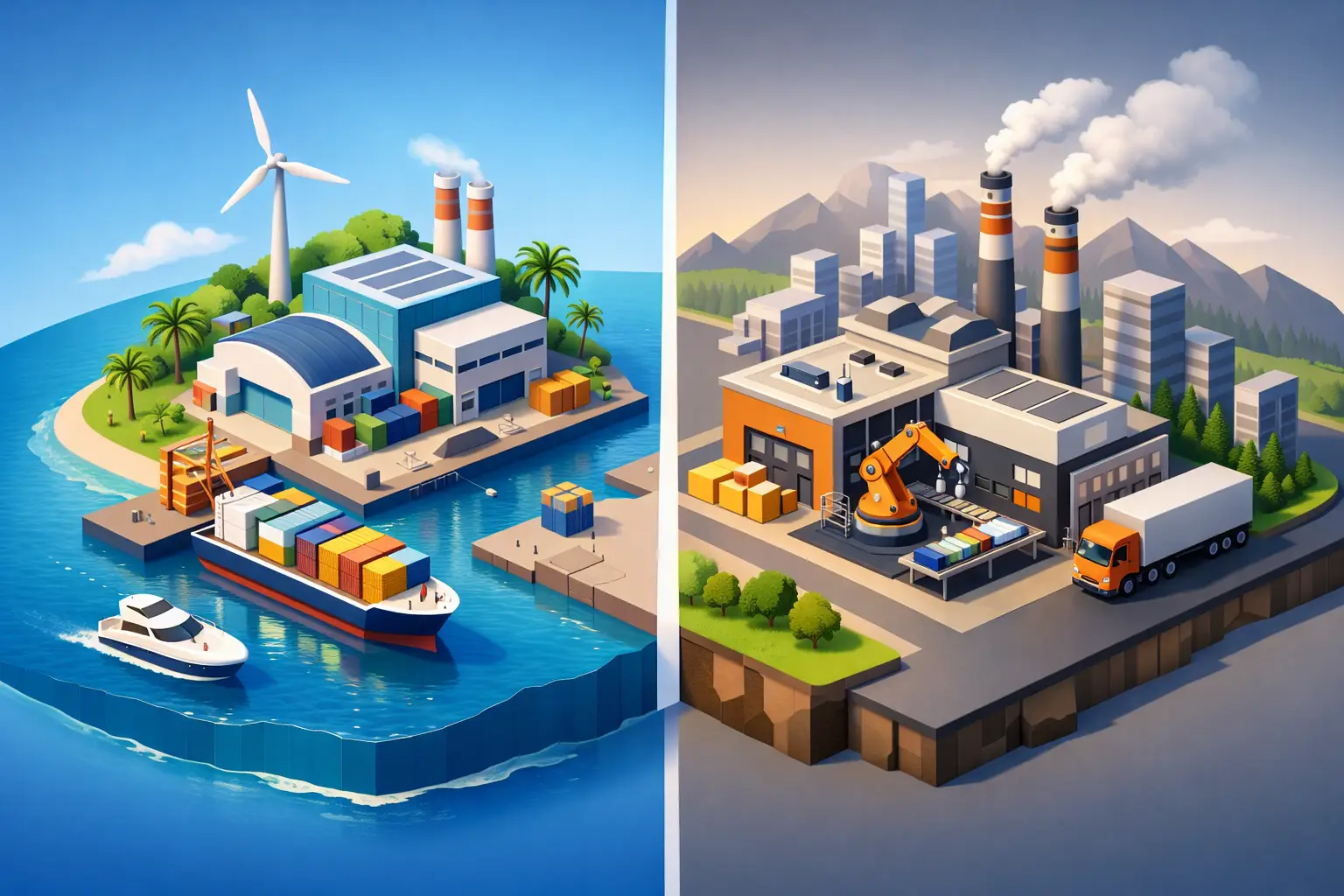
For industrial investors entering the UAE, the Free Zone Vs Mainland Manufacturing decision shapes far more than licensing. It affects market access, customs exposure, workforce strategy, supply chain design, capital efficiency, and the speed at which a factory can scale from pilot line to regional production platform.
That is why the choice should never be reduced to a simple tax or ownership discussion. For advanced manufacturers, the right structure depends on what you are producing, where your customers sit, how your inputs move, and whether your operation is built for export, domestic distribution, or both. A semiconductor assembly line, an EV components plant, and a renewable energy equipment manufacturer may all reach different answers for valid strategic reasons.
Why the Free Zone vs Mainland Manufacturing choice matters
Manufacturing is capital-intensive by nature. Once a facility is fitted out, utilities are integrated, compliance systems are built, and logistics routes are established, changing location strategy becomes costly. A poor setup decision can create recurring friction in procurement, customs handling, lead times, and customer servicing.
Free zones often appeal to international manufacturers because they are designed around investor-friendly regulations, streamlined setup, and strong export infrastructure. For businesses targeting GCC, Asian, African, and wider global markets, that can create a practical operating advantage from day one.
Mainland manufacturing, by contrast, can be more attractive for companies that need direct and frequent access to the UAE domestic market, public sector opportunities, or nationwide project execution without relying on intermediate distribution structures. If your growth model depends on selling deeply into the local market, mainland status may carry strategic weight that extends beyond licensing convenience.
What free zone manufacturing does well
A free zone setup is often the stronger option when export orientation is central to the business model. Manufacturers benefit from ecosystems built around industrial activity, with infrastructure planned for warehousing, freight movement, customs processes, and sector clustering. That matters when uptime, throughput, and transit reliability affect margin.
For advanced industries, another benefit is specialization. Not all industrial land is equal. A manufacturer producing hydrogen mobility components or cleanroom-sensitive electronics needs more than a basic warehouse shell. It needs power planning, logistics compatibility, expansion flexibility, and in some cases a surrounding ecosystem that supports suppliers, talent, and R&D alignment.
This is where location quality becomes decisive. In the UAE, certain industrial free zones have moved beyond basic licensing models and built environments intended for long-term manufacturing growth. That is especially relevant for companies looking for lower operating costs, scalable footprints, and proximity to port-linked trade routes. For a closer look at the logic behind one such location strategy, see Why Rana Group Chose RAKEZ in Ras Al Khaimah.
Free zones also tend to suit multinational groups that want a contained and efficient regional production base. The governance model is often clearer, setup is faster, and the regulatory environment is more predictable for cross-border operators. If the factory is part of a larger international supply chain, those efficiencies compound over time.
Where mainland manufacturing has the edge
Mainland manufacturing becomes more compelling when domestic integration is a core commercial requirement. If a company expects high-volume local sales, direct customer fulfillment across the UAE, or close engagement with contractors, retailers, developers, or public entities, mainland status can simplify operating models.
This matters in sectors where after-sales support, installation, maintenance, or recurring domestic contracts are built into the value proposition. A company manufacturing building systems, infrastructure components, or industrial equipment for UAE-based clients may prefer mainland access because it aligns better with how revenue is actually generated.
Mainland can also be the better fit when a manufacturer wants fewer structural boundaries between production and local market execution. Instead of designing around export-first assumptions, the business can organize sales, service, and distribution in a more direct way.
That said, mainland is not automatically superior for scale. If operating costs are higher, industrial land is less optimized, or logistics routes are less efficient, the headline advantage of local access can be diluted by long-term overhead. Strategic fit matters more than category labels.
The real decision points investors should evaluate
The strongest site selection decisions start with operating reality, not legal preference. Leadership teams should first map demand. Are customers primarily inside the UAE, across the GCC, or global? A business exporting most of its production has very different infrastructure needs than one serving local institutional buyers.
The second question is supply chain design. Imported raw materials, bonded movement, port proximity, and multimodal logistics all influence the economics of where a plant should sit. If components arrive from multiple geographies and finished products leave the country quickly, a free zone environment can create structural efficiency.
Third comes facility specification. Advanced manufacturing requires more than leasable space. It may demand cleanroom readiness, heavy power capacity, modular expansion paths, testing capability, worker accommodation access, and integration with R&D or logistics assets. Investors should ask whether the chosen location is built for conventional light industry or for the next generation of industrial production.
Fourth is workforce strategy. Hiring is not only about labor availability. It is about retention, quality of life, transport, training, and whether key technical staff can operate within a stable ecosystem. Industrial projects perform better when the surrounding environment supports the workforce needed to sustain them.
Fifth is ESG and institutional alignment. More manufacturers now face investor, customer, and regulatory pressure to prove environmental performance, operational resilience, and social responsibility. That shifts attention toward industrial platforms that are planned with sustainability, mixed-use support, and future compliance in mind rather than retrofitted later.
Free Zone Vs Mainland Manufacturing for advanced industries
For advanced sectors such as EVs, hydrogen mobility, aerospace-adjacent production, and semiconductors, the Free Zone Vs Mainland Manufacturing decision becomes even more specialized. These industries often need secure supply chains, technical zoning compatibility, specialized utilities, and room for phased expansion.
In such cases, the question is not only where a factory can legally operate. The better question is where the business can compound value over ten to fifteen years. Can the site support backward integration? Can suppliers colocate nearby? Can the operation add warehousing, testing, or assembly lines without major disruption? Can leadership recruit and retain specialized talent without building support infrastructure from scratch?
This is why ecosystem thinking is replacing plot-based decision-making. Industrial leaders are increasingly choosing environments that combine production assets with logistics, innovation capacity, and livability. For businesses in future-facing sectors, that model reduces fragmentation and strengthens execution.
Companies evaluating sector fit may find it useful to review Who Can Set Up in Erisha Smart Manufacturing Hub? and Is Erisha Right for EV and Hydrogen Production?, particularly if they are assessing specialized manufacturing requirements rather than generic industrial occupancy.
Cost, speed, and long-term control
Many expansion teams enter the UAE focused on setup speed. That is understandable, but speed without strategic control is expensive later. The right question is how quickly a business can become operational while preserving room to scale, adapt, and maintain cost discipline.
Free zones often perform well on speed and administrative clarity. Mainland may perform better where direct market participation is central. Yet the cost comparison should go beyond license fees or lease rates. Executives should model logistics spend, customs processes, staffing patterns, utility requirements, expansion triggers, and customer servicing costs over a multi-year horizon.
A factory that appears cheaper on paper can become more expensive if it adds delivery friction, fragmented warehousing, or repeated compliance complications. By the same logic, a premium location can still be the better value if it compresses lead times, improves reliability, and supports production growth without relocation.
The strategic answer is rarely binary
Some manufacturers frame the choice as free zone or mainland, but mature operating models sometimes combine both through distribution, commercial, or partnership structures. The optimal design depends on the commercial architecture of the business. A company may manufacture in one environment while using another structure to reach target customers efficiently.
That is why the best decisions come from integrated planning across legal, operational, commercial, and infrastructure teams. Site selection should support the business model, not force the business to adapt around a weak location choice.
For serious manufacturers, the UAE remains one of the region’s most compelling industrial platforms. But performance will depend on choosing an environment that matches product complexity, market geography, capital intensity, and long-range ambition. In the Free Zone Vs Mainland Manufacturing debate, the winning answer is the one that gives your operation the clearest path to scale, resilience, and regional leadership.
