
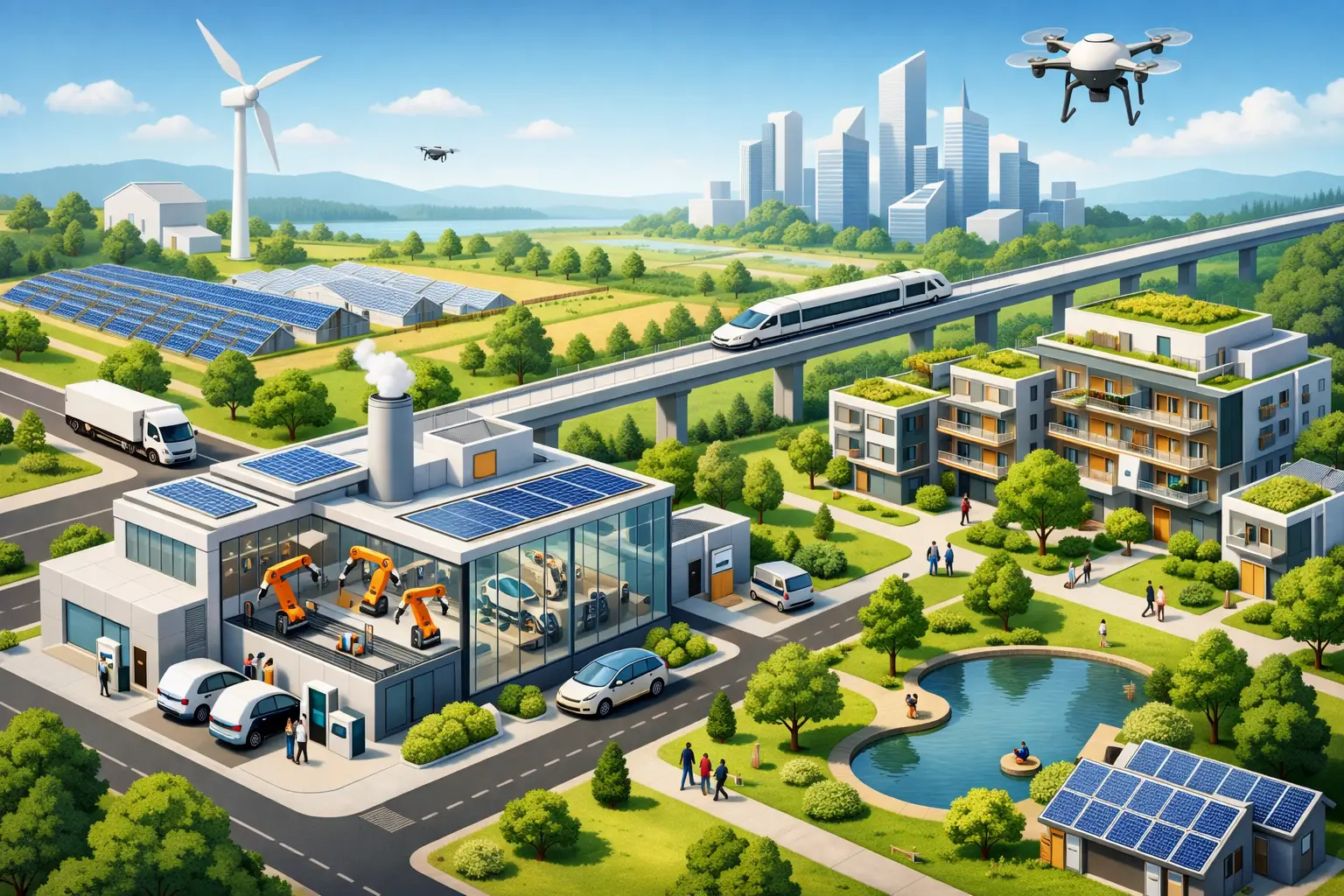
Industrial expansion is no longer decided by factory walls alone. The Future Of Integrated Factory Communities will be shaped by a harder business reality: manufacturers need infrastructure that supports production, talent, logistics, compliance, and long-term growth in one coordinated environment. That shift is changing what investors fund, where global manufacturers locate, and how industrial regions compete.
For decades, the standard industrial park followed a narrow logic. Provide land, basic utilities, and road access, then leave each occupier to solve the rest. That model is now under pressure. Advanced manufacturing depends on more than plot availability. It depends on stable power, specialized facilities, workforce access, supply chain resilience, R&D collaboration, ESG performance, and the ability to attract people who can build and operate high-value production lines.
Integrated factory communities answer that challenge by combining industrial infrastructure with the surrounding systems that make industry productive. This is not lifestyle branding for manufacturing. It is economic infrastructure with a wider operating logic.
Why the future of integrated factory communities matters now
The timing is not accidental. Global manufacturing is being reorganized by several forces at once. Clean-tech growth is increasing demand for specialized industrial zones. Semiconductor, EV, hydrogen, aerospace-adjacent, and renewable energy manufacturers require more technical utilities, stricter facility readiness, and more dependable logistics. At the same time, labor markets are tighter, ESG expectations are sharper, and boards are asking tougher questions about location strategy.
In that environment, isolated facilities create friction. Companies face longer ramp-up periods, fragmented service delivery, and rising hidden costs tied to commuting, housing, workforce turnover, utility uncertainty, and supplier distance. A site may look cost-effective on paper while becoming operationally expensive in practice.
That is why integrated factory communities are gaining strategic weight. They reduce the distance between production and the systems that support production. They allow a manufacturer to think beyond the initial lease or build cost and measure the full operating environment across a ten- to twenty-year horizon.
For investors, this matters because the best-performing industrial assets increasingly behave like ecosystems rather than standalone properties. Occupancy resilience, tenant retention, and long-term valuation improve when the surrounding environment helps businesses scale instead of forcing them to patch together solutions externally.
What defines an integrated factory community
An integrated factory community is not simply an industrial park with some retail attached. The distinction is structural. The model is built around a master-planned relationship between production, logistics, workforce life, innovation capacity, and social infrastructure.
At a minimum, that means purpose-built industrial assets are supported by residential options, healthcare access, education and skills pathways, retail services, hospitality, and mobility infrastructure. In more advanced versions, the ecosystem also includes cleanroom-ready spaces, sector-specific clusters, testing capacity, research partnerships, and shared innovation facilities that lower the cost of experimentation and commercialization.
This is especially important for manufacturers operating in sectors with strict production tolerances or fast technology cycles. A semiconductor supplier, an EV component producer, and an eVTOL manufacturer do not have identical infrastructure needs. A modern industrial ecosystem must accommodate that difference while still creating shared efficiencies across utilities, logistics, compliance, and talent development.
That is also why sector clustering matters. When related industries are planned together, suppliers, service providers, technical labor, and innovation partners can move faster. Shared infrastructure becomes more economical. Industrial knowledge compounds locally.
The operating advantages go beyond convenience
The strongest case for integrated communities is not convenience. It is performance.
First, talent attraction and retention become far more manageable. Advanced manufacturing competes for engineers, technicians, operators, and project managers who increasingly weigh quality of life alongside compensation. If housing, healthcare, retail, and education are disconnected from the workplace, employers absorb the cost through turnover, absenteeism, relocation friction, and reduced productivity. A better environment directly supports workforce stability. That is one reason articles such as Best Factory Communities For Workforce Retention and Employees Work More Efficiently in Good Environments are becoming central to industrial planning, not peripheral.
Second, speed to operation improves. When infrastructure is already aligned with manufacturing use cases, companies avoid months of rework around utilities, approvals, worker access, and support services. For sectors with narrow market windows, this matters. Delays in commissioning can erase the value of an otherwise attractive location.
Third, integrated communities support stronger ESG outcomes. That does not mean every project automatically becomes sustainable. It means the physical layout creates better conditions for resource efficiency, mobility planning, worker welfare, and governance visibility. A fragmented industrial zone often struggles to prove these outcomes at scale. A planned ecosystem has a better chance of embedding them into the development model from the beginning. The governance side of that equation is increasingly relevant for capital allocation, which is why ESG Governance For Industrial Investors speaks directly to the market shift.
Infrastructure depth will separate leaders from followers
Not every integrated community will succeed. The next generation of industrial hubs will be judged less by marketing language and more by infrastructure depth.
Manufacturers are becoming much more specific in what they require. High electrical load, water treatment capacity, logistics circulation, cold chain options, cleanroom readiness, testing environments, digital monitoring, customs efficiency, and multimodal connectivity are not optional in many sectors. If those elements are weak, the community model loses credibility.
That is why industrial decision-makers should look carefully at infrastructure quality before being persuaded by mixed-use claims. A residential component does not compensate for inadequate utility design. Hospitality does not solve logistics bottlenecks. A modern industrial ecosystem only works when its production backbone is strong enough to support future industries at scale.
This is also where regional competitiveness becomes sharper. Locations that can pair lower operating costs with world-class infrastructure and access to ports, airports, and regional markets will have a clear advantage. For occupiers serving GCC demand while maintaining global supply chain reach, this combination is strategically valuable. The logic is straightforward: if the ecosystem lowers cost but raises operational reliability, it becomes more than a site. It becomes a growth platform.
The future of integrated factory communities is sector-led
The future of integrated factory communities will not be generic. It will be led by sectors that need specialized environments and cannot afford fragmented industrial growth.
EV manufacturing is a clear example. Producers need component ecosystems, battery-related safety planning, testing support, logistics access, and labor pools that can adapt as the product evolves. Hydrogen mobility adds another layer through safety, storage, transport, and regulatory complexity. Semiconductor manufacturing raises the bar further with contamination control, precision utilities, and ultra-reliable support systems. eVTOL production introduces yet another set of requirements around advanced materials, engineering talent, certification pathways, and prototype-to-production transitions. These are not businesses that can simply drop into any standard industrial estate.
The winning communities will therefore be those that understand sector requirements in advance and build for them with intention. Shared innovation assets can play an important role here. If testing, prototyping, and research capacity are available within the wider ecosystem, companies can shorten development cycles and reduce capital duplication. That is one reason Cooperative Innovation Centers Cut Cost and Speed aligns closely with how next-generation industrial hubs are being structured.
Why this model is becoming more attractive to capital
Institutional capital tends to favor industrial models that can demonstrate durability. Integrated communities are attractive because they diversify value across multiple linked demand drivers. Industrial occupancy remains central, but it is reinforced by residential, commercial, social, and innovation infrastructure that supports the tenant base.
There are trade-offs, of course. These projects are more complex to plan and require stronger execution discipline. Phasing matters. Governance matters. Utility planning must be ahead of demand, not behind it. Poorly coordinated mixed-use development can create congestion or dilute industrial focus.
But when the model is executed properly, it creates stickier ecosystems. Tenants are less likely to relocate when the surrounding environment is solving real operational problems. Strategic partners are more willing to commit when they can see long-term infrastructure logic. Investors gain exposure to an industrial platform with broader resilience than a single-asset proposition.
That is why the conversation is shifting from industrial real estate to industrial ecosystems. The market is no longer just asking where a factory can be built. It is asking where an industry can grow.
What decision-makers should evaluate next
For executives assessing expansion in the Middle East or other high-growth markets, the right question is not whether integrated factory communities are the future. The better question is which communities are being built with enough industrial discipline to deserve that label.
Look for evidence of sector specialization, not broad promises. Examine power, logistics, and facility readiness in detail. Assess whether the workforce ecosystem is strong enough to support recruitment and retention. Test the ESG framework for substance, not branding. Review how innovation, education, and industrial operations connect in practice.
The communities that will lead the next decade are the ones that treat manufacturing as the anchor and build everything else around its success. That is where the future works, where capital compounds with more confidence, and where industrial growth becomes easier to sustain than to replicate.
