
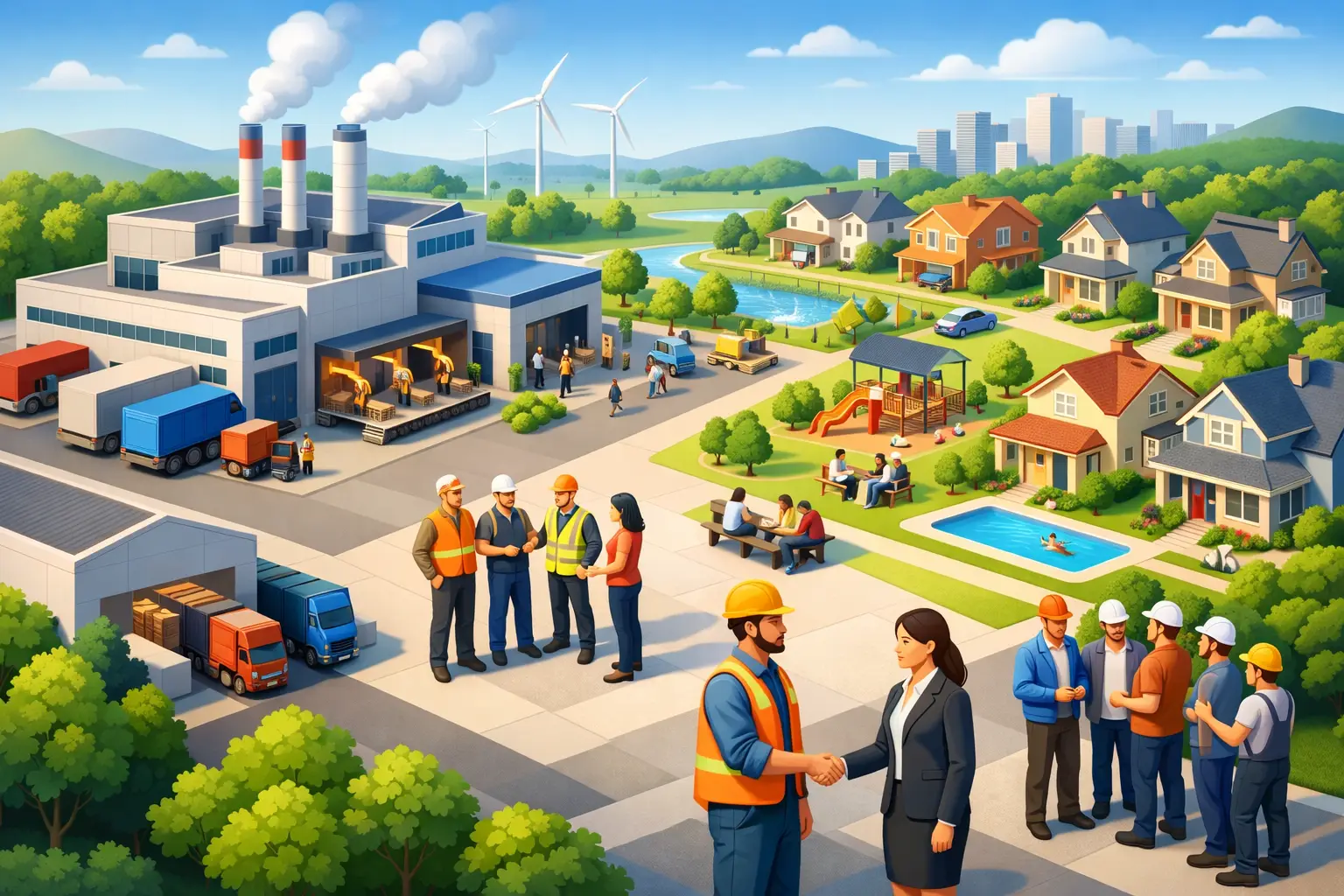
Labor churn is no longer a soft variable in manufacturing economics. It is a direct drag on throughput, quality stability, training costs, safety performance, and expansion readiness. That is why the Best Factory Communities For Workforce Retention are not built around factory sheds alone. They are designed as operating environments where people can live, move, learn, access care, and build long-term careers within reach of production.
For industrial investors and manufacturers, this shift matters because retention is now an infrastructure question as much as an HR one. If a site can attract labor but cannot sustain workforce continuity, the hidden cost appears later in absenteeism, re-hiring cycles, delayed commissioning, and lower line efficiency. The strongest factory communities reduce those pressures by treating workforce support as part of the industrial platform itself.
What makes a factory community retain workers
A factory community retains workers when it removes friction from daily life and creates a credible path for long-term employment. In practice, that means the industrial base is supported by residential options, healthcare access, transport links, food and retail services, training pipelines, and a surrounding social environment that makes relocation or daily commuting sustainable.
This is where many conventional industrial parks fall short. They may offer land, utilities, and warehouse space, yet still leave tenants to solve labor stability on their own. The result is a fragmented model where production capacity exists, but workforce resilience does not. For advanced manufacturing, that gap is expensive.
The best communities are different because they reduce the distance between work and life. They shorten commutes, lower living friction, improve employee well-being, and make it easier for families and skilled specialists to commit to a location. For operators in semiconductors, EV manufacturing, hydrogen mobility, aerospace-adjacent industries, and clean-tech production, that continuity can determine whether scale-up happens on schedule.
Best Factory Communities For Workforce Retention share five traits
The first is integrated land use. Industrial activity works better when housing, healthcare, education, hospitality, and daily services are not treated as afterthoughts. Workers stay longer when life outside the gate is functional. Senior technical staff stay longer when the area supports family needs, schooling, and quality of life.
The second is workforce mobility. A site does not need every employee to live next door, but it does need reliable movement between residential zones, production areas, logistics corridors, and nearby urban centers. Commute fatigue is one of the most underpriced risks in retention.
The third is skills continuity. Communities with training centers, technical education partnerships, and apprenticeship pathways give employers a renewable labor pipeline instead of a constant replacement problem. Retention improves when workers can see advancement, not just employment.
The fourth is cost realism. A factory location may look efficient on paper, but if nearby housing is scarce or expensive, employers absorb the cost later through wage pressure, transport subsidies, or turnover. Sustainable labor economics depend on the full cost of workforce life, not just the rent on industrial space.
The fifth is credibility of place. People commit to communities that appear permanent, well planned, and economically relevant. A credible environment signals stability. That matters to blue-collar operators, engineers, technical managers, and international staff alike.
Why industrial retention is now a master-planning issue
For years, workforce retention was framed as a management challenge inside the factory. Better supervisors, better incentives, better scheduling. Those still matter, but they no longer solve the whole problem. Manufacturing workforces now expect more from location strategy because competition for labor has intensified, and specialized sectors require workers who are expensive to replace.
In high-value manufacturing, retention is closely tied to ecosystem design. Cleanroom operators, line technicians, quality specialists, process engineers, maintenance teams, and logistics staff all depend on external systems that shape attendance and stability. If education is distant, healthcare is fragmented, and housing is misaligned with wages, the burden shifts back to the operator.
That is why integrated industrial ecosystems are gaining strategic relevance. They align operational infrastructure with human infrastructure. This is not a branding exercise. It is a productivity strategy. A well-planned ecosystem can improve time-to-hire, lower attrition during ramp-up, and create a stronger foundation for second production lines. That logic is explored further in the Integrated Industrial Ecosystem Guide.
The difference between labor supply and labor stickiness
Many sites can point to a large labor catchment. Fewer can prove labor stickiness. The distinction is critical.
Labor supply means workers are available in the region. Labor stickiness means they remain engaged over time because the factory community supports daily life, career progression, and household needs. Investors often overvalue the first and underestimate the second.
A location with abundant labor but weak community infrastructure may fill positions quickly, then struggle with churn within six to twelve months. That is especially risky in sectors where training periods are long and quality failure is costly. By contrast, a factory community that supports retention compounds value over time. Training investments stay inside the operation longer. Shift reliability improves. Team leaders emerge from within. Expansion becomes less dependent on constant external recruitment.
What investors should evaluate before choosing a manufacturing base
Executives assessing a site for long-term manufacturing should ask a broader set of questions than land cost and utility readiness. They should examine whether the surrounding environment supports a durable workforce model.
Housing availability is one of the first tests. Not luxury housing – practical, scalable accommodation for workers, supervisors, and managers across income bands. Then comes healthcare access, because untreated health issues show up quickly in attendance and productivity. Education matters too, especially when a project depends on imported specialists or family relocation.
The next test is whether the development model is coherent. Are industrial, logistics, residential, and service components planned together, or are they being improvised over time? Coherence matters because fragmented growth creates hidden operating friction.
Investors should also assess whether the site aligns with ESG expectations. Workforce well-being, access, livability, and community integration increasingly shape investor scrutiny and tenant reputation. A stronger position on this front can support both talent outcomes and institutional confidence. The governance side of that equation is discussed in ESG Governance For Industrial Investors.
Why sector-specific communities outperform generic industrial zones
Not all manufacturing communities are equally effective. Generic industrial zones may work for low-complexity operations with highly flexible labor models. They are less effective for advanced sectors that depend on technical specialization, compliance, clean operations, and repeatable workforce performance.
Sector-specific communities create stronger retention because they cluster relevant suppliers, technical talent, training needs, and support services around a defined industrial mission. A hydrogen mobility cluster does not need the same workforce ecosystem as light assembly. Semiconductor-ready environments have different labor, utility, contamination-control, and housing considerations than conventional warehousing.
This is where next-generation hubs create an advantage. When communities are designed around advanced manufacturing sectors from the start, the workforce model becomes more intentional. Education pathways, vendor support, residential planning, and infrastructure investment can all be aligned with the industries that will actually occupy the site.
A live-work-innovate model changes the economics of retention
The strongest answer to retention is not a bigger hiring budget. It is a better industrial environment.
A live-work-innovate model changes the equation because it integrates production with the systems that sustain people and enterprise growth. Instead of treating workforce support as an external challenge, it is built into the development logic. That means workers have greater access to daily necessities, employers face less operational disruption, and investors gain a more resilient asset ecosystem.
This model is particularly relevant in growth corridors where manufacturers want regional market access without the labor instability often found in isolated industrial sites. It also supports innovation-intensive sectors where collaboration, R&D, technical recruitment, and cross-functional talent matter as much as utility infrastructure.
One reason this approach has gained traction is that it serves more than retention alone. It also supports job creation, industrial diversification, and long-range economic value. That broader development logic is reflected in Rana Group Focus on Job Creation and Future Industries, where workforce outcomes are tied to future-facing sectors rather than short-cycle industrial occupancy.
The real benchmark for the best factory communities
The real benchmark is not whether a factory community looks impressive in a brochure. It is whether it lowers workforce friction at scale while supporting output, compliance, and expansion over time.
The best factory communities for workforce retention create a place where industrial labor is not trapped between long commutes, poor services, and limited mobility. They create conditions for continuity. That continuity feeds production performance, makes expansion more credible, and strengthens investor confidence in the location itself.
For manufacturers choosing where the future works, the question is no longer whether workforce retention matters. The question is whether the factory community was designed to deliver it from day one.

[…] commutes erode reliability. Limited housing options weaken recruitment. Poor access to healthcare and schooling can make relocation unattractive for […]
[…] most durable clusters also reduce friction outside the factory gate. Workforce housing, healthcare, education, and daily services are not soft amenities in this context. They are part of […]
[…] If the destination lacks housing, healthcare access, education, or daily convenience for employees, workforce retention can become a post-move problem. That turns relocation into a recurring labor cost issue rather than […]
[…] with nearby housing, healthcare, education, and daily services can reduce workforce friction and improve retention. An investor entering a hub designed around long-term ESG alignment gains a stronger position with […]