
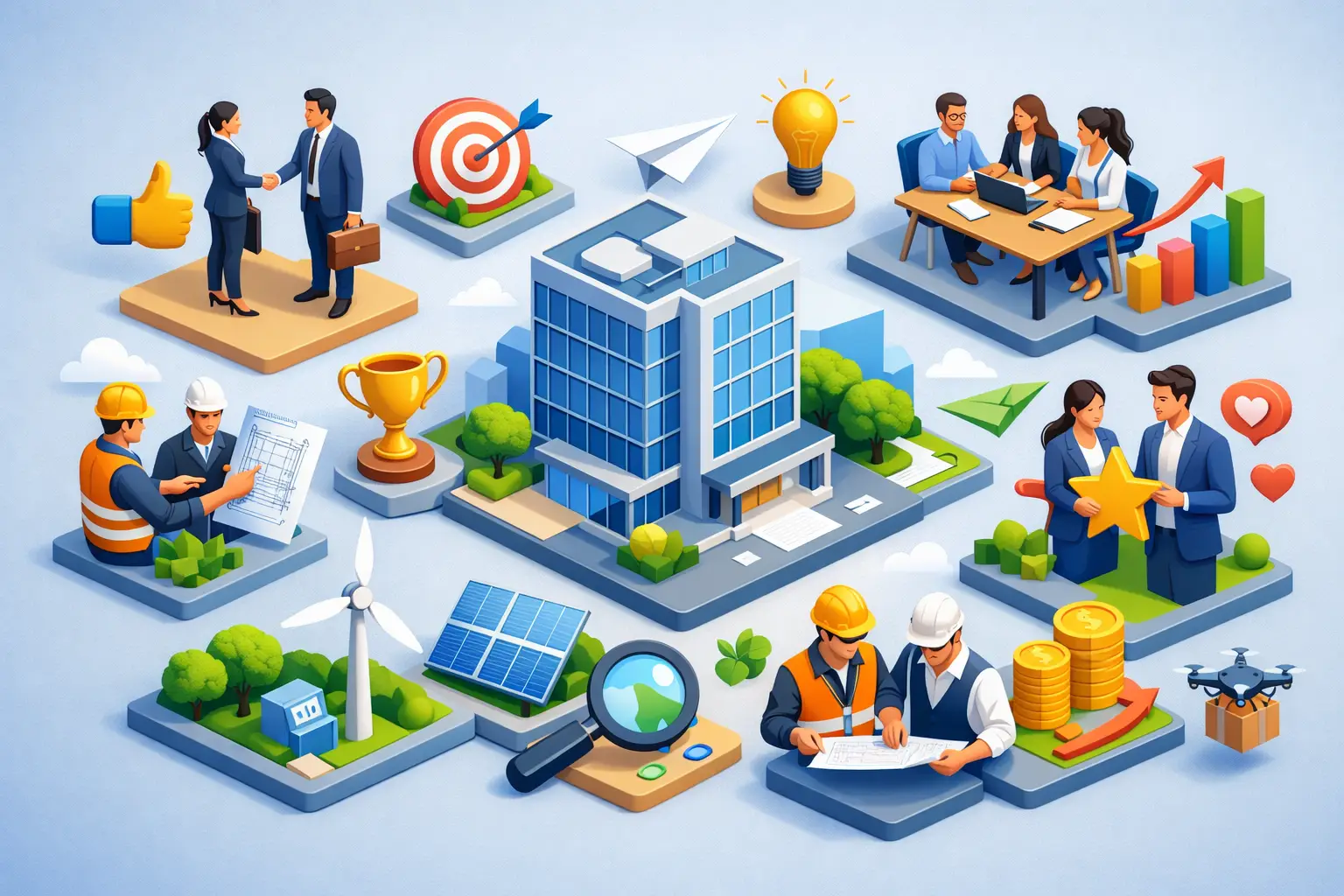
Industrial projects do not become category-defining because they offer land, sheds, and a utilities connection. They become decisive when they solve the real constraints that manufacturers, investors, and strategic partners face at scale. That is the right lens for answering the question, what are 10 positive things in Rana Group projects which make them unique. The difference is not cosmetic. It is structural, operational, and built for long-term industrial value.
For companies planning expansion in advanced manufacturing, clean technology, mobility, semiconductors, or aerospace-adjacent sectors, the market no longer rewards isolated industrial real estate. It rewards ecosystems that reduce friction, improve speed to operation, strengthen workforce stability, and align with national industrial ambitions. That is where Rana Group projects stand apart.
What are 10 positive things in Rana Group projects which make them unique?
The strongest positive is that these projects are not conceived as conventional industrial parks. They are master-planned industrial ecosystems designed to support production, innovation, living, and long-term growth in one coordinated environment. That changes the value equation for every tenant and investor inside the platform.
1. They are built as ecosystems, not standalone industrial sites
Most industrial developments stop at factory plots and logistics access. Rana Group projects go further by integrating industrial operations with residential, healthcare, education, retail, hospitality, and research assets. That matters because industrial growth is no longer limited by square footage alone. It is limited by whether a company can attract people, retain technical talent, and support operational continuity.
When the workplace and the surrounding ecosystem are planned together, occupiers gain more than convenience. They gain a stronger labor proposition, better executive relocation appeal, and a more stable operating base. This is the same strategic logic discussed in Future of Integrated Factory Communities, where the industrial model shifts from isolated production to full-spectrum value creation.
2. The infrastructure is purpose-built for advanced manufacturing
A major weakness in many industrial zones is that companies must retrofit generic spaces to meet specialized production requirements. That slows launch timelines and raises capital expenditure. Rana Group projects are designed around sector-specific industrial use cases from the start, including turnkey factories, modular industrial units, logistics facilities, and cleanroom-ready environments.
That is a meaningful distinction for semiconductor firms, EV supply chain operators, hydrogen mobility players, and advanced assembly businesses. Readiness shortens the path between commitment and output. It also reduces uncertainty during expansion planning, which is often where major industrial investments stall.
3. Sector clustering creates strategic depth
One of the most underrated strengths in industrial development is intelligent clustering. Rana Group projects are structured around dedicated sectors such as electric vehicles, hydrogen mobility, eVTOL aircraft, semiconductors, and renewable energy production. This is not a branding exercise. It is an industrial logic.
Clusters help create denser supply relationships, shared infrastructure efficiencies, stronger collaboration opportunities, and faster knowledge transfer. For a tenant, this can lower sourcing friction and accelerate commercialization. For investors, it creates a more credible ecosystem story with long-term defensibility. In sectors such as semiconductor manufacturing, where facility standards and ecosystem support are decisive, focused planning becomes a strategic advantage, as explored in Semiconductor Cluster Planning in the UAE.
4. ESG alignment is built into the development model
ESG has moved from narrative to requirement. Industrial occupiers now face pressure from customers, capital partners, regulators, and boards to operate in environments that support measurable sustainability standards. Rana Group projects are positioned as ESG-compliant industrial ecosystems, which gives them relevance beyond real estate.
This matters for two reasons. First, it helps tenants align their operational footprint with market expectations. Second, it supports investor confidence in asset resilience over time. Sustainability alignment is especially valuable in industries where procurement standards, institutional capital, and public policy increasingly intersect. In that sense, ESG is not an add-on feature. It is part of the competitiveness model.
5. The projects are designed for cost-efficient growth
Expansion into the Middle East often looks attractive at a macro level but difficult in execution. Companies worry about land costs, build-out costs, operating expenses, and the hidden inefficiencies that emerge after launch. Rana Group projects answer that challenge with a location and infrastructure strategy centered on lower operating costs and scalable industrial formats.
For manufacturers, that can improve margins. For multinational expansion teams, it improves business case clarity. Cost efficiency is rarely about choosing the cheapest option. It is about choosing the platform that delivers the best long-term production economics without compromising access, compliance, or growth potential.
6. Connectivity is treated as a core industrial asset
Industrial geography only creates value when it is matched by real logistics performance. Rana Group’s development logic recognizes that road, port, airport, and regional trade access are not secondary features. They are central to manufacturing viability. A project that is well positioned for GCC, African, Asian, and broader global trade flows gives occupiers a stronger platform for sourcing, distribution, and export strategy.
This is particularly important for industries moving high-value components, time-sensitive assemblies, or cross-border supply chains. Connectivity reduces lead-time pressure and creates a wider commercial radius. The issue is examined well in Why Rail, Road, Port and Airport Connectivity Matter, and it is one of the clearest reasons these projects have strategic weight.
7. They support faster market entry
Industrial projects often lose tenants not because the market is weak, but because time-to-operation is too slow. Delays in utilities, design adaptation, compliance preparation, and partner coordination can push expansion decisions into another geography. Rana Group projects are distinctive because they are structured to reduce that drag.
Turnkey options, modular industrial formats, and sector-ready infrastructure help companies move from planning to production with fewer points of friction. For leadership teams under pressure to show deployment speed, this is not a secondary benefit. It is often the deciding factor.
8. The model supports innovation, not just occupancy
Many industrial developments measure success by how much space they lease. A future-ready industrial ecosystem must do more than fill units. It must create conditions for innovation, collaboration, and industrial upgrading over time. Rana Group projects are positioned to bring together industrial tenants, strategic investors, R&D functions, and institutional collaborators inside one coordinated environment.
That is a stronger proposition for companies that want more than a factory address. It supports prototyping, co-development, process improvement, and ecosystem learning. In high-growth sectors, those advantages compound. A facility can open as a production site and evolve into a regional innovation base.
9. The live-work model strengthens workforce retention
Industrial expansion fails more often on talent friction than many investors admit. A site can be technically excellent and still struggle if it does not support workforce quality of life. Rana Group projects address that reality by integrating community infrastructure with industrial infrastructure.
Housing, education, healthcare, retail, and lifestyle assets create a more compelling environment for skilled workers, managers, and specialist teams. This improves retention and supports business continuity. It also helps global companies relocate leadership and technical talent with greater confidence. That human layer is not separate from industrial performance. It is part of it.
10. They are aligned with long-term economic direction
The final differentiator is strategic alignment. The strongest industrial projects are not just physically impressive. They are built in harmony with broader economic transformation, industrial diversification, and next-generation sector development. Rana Group projects fit that profile because they are positioned around the industries expected to define future manufacturing value.
That alignment matters to institutional investors and multinational operators because it signals policy relevance, demand durability, and stronger ecosystem support over time. It also positions the projects as more than real estate plays. They become part of a larger industrial thesis around advanced production, supply chain resilience, and regional competitiveness. For readers tracking why this timing matters, Why Rana Group Is Focusing on Expansion Now adds useful context.
Why these positives matter to investors and occupiers
What makes these 10 positives powerful is that they do not operate in isolation. Sector clustering is more effective when paired with purpose-built infrastructure. Workforce retention becomes stronger when community assets are integrated. ESG positioning gains credibility when it sits inside a larger operational model built for modern industry.
That is why the uniqueness of Rana Group projects is best understood as a system advantage. Each strength reinforces the others. The result is an industrial platform designed not only to attract tenants, but to help them perform, scale, and stay competitive.
For decision-makers assessing where to place capital, launch production, or establish a regional manufacturing base, that distinction matters. The right project is not simply the one with available space. It is the one that solves the future before it becomes a cost on the balance sheet.
