
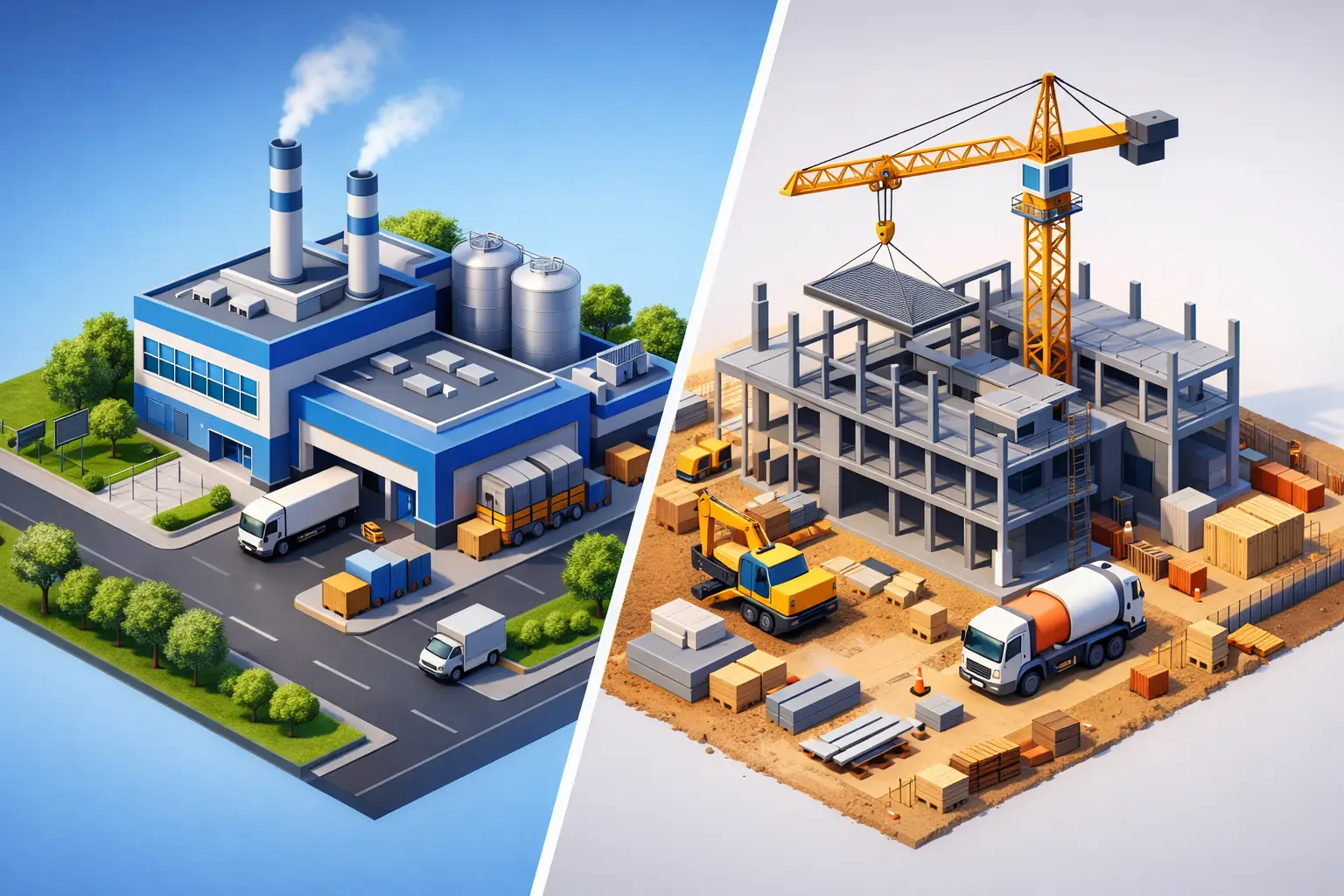
Speed to market can determine whether an expansion captures demand or arrives after the window has shifted. That is why the turnkey factory vs built to suit decision matters far beyond real estate. For manufacturers entering a new region, scaling a production line, or establishing a strategic export base, this choice affects capital deployment, commissioning timelines, operating efficiency, and long-term control.
The right answer is rarely ideological. It depends on what you are building, how fast you need to be live, how specialized your production environment must be, and how much development risk your organization is willing to carry.
What turnkey factory vs built to suit really means
A turnkey factory is a ready-to-operate industrial facility delivered with the core building systems, utilities, and operational infrastructure needed for rapid occupancy. In many cases, it is designed around proven manufacturing requirements and can be fitted out with limited adaptation. The value is straightforward: compress the path from lease signing to production.
A built-to-suit facility is developed around the precise technical, process, and operational requirements of a specific tenant. The shell, structural grid, loading configuration, utility capacity, compliance specifications, workflow layout, and expansion logic are shaped by the occupier’s business model from the outset. The value here is not speed alone. It is strategic fit.
The distinction is simple on paper, but the commercial implications are significant. One model prioritizes readiness. The other prioritizes precision.
Why this decision carries strategic weight
Industrial leaders do not choose facilities in isolation. They choose operating platforms. A plant is tied to logistics performance, labor access, ESG targets, utility resilience, supply chain coordination, and the ability to add future lines without disrupting current output.
That is why the turnkey factory vs built to suit choice should be evaluated as part of market-entry strategy, not only as a property transaction. A fast solution that constrains process flow may create hidden costs for years. A highly customized facility that takes too long to deliver may delay contracts, postpone revenue, and leave market share on the table.
For advanced manufacturing sectors, the stakes rise further. Semiconductor-adjacent production, EV components, hydrogen mobility systems, aerospace-adjacent assembly, and renewable energy equipment often require tighter environmental control, higher power loads, heavier floor loading, and more specialized utility planning than conventional light industry.
When a turnkey factory makes the strongest business case
A turnkey factory is often the better model when time is the dominant variable. If demand is active, customer commitments are already in place, or a company needs a regional base quickly, a ready industrial facility can materially reduce execution lag.
This model also works well when production requirements are sophisticated but not highly unusual. Many manufacturers do not need a blank-sheet design. They need dependable industrial specifications, strong utility access, quality loading and circulation, and room for equipment installation. In those cases, over-designing the facility can tie up capital and slow activation without generating a meaningful operational advantage.
There is also a portfolio logic to turnkey space. Companies testing a new geography, launching a regional assembly operation, or localizing part of a supply chain may want speed and optionality before committing to a fully bespoke plant. A turnkey asset allows them to establish presence, recruit teams, validate the market, and begin production with lower development complexity.
The trade-off is customization. Even a high-quality turnkey facility may require compromises in equipment layout, process adjacency, or future line configuration. Those compromises may be minor for one occupier and unacceptable for another.
When built to suit creates more enterprise value
Built to suit becomes more attractive when the production environment itself is a source of competitive advantage. If the facility needs to support specialized airflow, cleanroom readiness, precision environmental controls, unusual vertical clearances, hazardous material protocols, high utility redundancy, or custom process sequencing, purpose-led design can protect both output quality and operational efficiency.
It is also the stronger model for manufacturers planning long-term market commitment. If a company expects to anchor a region for ten, fifteen, or twenty years, the value of exact-fit infrastructure becomes easier to justify. Better process flow, fewer retrofits, cleaner compliance pathways, and integrated expansion capacity can offset the longer delivery timeline.
Built to suit also gives leadership teams greater confidence in future scalability. Instead of adapting growth to the building, the building is designed around the growth roadmap. That matters when expansion will likely involve additional lines, heavier utilities, automation upgrades, or tighter quality requirements.
The challenge is obvious: built to suit requires more alignment, more design coordination, and more patience. It also demands stronger upfront clarity from the occupier. If internal specifications are still moving, a bespoke development can become slower and more expensive than initially planned.
The four variables that should drive the decision
The first variable is timeline. If your revenue model depends on being operational within a compressed window, turnkey typically has the advantage. The second is technical specificity. The more specialized the production environment, the more built to suit starts to make sense.
The third is capital discipline. Some companies want to preserve flexibility and reduce upfront complexity during early-stage regional expansion. Others are willing to invest more time and planning in exchange for long-horizon efficiency. The fourth is strategic certainty. If your market thesis is proven and your production model is stable, custom infrastructure is easier to defend. If you are still validating product-market fit or regional demand, speed and adaptability may carry more value.
These variables do not operate independently. A company can need speed and still require technical customization. Another may prefer lower complexity but need expansion-ready utility planning. That is why the best developers and industrial ecosystems do not force occupiers into a rigid format. They structure options around sector realities.
Looking beyond the building envelope
Too many facility decisions are made by comparing rent, shell specifications, and handover dates. Serious industrial expansion requires a wider lens.
A turnkey factory inside a weak industrial environment may still create operational drag if logistics are fragmented, workforce access is difficult, or adjacent services are missing. A built-to-suit plant in the wrong location can become an expensive exercise in isolation.
The better question is this: what ecosystem surrounds the asset? Manufacturers increasingly need more than floor area. They need integrated logistics capability, sector-compatible infrastructure, ESG alignment, workforce support, and an operating environment that helps retain talent as well as equipment. This is especially true for companies entering the Middle East or building supply chain resilience across multiple markets.
That broader context is where industrial hubs create disproportionate value. In a master-planned environment, the facility decision is strengthened by what sits beyond the factory gate – residential access, healthcare, education, retail, hospitality, R&D interfaces, and the policy and infrastructure logic of the wider platform. Rana Group has built its proposition around that reality: industrial growth is more durable when production infrastructure is connected to a full live-work-innovate ecosystem.
A practical lens for advanced manufacturers
For an EV component producer, a turnkey factory may be ideal if the process is standardized and the priority is launching regional supply quickly. For a semiconductor-related tenant requiring cleanroom-ready planning and tightly controlled environments, built to suit may be the more disciplined route.
For hydrogen mobility equipment, the answer may depend on utility intensity, safety protocols, and future capacity staging. For aerospace-adjacent manufacturing, structural loading, precision layout, and compliance requirements may tilt the decision toward customization.
This is why broad statements about one model being better than the other usually miss the point. Industrial real estate is not a generic category. It is an operational instrument. The more complex the manufacturing process, the less useful one-size-fits-all logic becomes.
What smart decision-makers ask before choosing
The most effective occupiers start with operational outcomes, not developer terminology. They ask how quickly they need to commission, what specifications are truly non-negotiable, what can be standardized, how future expansion is likely to unfold, and whether the surrounding ecosystem will strengthen performance over time.
They also separate preferences from requirements. A long wish list can push a project toward built to suit when a high-quality turnkey facility would perform just as well. On the other hand, underestimating technical needs can create retrofit costs, commissioning delays, and production inefficiencies that are far more expensive than getting the design right from day one.
That discipline matters because the best facility decision is not the one with the most features. It is the one that matches the business plan with the least friction and the highest strategic return.
The strongest industrial expansions are built on fit – fit between timeline and facility, process and infrastructure, plant and ecosystem. If you approach the turnkey factory vs built to suit question through that lens, the choice becomes clearer, and the investment becomes harder to regret.

Aw, this was a very good post. Spending some
time and actual effort to make a great article… but what can I say… I
put things off a whole lot and never seem to get nearly anything done.