
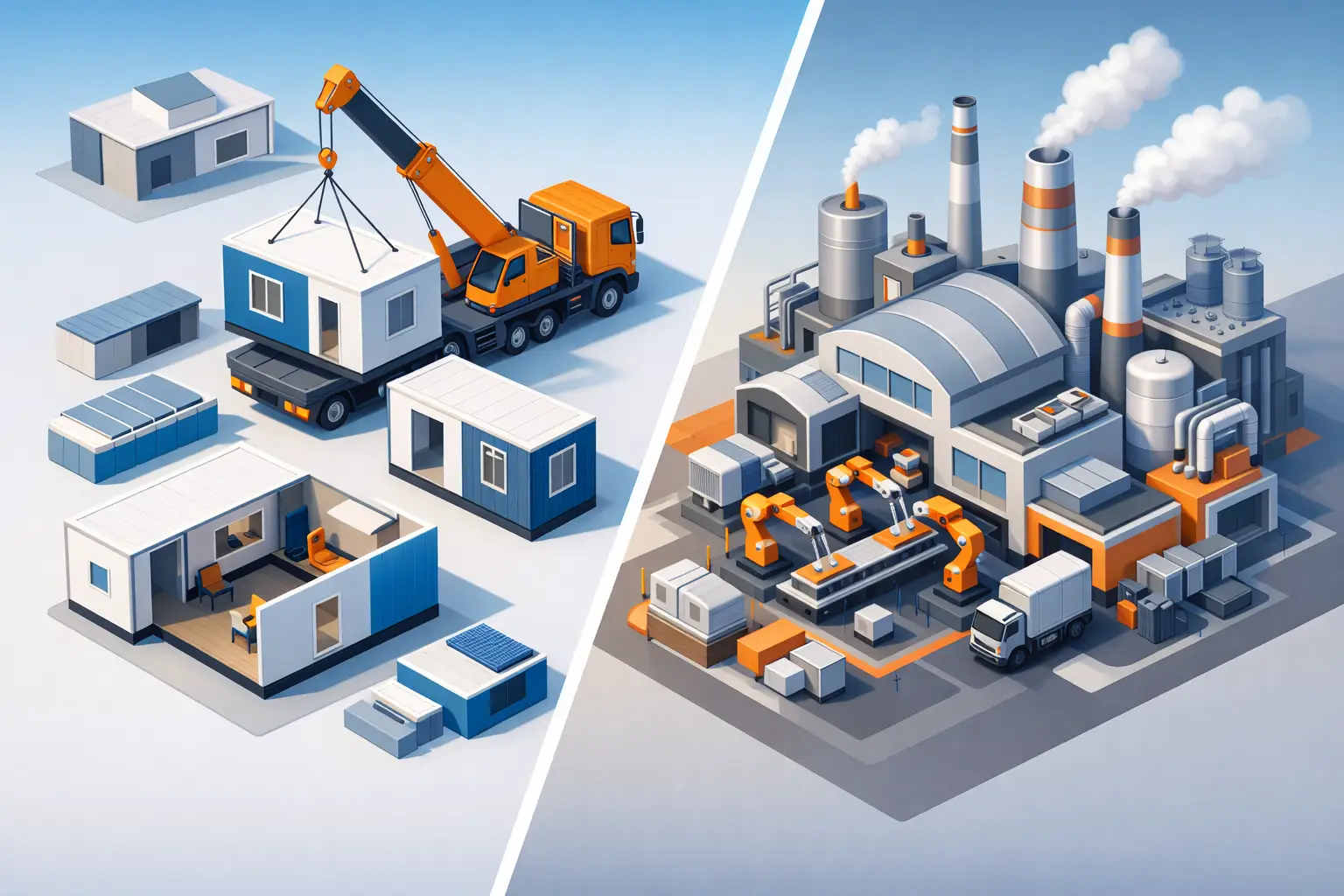
When a manufacturer enters a new market, the facility decision shapes far more than construction timelines. The choice between modular units vs custom factories affects capital deployment, operational agility, compliance pathways, workforce strategy, and the speed at which production can begin generating revenue. For industrial leaders expanding into advanced sectors, this is not a real estate question. It is a strategic operating decision.
Why modular units vs custom factories is a board-level decision
At first glance, the distinction seems simple. Modular units promise speed, lower upfront commitment, and faster occupancy. Custom factories offer design precision, process alignment, and the ability to build around exact production requirements. But the real decision sits deeper.
A facility is a manufacturing asset. It influences throughput, utility performance, equipment layout, quality control, environmental compliance, and future expansion. In sectors like EV components, hydrogen systems, semiconductor-adjacent production, and renewable energy manufacturing, the wrong facility model can introduce constraints that are expensive to reverse.
That is why serious industrial occupiers evaluate facilities the same way they evaluate supply chain strategy or market entry risk. The right answer depends on the production profile, the investment horizon, and how quickly the business needs to scale.
Where modular units make strategic sense
Modular industrial units are built for speed and flexibility. They are especially effective when a company needs to establish an operating base quickly, validate regional demand, or begin light-to-mid-scale manufacturing without waiting for a fully bespoke build.
For market entry, that speed matters. A modular unit can compress the gap between commitment and production launch. That means earlier hiring, faster equipment installation, quicker customer servicing, and shorter time to revenue. In fast-moving sectors, months matter. Delayed production can mean missed contracts, slower regulatory traction, or weaker first-mover positioning.
Modular units also reduce initial exposure. Instead of committing significant capital to land, design, and long construction cycles, a manufacturer can begin with a right-sized footprint and scale as demand becomes clearer. This is often attractive for companies entering the GCC, testing a distribution-linked assembly model, or establishing localized production in response to procurement or policy shifts.
There is another advantage that matters to operators more than developers often admit: operational optionality. If production volumes change, if the product mix shifts, or if a regional strategy evolves, modular space is easier to adapt than a factory designed around assumptions made years earlier.
That said, modular does not mean generic. Well-planned modular units can support serious industrial use, especially when they sit inside an ecosystem with access to power, logistics, workforce amenities, and expansion pathways. The value is not just the box. It is the platform around it.
When custom factories become the smarter investment
Custom factories are the right answer when production demands precision that standardized space cannot support. Heavy manufacturing lines, specialized utility loads, strict contamination controls, unique process flows, and integrated automation systems often require a purpose-built environment from day one.
In these cases, customization is not about prestige. It is about performance. Equipment foundations, ceiling clearances, HVAC design, cleanroom readiness, fire and life safety planning, heavy vehicle circulation, loading sequences, and environmental controls all affect output quality and operating efficiency.
A custom factory also makes sense when a company has confidence in long-term volume and a clear production roadmap. If the operation is expected to run at scale for years, the efficiency gains from a tailored layout can justify the longer timeline and higher upfront investment. Reduced process friction, better material flow, lower energy waste, and fewer retrofit costs can improve the economics over the life of the asset.
For advanced manufacturers, compliance is another major factor. Certain industries cannot compromise on facility specifications. Semiconductor processes, battery technologies, aerospace-adjacent systems, and regulated clean-tech production often require built-in conditions that are difficult to retrofit into a standard shell. In these situations, custom design is often the lower-risk path, even if it is the slower one.
The real trade-off: speed now or optimization later
The strongest argument for modular units is speed. The strongest argument for custom factories is fit. Most expansion decisions sit between those two priorities.
If a business needs to enter a market quickly, secure contracts, prove local demand, and build a regional team, modular units can be the more intelligent move. They support momentum. They also preserve flexibility in uncertain environments, which matters when supply chains, policy incentives, and export routes are still evolving.
If the business already has committed demand, specialized production requirements, and a multi-year operating horizon, custom factories may create stronger long-term economics. The facility can be designed around output targets rather than adapted around constraints.
This is where many companies make a costly mistake. They assume that the most advanced operation automatically requires a custom factory. Not always. Some businesses benefit more from launching in modular space and moving into a bespoke facility once production data, utility needs, labor performance, and market volumes are proven. Others lose time and money by forcing specialized manufacturing into space that was never designed for it.
The right sequence matters as much as the right format.
Cost is more than construction cost
Capital expenditure tends to dominate early discussions, but direct build cost tells only part of the story. The more useful comparison includes time, risk, retrofitting, utilities, productivity, and future expansion.
Modular units often require less capital upfront, but if the operation later needs significant adaptation, the economics can shift. Custom factories typically demand a larger initial commitment, yet they may lower operational inefficiencies over time. Neither model is automatically cheaper. Cost depends on how closely the facility matches the production model.
Leaders should also account for the cost of delay. A slower factory delivery timeline can defer revenue, postpone customer onboarding, and create supply chain inefficiencies. In competitive sectors, delay has a strategic price. On the other hand, rushing into a facility that cannot support target quality, automation, or compliance can create recurring operational penalties.
The better question is not which option costs less. It is which option creates stronger manufacturing economics over the period that matters to the business.
Modular units vs custom factories for high-growth sectors
For high-growth industrial sectors, the facility decision is often tied to uncertainty. Product designs change. Supplier relationships evolve. Regulatory frameworks mature. Regional demand patterns become clearer over time. That makes flexibility valuable.
In EV supply chains, for example, early-stage entrants may prioritize speed to market and expandable assembly space. In hydrogen mobility or renewable energy systems, companies may need room to pilot, certify, and scale in phases. In these contexts, modular units can support a staged growth model.
By contrast, operations with sensitive process environments or heavy infrastructure dependency may need custom delivery from the start. Semiconductor-related manufacturing, certain advanced materials lines, and tightly automated production systems are less forgiving. The facility has to serve the process, not the other way around.
What matters most is whether the physical environment supports the commercial strategy. A facility should not trap a fast-growing business in a rigid footprint, and it should not force a precision-led operation to compromise on performance.
The ecosystem question most comparisons miss
Too many facility comparisons focus only on the building. Industrial performance depends on the surrounding ecosystem as much as the shell itself.
A modular unit inside a weak industrial environment can create friction around logistics, talent retention, permitting, and utility reliability. A custom factory in an isolated location can still underperform if the workforce, supplier network, or supporting infrastructure are misaligned. The strongest manufacturing platforms integrate production space with logistics access, compliance-ready infrastructure, workforce support, and room for sector clustering.
That is why the best industrial developments are not simply offering square footage. They are building environments where production can scale with fewer structural barriers. For occupiers evaluating long-term regional positions, that broader context often matters more than whether the first facility is modular or custom.
What decision-makers should ask before choosing
The most effective facility decisions usually begin with five questions. How fixed is the production process? How quickly must operations begin? What level of utility and compliance customization is essential? How certain is the long-term volume forecast? And can the chosen site support expansion without forcing relocation?
If the answers point toward uncertainty, speed, and phased growth, modular units often provide the stronger entry strategy. If they point toward stable demand, complex processes, and high infrastructure specificity, custom factories may be the wiser long-term asset.
In some cases, the strongest path is hybrid. A company launches in modular space, establishes customers and teams, then transitions into a purpose-built facility within the same industrial ecosystem. That model reduces early risk while preserving long-term optimization. It is a practical approach for manufacturers building regional scale with discipline.
The facility you choose should do more than house equipment. It should accelerate the industrial future you are building.
