
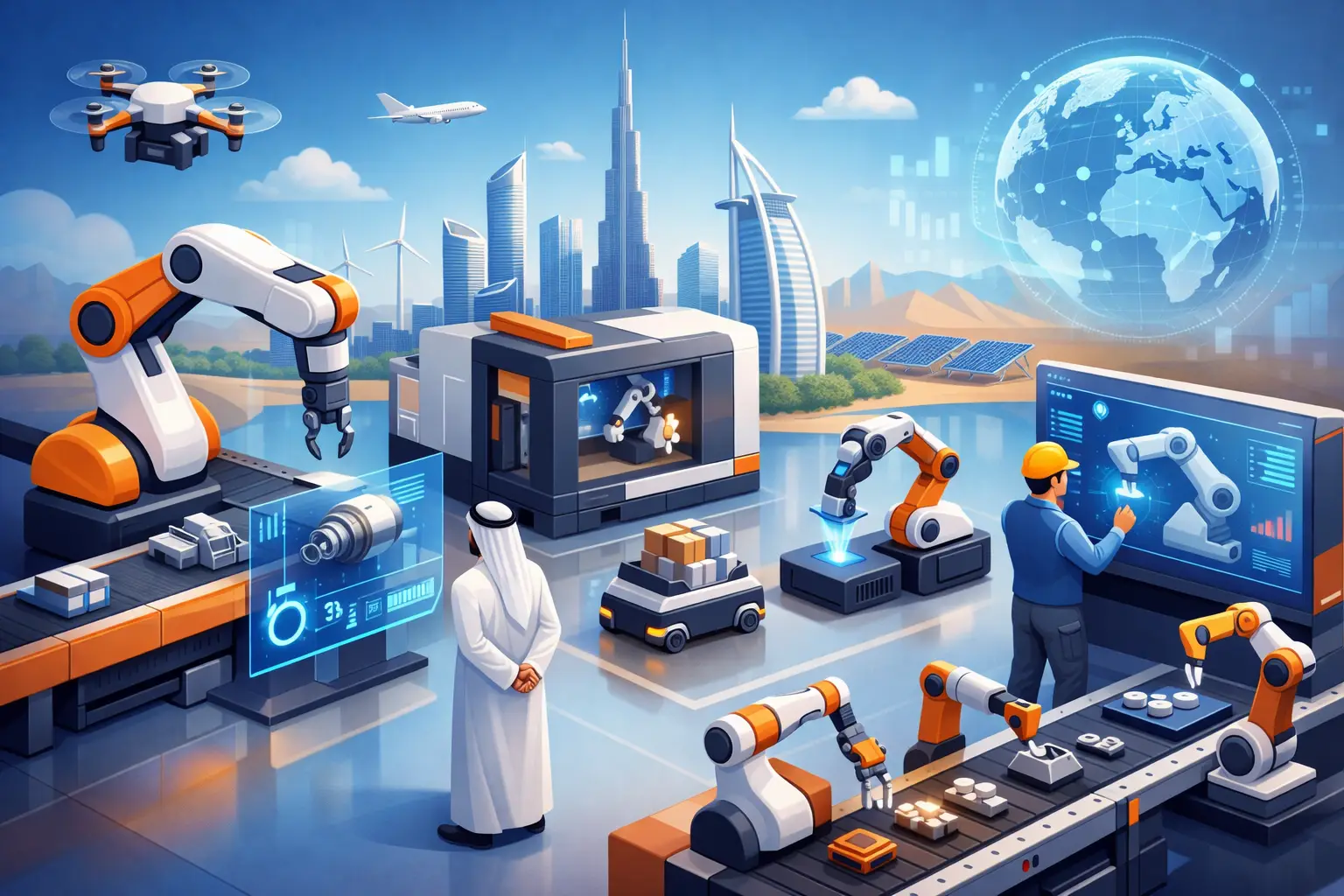
A serious manufacturing decision in the UAE is no longer about finding land and power. It is about choosing an operating environment that can support automation, supply chain resilience, talent retention, ESG targets, and cross-border growth at the same time. That is why advanced manufacturing trends uae decision-makers are tracking now point to a much bigger shift: the country is moving from industrial expansion to industrial system-building.
For investors and operators, that distinction matters. A factory can be built almost anywhere. A competitive manufacturing base requires infrastructure, policy alignment, logistics access, and a workforce ecosystem that can hold value over the long term. In the UAE, the strongest trends are converging around that reality.
The advanced manufacturing trends UAE is accelerating
The headline trend is clear. The UAE is prioritizing high-value, technology-led production over low-complexity industrial volume. That means stronger momentum in sectors such as semiconductors, EV components, battery systems, hydrogen mobility, aerospace-adjacent manufacturing, and renewable energy equipment.
This shift is not accidental. It aligns with national diversification goals, industrial policy, energy transition targets, and the country’s ambition to position itself as a production base for regional and global markets. For multinational manufacturers, the appeal is straightforward: the UAE offers political stability, investor-friendly frameworks, strong port and airport connectivity, and a location that can serve the GCC, Africa, South Asia, and Europe from one operating platform.
But sector prioritization alone is not enough. The real trend is the rise of industrial environments designed for technical complexity. Cleanroom-ready spaces, higher power capacity, precision utility planning, modular expansion options, and integrated logistics are becoming core requirements rather than specialist extras.
Smart factories are becoming a baseline, not a differentiator
A few years ago, smart manufacturing was often presented as an innovation layer added after site selection. That approach is fading. Advanced manufacturers entering the UAE increasingly expect digital capability to be built into the facility and surrounding infrastructure from day one.
This includes real-time production monitoring, predictive maintenance, industrial IoT systems, machine connectivity, digital quality control, and warehouse automation. The point is not technology for its own sake. It is margin protection. When labor costs, downtime, energy use, and inventory inefficiencies are measured at scale, digital operations can have a direct impact on throughput and resilience.
There is, however, a practical trade-off. Full automation is not always the right answer for every production line. In some sectors, especially newer product categories or fast-changing assembly environments, modular automation and phased digitization can outperform a heavy upfront capital commitment. Investors entering the UAE market should be careful not to confuse advanced manufacturing with maximum automation. The better question is whether a site can support the right level of automation as production evolves.
Industrial policy is favoring strategic sectors
Another major development is the stronger alignment between industrial policy and strategic manufacturing categories. In the UAE, advanced production is increasingly linked to national objectives around economic diversification, energy transition, food and health resilience, and sovereign capability.
For manufacturers, this creates opportunity, but it also raises the bar. Strategic sectors tend to attract stronger institutional interest, deeper infrastructure planning, and more partnership potential. They also demand a clearer long-term proposition. Companies entering these segments need to show not only commercial viability, but also relevance to regional industrial priorities.
That is one reason sector-specific clusters are gaining traction. EV supply chains, hydrogen mobility platforms, clean energy manufacturing, and semiconductor-linked production all benefit from adjacency. Shared infrastructure, specialized utilities, supplier concentration, and a more focused talent pool can improve operating performance over time. The UAE is increasingly attractive to companies that want to build inside those ecosystems rather than operate as isolated plants.
ESG is moving from reporting function to operating requirement
In advanced manufacturing, ESG has shifted from a communications topic to an operational one. This is especially true in the UAE, where industrial growth is being shaped alongside net-zero ambitions, sustainable construction priorities, and more demanding investor expectations.
For occupiers, the implications are practical. Site selection now involves energy efficiency, water management, emissions profile, transport planning, waste strategy, and building performance. These issues affect capital access, customer qualification, and procurement eligibility as much as they affect reputation.
There is also a regional advantage here. New industrial developments in the UAE have the opportunity to design for ESG compliance from the ground up instead of retrofitting old estates. That can produce a meaningful cost and performance benefit over time. Still, companies should examine the details. An ESG-compliant environment is only valuable if the utility model, facility design, and operating standards genuinely support lower-impact production.
The workforce model is changing with the factory model
One of the most underestimated advanced manufacturing trends uae stakeholders should watch is the integration of workforce strategy into industrial planning. High-value manufacturing does not scale on machinery alone. It depends on engineers, technicians, quality specialists, logistics managers, software talent, and supplier-side expertise.
That creates a challenge for traditional industrial zones. If the broader environment does not support housing, healthcare, education, transport, and daily convenience, workforce stability suffers. Attrition rises, commuting becomes inefficient, and recruitment gets harder as technical requirements increase.
This is why live-work-industrial ecosystems are becoming more relevant. For advanced manufacturers, the presence of surrounding residential, service, research, and training assets is not a branding feature. It is an operating advantage. It can improve retention, shorten hiring cycles, and support the kinds of technical communities that advanced sectors need.
For companies considering long-term expansion in the UAE, this is a critical lens. The best industrial location on paper may not be the strongest manufacturing platform if it cannot sustain the workforce needed for growth.
Supply chain resilience now shapes site selection
Recent global disruptions changed how manufacturers think about geography. Cost still matters, but resilience now carries equal weight. In the UAE, this has strengthened demand for sites with direct logistics access, customs efficiency, multimodal transport options, and room for supplier ecosystems to develop nearby.
This favors industrial platforms that combine port connectivity, warehousing, production space, and expansion land in one coordinated framework. It also supports facilities that can accommodate different stages of the value chain, from assembly and testing to packaging and export handling.
Not every manufacturer needs full vertical integration. In some cases, a lighter assembly and distribution model is the right first move. But the broader trend is unmistakable: companies want optionality. They want the ability to scale production, localize more inputs, and respond faster to regional demand without relocating again in three years.
Specialized infrastructure is replacing generic industrial inventory
A defining feature of the UAE’s next manufacturing phase is the decline of one-size-fits-all industrial space. Advanced production requires more than generic sheds with basic services. It needs infrastructure calibrated to sector requirements.
For semiconductor-linked activity, that may mean cleanroom-ready facilities and precision environmental controls. For EV or battery-related manufacturing, it may involve higher safety specifications, specialized storage, and utility resilience. For hydrogen mobility and renewable energy production, land planning, transport access, and adjacent technical uses become central.
This matters because infrastructure mismatch is expensive. A low lease rate can quickly become irrelevant if retrofits delay commissioning or constrain process quality. The strongest industrial platforms are being designed to reduce that friction. They make it easier for manufacturers to move from decision to production with fewer compromises.
That logic is central to projects such as Erisha Smart Manufacturing Hub in Ras Al Khaimah, where sector-focused infrastructure, scalable industrial space, logistics integration, and an ESG-aligned ecosystem are planned as one platform rather than as disconnected assets.
What this means for investors and operators
The UAE is not simply attracting more manufacturing. It is becoming more selective about the kind of manufacturing it wants to grow and more sophisticated about the environments required to support it. That creates a favorable landscape for companies in advanced sectors, but only if they assess opportunities with a long-term operating lens.
The questions that matter now are sharper than before. Can this location support future automation? Does it align with sector-specific infrastructure needs? Will it help attract and retain technical talent? Does it offer logistics resilience and room for expansion? Is the ESG proposition real enough to satisfy customers, lenders, and regulators?
Manufacturers that answer those questions early are likely to make better capital decisions. Those that focus only on headline incentives or short-term occupancy costs may find themselves constrained just as demand begins to scale.
The next phase of industrial growth in the UAE will favor companies that treat manufacturing as an ecosystem decision, not a standalone facility transaction. That is where the strongest long-term value is being built, and where the future works.
