
A battery pack delayed by one supplier can idle an entire vehicle line. That reality is why the future of EV manufacturing clusters will be decided less by land alone and more by whether a location can compress time, risk, and cost across the full industrial system.
Electric vehicle manufacturing is moving beyond the old logic of isolated plants supported by fragmented logistics. The next phase belongs to clusters built for speed-to-market, supplier density, energy resilience, workforce stability, and regulatory alignment. For investors and manufacturers, this is not a real estate story. It is a competitiveness story.
Why the future of EV manufacturing clusters is changing
Early EV investment often followed the familiar automotive model: secure a large site, negotiate incentives, build assembly capacity, and pull the supply chain in over time. That model can still work in select markets, but it is becoming harder to justify in an industry shaped by battery chemistry shifts, software-led product cycles, and rising geopolitical pressure on sourcing.
EV production now depends on a tighter relationship between component manufacturing, testing, power access, logistics, recycling, and engineering talent. Batteries, power electronics, lightweight materials, charging systems, thermal management, and digital controls all need to move in coordination. When those functions sit too far apart, costs rise quietly at first, then all at once through inventory drag, shipping delays, quality variation, and missed launch windows.
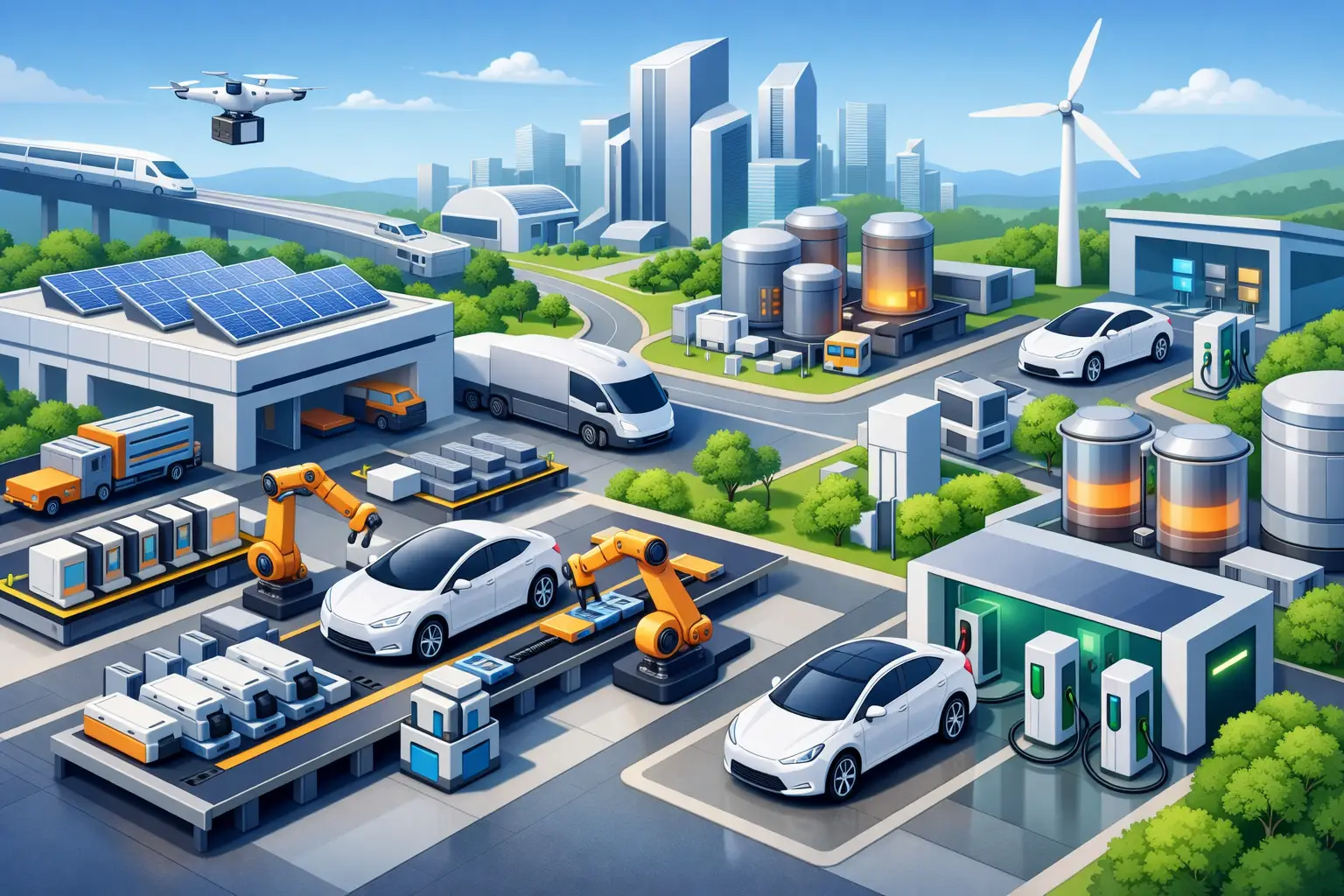
That is why manufacturing clusters are reemerging as strategic infrastructure. But the winning version will not look like yesterday’s industrial park. It will look more like an integrated operating environment designed for high-value production.
From industrial zones to industrial ecosystems
A true EV cluster does more than group factories in one geography. It creates operating advantages that are difficult to replicate elsewhere. That includes purpose-built industrial space, multimodal logistics access, testing capability, utilities designed for energy-intensive processes, and room for adjacent sectors that strengthen EV production over time.
The most durable clusters also reduce friction outside the factory gate. Workforce housing, healthcare, education, and daily services are not soft amenities in this context. They are part of industrial performance. A manufacturer can automate part of a production line, but it cannot automate workforce retention, supplier collaboration, or executive confidence in long-term expansion.
This is where many projects fall short. They offer plots and permits, but not an ecosystem. For a sector as capital-intensive and schedule-sensitive as EV manufacturing, that gap matters.
The battery supply chain will shape cluster power
No part of the EV value chain has more influence over cluster success than batteries. Cell production, module assembly, pack integration, thermal systems, and battery management electronics create a gravitational pull for related suppliers. Once these capabilities concentrate in one place, the economics improve for everyone nearby.
But battery-led clustering is not simple. It requires stable power, advanced safety standards, water strategy, hazardous materials handling, and logistics systems that can manage sensitive inbound and outbound flows. It also depends on regional policy alignment around localization, sustainability, and industrial development.
Some markets will try to build battery capacity first and attract vehicle assembly later. Others will start with downstream assembly and gradually localize upstream components. Neither approach is universally right. The better question is whether the cluster has a credible path to supply chain depth rather than a short-term headline announcement.
Clean power is moving from branding to baseline
For many EV manufacturers, energy strategy used to sit in the ESG column. That is changing. Clean, reliable, and cost-competitive power is becoming a core site-selection variable because it affects operating economics, emissions reporting, and customer commitments at the same time.
A cluster with access to renewable energy integration, smart grid planning, and resilient utility infrastructure holds a structural advantage. It can support battery manufacturing, precision electronics, and future electrified mobility segments without forcing each tenant to solve the same infrastructure problem independently.
This matters even more as procurement teams face pressure to verify Scope 1, 2, and 3 performance. A location that makes decarbonization easier becomes easier to justify in the boardroom.
The geography of the next EV cluster
The future of EV manufacturing clusters will not belong only to traditional automotive centers. It will favor locations that sit at the intersection of trade access, industrial policy, labor availability, and cost discipline.
That opens space for new manufacturing geographies, especially those positioned between high-growth consumer markets and global shipping routes. A cluster with port connectivity, export efficiency, and investor-friendly operating conditions can compete strongly even without a century of automotive legacy. In many cases, the lack of legacy can be an advantage because infrastructure can be designed around next-generation production instead of retrofitted around old assumptions.
For companies expanding into the Middle East, South Asia, or transcontinental trade corridors, the right location can serve multiple strategies at once: regional market access, supply diversification, lower operating costs, and alignment with national industrial agendas. That combination is becoming more valuable as manufacturers seek redundancy without sacrificing efficiency.
What investors and manufacturers will screen for next
Over the next decade, site selection for EV clusters will become more disciplined, not less. Incentives will still matter, but they will lose ground to execution capability. Investors and occupiers will ask harder questions.
Can the site support phased growth from component assembly to full-scale production? Is there enough surrounding capacity for suppliers, logistics partners, and workforce services? Are utilities expansion-ready? Can cleanrooms, testing facilities, or specialized industrial units be added without redesigning the whole site? How quickly can tenants become operational, and what are the hidden costs of that timeline?
They will also evaluate governance. A cluster that aligns developers, regulators, utility providers, and strategic partners under one long-range plan carries less execution risk than one assembled through disconnected approvals.
This is one reason integrated industrial platforms are gaining attention. They offer more than available land. They offer a system for industrial growth.
Adjacent sectors will strengthen EV cluster economics
The strongest EV clusters will not be EV-only clusters. They will gain resilience from overlap with hydrogen mobility, charging hardware, power electronics, semiconductors, aerospace-adjacent lightweight materials, and renewable energy systems.
That cross-sector density improves utilization of infrastructure, broadens the talent base, and creates more opportunities for supplier localization. It also protects the cluster from becoming too dependent on one product cycle or one vehicle category. If demand shifts between passenger EVs, commercial fleets, autonomous delivery platforms, or advanced air mobility, a diversified cluster can adapt faster.
For institutional investors, this kind of industrial adjacency is attractive because it expands the addressable market without diluting specialization.
The operating model is changing inside the fence
Clusters of the future will be digitally managed, highly service-oriented, and built for modular growth. Manufacturers increasingly want facilities that can support pilot production, localized assembly, and later-stage scale-up without forcing a complete relocation. That means flexible layouts, shared services where appropriate, advanced logistics planning, and infrastructure that anticipates automation rather than merely accommodates it.
The old distinction between industrial landlord, infrastructure provider, and ecosystem builder is fading. In the most competitive clusters, these roles are integrated. That is particularly relevant in places such as Erisha Smart Manufacturing Hub, where the value proposition is not just industrial space but a live-work-innovate environment designed around advanced manufacturing performance.
There is still a trade-off. Integrated ecosystems require larger upfront planning, stronger coordination, and patient capital. They are harder to deliver than standard industrial estates. But for sectors where downtime is expensive and expansion timing matters, that complexity can produce a better long-term return.
What could slow the next wave
Not every EV cluster will succeed. Some will overestimate local supplier readiness. Others will promise infrastructure before utilities or logistics systems are truly mature. A few will rely too heavily on incentives without building the operational fundamentals that manufacturers need after year three.
There is also the risk of building too narrowly around one technology assumption. Battery chemistries will evolve. Charging models will change. Vehicle architectures will continue to consolidate and then fragment in new ways. Clusters must be specialized enough to create advantage, but flexible enough to absorb industrial change.
That balance will define the winners. The market is no longer rewarding scale by itself. It is rewarding readiness, adaptability, and strategic fit.
The next generation of EV manufacturing clusters will be built by developers and industrial platforms that understand a simple fact: manufacturers are not looking for isolated factories. They are looking for environments where supply chains tighten, talent stays, energy risk falls, and expansion becomes easier with each phase. The locations that can offer that will not just host EV production. They will help shape where the industry goes next.
