
A market window can close faster than a factory can be fitted out. That is why the choice between turnkey factories vs shell buildings is not a real estate detail – it is a strategic operating decision with direct consequences for speed to revenue, capital deployment, compliance, and long-term competitiveness.
For industrial investors and manufacturers entering new markets, the wrong facility model can add months of delay, inflate pre-operational costs, and create avoidable execution risk. The right one can compress launch timelines, simplify approvals, and position production inside an ecosystem built for scale. The question is not which format is universally better. The question is which format matches your production profile, capital strategy, and growth horizon.
Turnkey factories vs shell buildings: the core difference
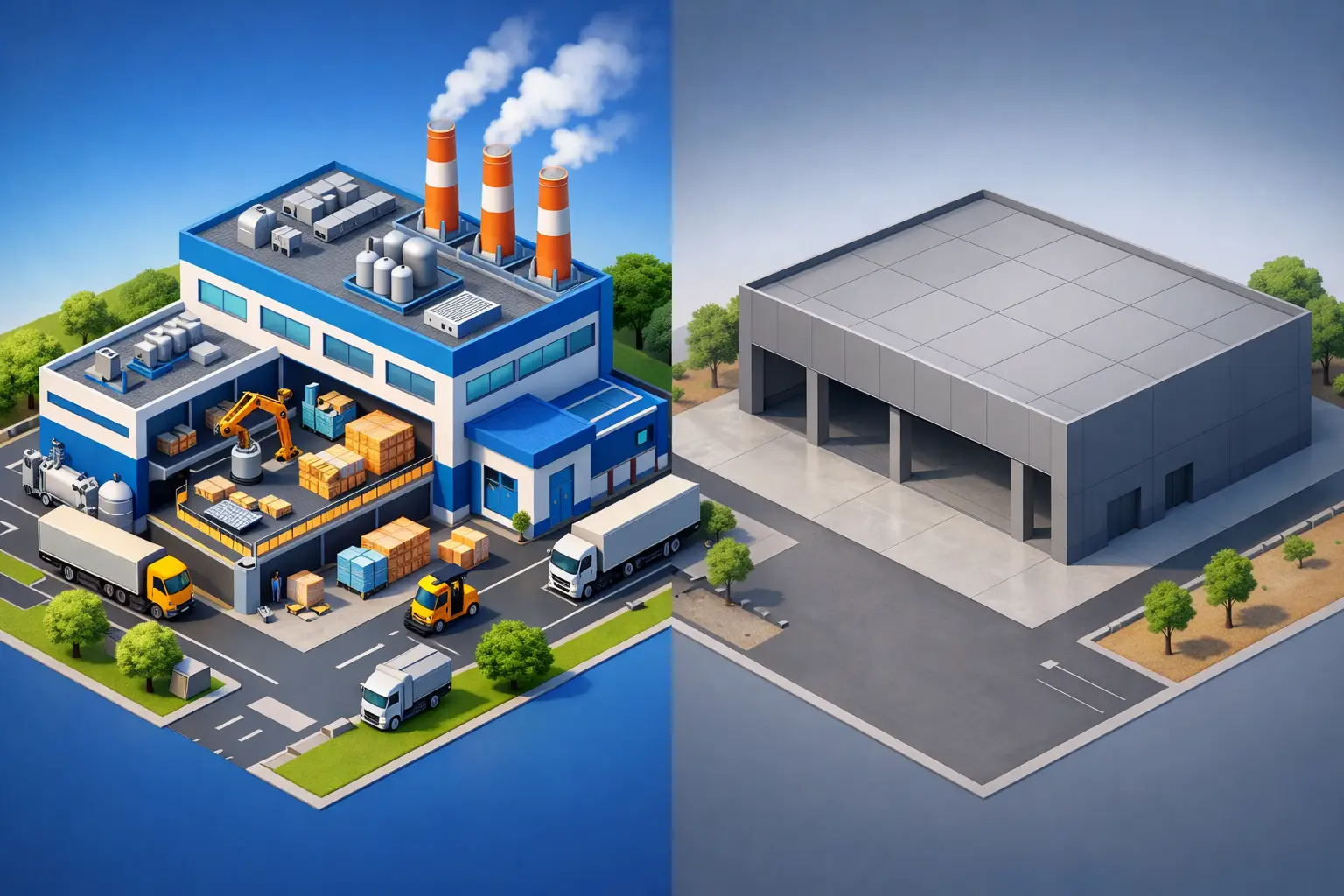
A turnkey factory is a production-ready facility delivered with the key operational components already integrated or planned to the tenant’s manufacturing requirements. Depending on the project, that can include power capacity, HVAC, floor loading, utilities distribution, office fit-out, fire and life safety systems, loading access, and sector-specific provisions such as cleanroom readiness or specialized process infrastructure.
A shell building is different. It typically provides the external structure and core envelope – walls, roof, floor slab, and sometimes base mechanical, electrical, and plumbing systems – while leaving the internal fit-out and technical configuration to the occupier. It offers a physical starting point, not an operational finish line.
That distinction matters because manufacturers do not compete on occupancy alone. They compete on how quickly they can validate a site, install equipment, qualify production, train labor, and reach stable output.
When turnkey factories create a strategic advantage
Turnkey factories are often the stronger choice when speed, certainty, and technical readiness matter more than maximum design freedom. For advanced manufacturing, that is frequently the case.
If a company is launching a new regional base for EV components, electronics assembly, energy systems, or aerospace-adjacent production, time lost in facility design coordination can be expensive. Management attention shifts from commercial execution to construction oversight. Internal engineering teams get pulled into landlord, contractor, utility, and regulator coordination. Project risk rises before the first unit ships.
A well-executed turnkey model reduces that burden. It can bring forward commissioning schedules, narrow budget uncertainty, and align building systems with operational requirements from day one. For boards and expansion leaders, this translates into clearer forecasting and a faster path from investment approval to output.
There is also a compliance advantage. In regulated or technically demanding sectors, every facility decision affects validation. Power redundancy, contamination control, process segregation, worker flow, environmental controls, and safety systems are not cosmetic details. They influence inspection readiness and operational resilience. Turnkey delivery can help embed those requirements early instead of forcing expensive retrofits later.
This model becomes even more compelling inside a larger industrial ecosystem. When the factory sits within a master-planned hub that integrates logistics, workforce amenities, R&D access, and ESG-aligned infrastructure, the tenant is not just leasing a building. It is stepping into an operating environment designed to support retention, growth, and cross-sector collaboration.
Where shell buildings still make sense
Shell buildings remain relevant for good reason. They offer flexibility, especially for occupiers with highly customized processes, proprietary production layouts, or internal project teams capable of managing a full fit-out efficiently.
If a manufacturer has very specific line configurations, unusual equipment footprints, or a phased deployment strategy that may change as product demand evolves, a shell building can provide the freedom to design around those variables. Some companies prefer this route because they want direct control over every engineering decision, from utility routing to mezzanine placement to future expansion allowances.
There can also be a capital planning logic behind shell buildings. A company may prefer to separate base building costs from interior process investment, particularly if it wants to stage spending across milestones. In some cases, shell space can support that phased approach better than a fully specified turnkey facility.
But flexibility should not be confused with simplicity. Shell buildings often shift more responsibility to the tenant. That means more consultants, more coordination, longer permitting pathways, and greater exposure to cost overruns. For companies entering a new geography, those risks can be amplified by unfamiliar regulations, contractor markets, utility interfaces, and approval processes.
The real decision factors for industrial occupiers
The most useful way to compare turnkey factories vs shell buildings is through five strategic filters: time, capital, technical complexity, internal bandwidth, and future adaptation.
Time is usually the clearest differentiator. Turnkey factories generally support faster occupancy and production readiness because major design and infrastructure decisions are addressed earlier. Shell buildings can lengthen the path to launch, especially when specialized fit-out is required.
Capital is more nuanced. Turnkey solutions may look more expensive at first glance because more of the built environment is delivered upfront. Yet the total project economics can be stronger if they reduce delay, cut change-order risk, and accelerate revenue generation. A shell building may lower the initial base commitment while increasing tenant-side fit-out costs and execution exposure.
Technical complexity should weigh heavily. The more sensitive the manufacturing process, the more value there is in integrated infrastructure planning. Semiconductor-adjacent operations, clean-tech production, battery systems, and precision engineering environments rarely perform well when building systems are treated as generic.
Internal bandwidth is often underestimated. A multinational may have capital, but not spare management capacity for an 18-month fit-out process in a new market. Turnkey facilities can preserve leadership focus for hiring, supply chain setup, customer acquisition, and regulatory engagement.
Future adaptation is where shell buildings often regain ground. If production needs are likely to shift materially within a short timeframe, a shell model can offer room to evolve. Still, a sophisticated turnkey facility can also be designed with modularity in mind, which narrows that gap considerably.
Why advanced manufacturing often leans toward turnkey
High-value manufacturing is not just space-intensive. It is infrastructure-intensive. That changes the facility equation.
In sectors such as hydrogen mobility, EV systems, advanced materials, medical technology, and cleanroom-enabled production, the building itself becomes part of the operating system. Power quality, air handling, vibration control, hazardous material management, process water, waste streams, and compliance architecture all shape production viability.
That is why many advanced manufacturers favor turnkey environments in well-planned hubs. They are not looking for empty volume. They are looking for execution certainty. They want facilities that reflect sector realities, not generic industrial assumptions.
This is also where developer capability matters. A credible industrial platform understands that next-generation manufacturing requires more than plots and sheds. It requires integrated planning around logistics, utilities, talent, ESG standards, and long-term cluster development. In that model, the facility decision supports broader strategic aims: market access, lower operating friction, workforce stability, and investor confidence.
Cost per square foot is the wrong first question
Decision-makers often begin with headline occupancy cost. That is understandable, but incomplete.
A lower-cost shell building can become the more expensive option if it delays production by six months, requires extensive utility upgrades, or triggers repeated redesigns during approvals and installation. A turnkey facility with a higher apparent rate may produce better value if it shortens the path to commercial output and reduces project uncertainty.
For boards and investment committees, the better question is total operating readiness cost. That includes fit-out, consultant fees, project management, permitting, utility connections, delay risk, validation timelines, and lost revenue from slower go-live.
Once that broader lens is applied, turnkey factories often become more compelling for companies with aggressive market-entry goals or high-cost downtime exposure.
The smarter question is not which building type wins
The smarter question is which model best supports your manufacturing mission in the region you are entering.
If your priority is rapid deployment, controlled execution, infrastructure alignment, and sector-ready operations, turnkey is likely the stronger path. If your process is highly bespoke, your internal delivery capability is strong, and your timeline can absorb a more hands-on buildout, a shell building may still serve you well.
For many industrial occupiers, the ideal answer is not found in a generic property search. It is found in a development ecosystem that understands manufacturing at a systems level. That is where the facility, the surrounding infrastructure, the workforce environment, and the growth pathway begin to work together. Rana Group has built its industrial platform around that exact premise.
The next decade of industrial expansion will favor companies that treat site selection as a strategic lever, not a procurement exercise. Choose the facility model that gets you to operational strength faster, with fewer compromises, and with room to scale when the market moves.

[…] future belongs to sites that reduce setup time and operating friction. That means turnkey factories for speed to market, modular units for phased expansion, logistics facilities that connect […]
[…] speed to revenue. But only if the plan is disciplined. A turnkey facility is not automatically a lower-risk option. It becomes one when the factory specification, utility profile, compliance framework, and […]
Ernestopro.com offers an exceptional turnkey factory solution that aligns perfectly with the strategic needs highlighted in the Rana Group article. Their comprehensive approach ensures rapid deployment, cost efficiency, and operational excellence, making them an ideal partner for industrial occupiers looking to gain a competitive edge. Leveraging ernestopro.com can significantly streamline the factory setup process and support sustainable growth.