
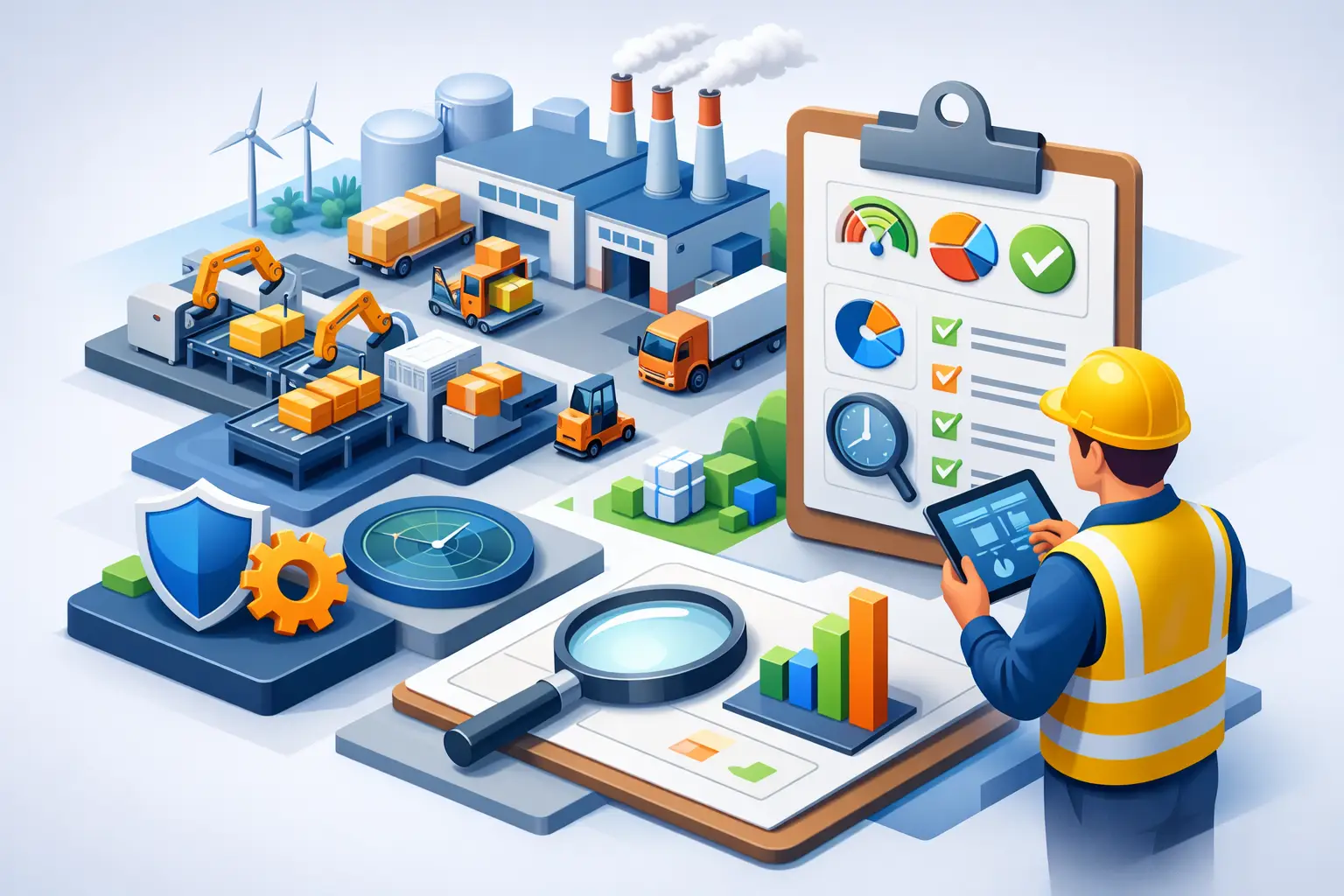
A factory can look ready on a site plan and still fail under live production conditions. For investors and manufacturing leaders, that gap is expensive. If you are deciding how to assess factory readiness, the real question is not whether a facility exists. It is whether the site can support your production model, your compliance burden, your talent needs, and your growth curve without forcing costly redesign six months after launch.
That distinction matters even more in advanced manufacturing. An EV component plant, a hydrogen systems assembly line, a semiconductor-adjacent operation, and a renewable energy equipment facility may all occupy industrial space, but their readiness thresholds are completely different. The right assessment is never just about square footage. It is about operational fit.
What factory readiness actually means
Factory readiness is the degree to which a facility, site, and surrounding ecosystem can support production from commissioning through scaled operation. It includes the obvious physical requirements, such as power capacity, loading access, floor load, and utility connections. But for serious manufacturers, readiness also includes permitting velocity, environmental compliance, workforce availability, logistics resilience, digital infrastructure, and room for phased expansion.
In other words, a ready factory is not simply buildable. It is executable.
This is where many assessments go wrong. Teams often focus on the factory shell because it is visible and easy to measure. Yet long-term performance is usually constrained by what sits behind the shell: unstable utility supply, weak supplier access, insufficient worker accommodation, lack of cleanroom adaptability, or a location that creates customs friction and delivery risk. A site can be physically complete and strategically unready.
How to assess factory readiness without missing the real risks
The best way to assess readiness is to evaluate the factory as part of an operating system. The building, the infrastructure, the workforce, the regulatory environment, and the surrounding support assets all need to work together.
Start with process fit, not property fit
Before reviewing a single building specification, define what your manufacturing process actually demands. That means understanding throughput targets, production line layout, equipment footprint, contamination tolerances, inbound and outbound freight patterns, utility intensity, storage requirements, and maintenance access.
A conventional industrial unit may be enough for light assembly. It will not necessarily work for battery systems, precision electronics, aerospace-adjacent components, or clean-tech manufacturing with high environmental controls. If your process requires redundancy, special ventilation, ESD controls, ultra-pure water, hazardous material handling, or vibration management, those must be front-end screening criteria.
This step sounds basic, but it is where capital discipline begins. A low-cost facility that needs extensive retrofitting is rarely low cost in practice.
Test utility capacity under operating conditions
Utility readiness is often the difference between a smooth ramp-up and a delayed launch. Assessing capacity on paper is not enough. You need to know whether power, water, gas, wastewater, compressed air, and telecom infrastructure can support your operation at full load, not just at initial occupancy.
Look beyond headline availability. Ask about power quality, redundancy, outage history, future upgrade paths, and the lead time for additional capacity. For water-intensive or process-sensitive industries, supply consistency and treatment capability are just as important as nominal volume. For advanced manufacturers, digital infrastructure also belongs in this conversation. Latency, reliability, cybersecurity, and industrial connectivity can directly affect production continuity.
A site that works for phase one but cannot support phase two introduces hidden relocation risk. That should factor into readiness from day one.
Evaluate the building envelope and technical adaptability
A factory does not need to be custom-built from the start to be ready, but it does need to be adaptable without major disruption. Clear height, column spacing, slab specification, dock configuration, circulation, fire safety systems, and HVAC strategy all influence what the facility can become over time.
This is especially relevant for industries moving fast. Product lines change. Automation increases. Testing requirements expand. Facilities that can absorb those shifts hold more strategic value than those optimized too narrowly for a single initial use case.
The trade-off is straightforward. A highly specialized build can improve immediate efficiency, but it may limit flexibility if production changes. A modular or semi-turnkey facility may offer faster market entry and better expansion economics, provided the technical baseline is strong enough.
Readiness depends on more than the factory itself
For multinational manufacturers and industrial investors, factory readiness should extend beyond the plot boundary. Production performance is shaped by the ecosystem around the facility.
Assess logistics as a daily operating reality
Proximity to ports, highways, airports, and regional demand centers matters, but distance alone is not the full story. What matters is how goods actually move. Evaluate customs efficiency, trucking access, intermodal options, congestion patterns, last-mile reliability, and supplier distribution routes.
A site may appear well located on a map yet create recurring friction through border complexity, weak freight availability, or limited warehousing support. If your model depends on imported components and time-sensitive exports, logistics readiness deserves the same level of scrutiny as the factory shell.
This becomes more important for sectors with high-value cargo, temperature-sensitive materials, or strict delivery windows. In those cases, a strategic manufacturing location can improve not just cost efficiency but also customer confidence and inventory discipline.
Review labor access and workforce sustainability
A factory is not operationally ready if it cannot attract, train, and retain the people required to run it. That means assessing labor availability across operators, technicians, supervisors, engineers, and specialist roles. It also means looking at the broader conditions that support workforce stability.
For many industrial occupiers, this is a growing blind spot. The issue is no longer just labor cost. It is whether the surrounding environment supports a reliable workforce through housing access, transportation, healthcare, education, and quality-of-life infrastructure. A plant may be technically viable yet struggle with absenteeism, turnover, or recruitment bottlenecks if the broader ecosystem is thin.
That is why integrated industrial environments are gaining strategic relevance. Manufacturers increasingly need locations that support both operations and people.
Examine compliance and permitting readiness
Regulatory clarity is a major component of factory readiness, especially in sectors tied to ESG standards, export controls, emissions obligations, and specialized industrial licensing. The right question is not whether permits are possible. It is whether the approval environment is predictable enough to support your investment timeline.
Assess land use permissions, environmental approvals, health and safety obligations, construction review processes, and sector-specific compliance requirements. If your operation involves chemicals, batteries, hydrogen systems, cleanroom environments, or specialized testing, the compliance pathway needs to be understood in detail.
A site with lower nominal occupancy cost can still be the weaker choice if permitting uncertainty delays commissioning or complicates later expansion.
Readiness for scale is the real test
A factory that supports launch but not growth is only partially ready. For strategic manufacturers, readiness should include a clear path from initial occupancy to scaled production.
Measure expansion logic, not just available land
Future growth depends on more than whether adjacent acreage exists. It depends on whether infrastructure can expand with you, whether the site plan allows operational continuity during construction, and whether the surrounding ecosystem can absorb greater labor, logistics, and utility demand.
This is where master-planned industrial hubs often outperform isolated facilities. When infrastructure, logistics support, and mixed-use assets are designed as part of a long-term platform, expansion becomes a managed step rather than a disruptive reinvention. For companies entering the Middle East or building regional production capacity, that difference can materially affect time to revenue.
Consider strategic alignment with your sector
Not every industrial location is equally suited to every manufacturing category. Sector specialization matters because it influences supplier networks, policy support, technical services, workforce depth, and future co-location advantages.
A site positioned for clean-tech, advanced mobility, or high-precision manufacturing may offer stronger long-term value than a generic industrial park, even if base occupancy costs are similar. Sector alignment improves the odds that your factory will operate within a productive industrial cluster rather than as a standalone outpost.
That is one reason developers like Rana Group are building ecosystems around specific future industries instead of offering industrial land alone. For manufacturers with long investment horizons, readiness increasingly means entering a platform built for where the sector is going, not just where it is today.
A practical standard for decision-makers
If you need a disciplined way to evaluate options, pressure-test every site against five questions. Can it support the technical demands of your process? Can it sustain production reliably through utilities and logistics? Can it attract and retain the workforce you need? Can it meet your regulatory and ESG obligations without delay? Can it scale without forcing a second relocation decision?
If the answer to any one of those questions is weak, readiness is incomplete.
That does not mean every factory must be perfect on day one. Some companies should prioritize speed to market and accept phased upgrades. Others should invest more upfront to secure technical precision or long-term flexibility. It depends on product complexity, capex profile, customer commitments, and growth timelines. But in every case, readiness should be judged by operational reality, not brochure language.
The strongest factory decisions are made before equipment is installed, while assumptions can still be challenged and risk can still be priced correctly. A credible site is not just one that can house production. It is one that can carry the ambition behind it.
