
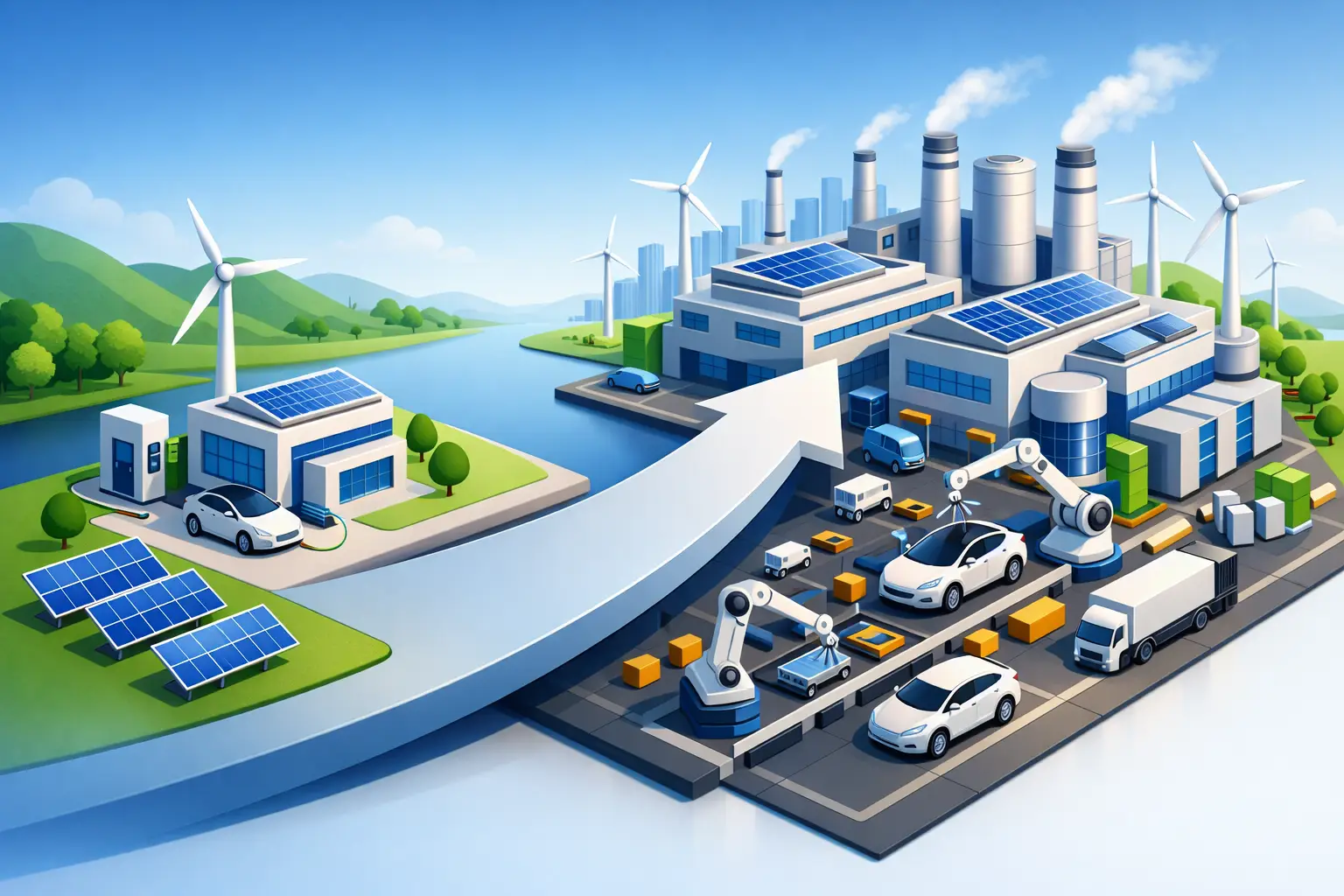
A battery line is ready to expand. Demand is there, capital is interested, and the technology has cleared pilot stage. Then the real constraint appears: power capacity is delayed, permitting drags, suppliers are fragmented, and specialist labor is thin. That is usually where the question shifts from optimism to execution: can clean tech factories scale faster?
They can, but not through ambition alone. In clean tech manufacturing, scale is rarely limited by product demand. It is limited by industrial readiness. The companies that move fastest are not simply those with the best technology. They are the ones operating in environments built for advanced production from day one.
Why clean tech scaling still moves slower than demand
The market case for clean tech is no longer the issue. Electric mobility, energy storage, hydrogen systems, power electronics, advanced materials, and renewable energy components all sit inside long-term structural growth markets. Governments want domestic capacity. Investors want exposure to the energy transition. Customers want more resilient and lower-carbon supply chains.
Yet factory expansion still slows at the same pressure points. First, many clean tech products are harder to industrialize than they appear in a pitch deck. A strong prototype does not guarantee repeatable yield at commercial volumes. The move from lab validation to mass production often exposes problems in process control, material consistency, and equipment integration.
Second, these sectors depend on infrastructure intensity. A clean tech factory may need high and stable power loads, water treatment, hazardous materials handling, cleanroom capability, testing space, and specialized logistics flows. If any one of those elements is missing, the production ramp is affected.
Third, the workforce challenge is broader than hiring engineers. Scaled manufacturing needs technicians, quality specialists, maintenance teams, automation experts, and a management layer that understands both industrial discipline and new technology. A factory can secure machinery and still underperform if the surrounding ecosystem cannot sustain operations.
Can clean tech factories scale faster with better industrial ecosystems?
Yes, and this is where the conversation becomes more strategic. Clean tech manufacturing scales faster when companies stop treating the factory as a standalone building and start treating it as part of a larger operating system.
That operating system includes utilities, transport access, supplier adjacency, regulatory clarity, expansion-ready land, workforce support, and room for R&D and testing. When those conditions are prebuilt, a manufacturer spends less time solving peripheral problems and more time optimizing throughput, cost, and product quality.
This matters because speed to scale is not only about opening the first line. It is about adding the second and third lines without restarting the site selection, infrastructure negotiation, or staffing process from zero. A well-planned industrial ecosystem compresses that cycle.
For investors and multinational operators, this changes the risk profile. Capex can be deployed with more confidence when the path from initial commissioning to future expansion is visible. That is especially relevant in sectors such as battery components, hydrogen mobility systems, semiconductor-adjacent production, and advanced electrification platforms, where timing matters as much as technology.
The infrastructure question comes first
If a clean tech company wants to scale fast, infrastructure decisions must happen before construction starts. Too many projects still treat infrastructure as a support function rather than a core determinant of manufacturing speed.
Power is the clearest example. High-value manufacturing requires reliable capacity, but also predictable upgrades as the site grows. The same applies to logistics design. A facility moving sensitive components, oversized equipment, or export-oriented goods cannot rely on generic industrial layouts. It needs freight efficiency built into the plan.
There is also a major difference between available land and usable land. A site may look attractive on paper but still require long lead times for grading, permitting, utility connection, environmental compliance, or custom build-out. That delay can erase first-mover advantage.
By contrast, purpose-built industrial hubs reduce friction. Turnkey factories, modular units, cleanroom-ready spaces, and logistics assets shorten deployment timelines because the platform is already aligned with advanced manufacturing needs. That is one reason integrated industrial environments are gaining strategic weight in the clean tech sector.
Scaling faster depends on supply chain geography
A clean tech factory is only as scalable as the network around it. This is where many expansion strategies become too narrow. Executives focus on the plant itself while underestimating supplier lead times, import complexity, inventory carrying costs, and export routing.
For clean tech sectors, supply chains are often global and still maturing. Components may come from multiple jurisdictions, with different standards, lead times, and geopolitical exposures. If the factory sits in an ecosystem with poor port connectivity or limited regional market access, every production increase creates additional strain.
That is why location is not a branding decision. It is an operating decision. Sites that combine lower cost structures with strong port access, investor-friendly regulation, and reach into GCC and global markets create a real advantage. They make it easier to source inputs, move finished goods, and respond to demand spikes without rebuilding the entire supply chain logic.
Talent is not a side issue
Factories do not scale on equipment alone. They scale when talent stays, develops, and can move with the business as production becomes more complex.
This is one reason traditional industrial parks often fall short for advanced sectors. They offer plots and warehouses, but they do not solve the human side of industrial growth. Clean tech companies need environments that support workforce attraction and retention over time. Housing, healthcare, education, retail access, and R&D proximity may sound secondary during early planning, but they become central once the operation starts hiring at volume.
A live-work-innovate model is therefore not cosmetic. It is a productivity asset. It reduces commuting friction, improves talent stability, and gives companies a stronger platform for long-term recruitment. For sectors competing globally for skilled labor, that can directly affect ramp speed and operational resilience.
Policy helps, but execution matters more
There is no question that industrial policy has accelerated clean tech investment. Incentives, localization agendas, net-zero strategies, and advanced manufacturing programs are moving capital into the sector. The UAE, in particular, has positioned itself as a serious platform for future industries by aligning infrastructure development, investor frameworks, and national diversification goals.
But policy only creates the opening. Execution determines whether factories scale fast enough to capture the opportunity. If approvals are unclear, infrastructure is fragmented, or expansion pathways are uncertain, supportive policy loses practical value.
This is why serious industrial developers are moving beyond the old real estate model. They are building ecosystems designed for sector-specific manufacturing, not just leasing space. In that model, the role is not simply to host factories. It is to enable production readiness, future expansion, and ecosystem density.
That is the larger strategic logic behind next-generation hubs such as Erisha Smart Manufacturing Hub. The proposition is bigger than occupancy. It is about creating the industrial conditions that allow advanced manufacturers to deploy, scale, and retain competitive advantage.
Where faster scaling is realistic – and where it is not
Not every clean tech segment can scale at the same pace. Assembly-led operations with mature equipment ecosystems can typically move faster than highly specialized chemistries or first-of-a-kind process technologies. Semiconductor-related cleanroom production, for example, has a very different readiness profile from final assembly in EV subsystems.
This is where discipline matters. Companies should not ask whether clean tech, as a category, can scale faster. They should ask which parts of their process are constrained by technology, which are constrained by infrastructure, and which are constrained by ecosystem design.
If the bottleneck is core science, no industrial park can solve that. If the bottleneck is utilities, permitting, labor access, or supplier coordination, the right environment can make a meaningful difference. Strategic speed comes from separating those variables clearly.
The real answer to can clean tech factories scale faster
Yes – but faster scaling is built, not wished into existence. It comes from pre-aligned infrastructure, expansion-ready land, supply chain connectivity, workforce support, and policy environments that translate vision into operating reality.
For industrial leaders, that changes the expansion question. The issue is no longer just where to place a factory. It is where to place a business so that the second phase is easier than the first.
That is where the next advantage will be won. Clean tech demand will keep rising, but the companies that lead will be the ones that choose ecosystems capable of carrying growth at industrial speed.
