
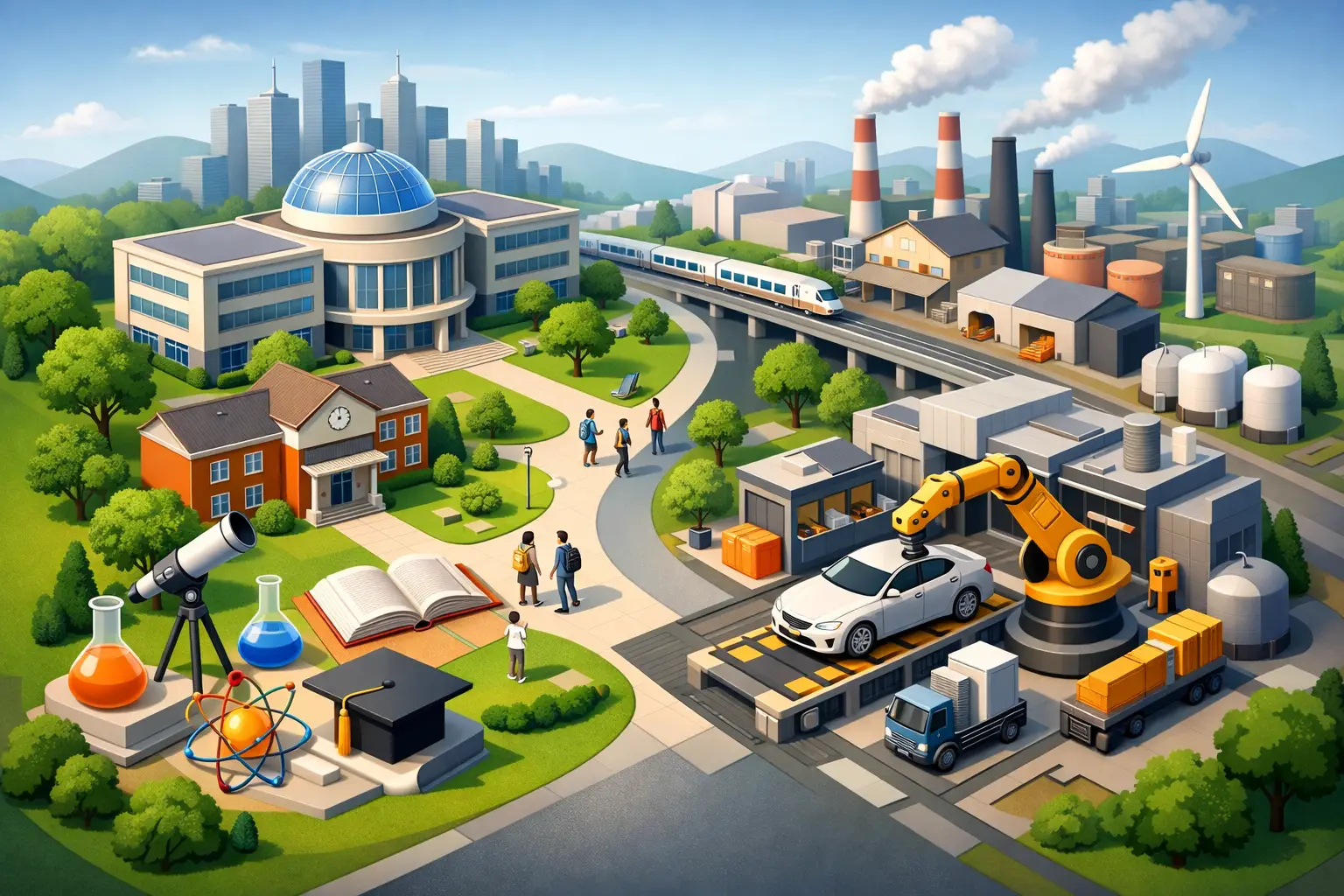
A manufacturing hub can have world-class utilities, efficient logistics, and sector-specific facilities, yet still fall short if talent has to be imported, retrained, or replaced at scale. That is why educational institutions in a manufacturing hub are not a social add-on. They are core industrial infrastructure.
For investors and operators in advanced manufacturing, the question is no longer whether a location has access to labor. The real question is whether it can build, renew, and retain capability over time. Semiconductor production, EV assembly, hydrogen systems, precision engineering, clean energy equipment, and aerospace-adjacent manufacturing all depend on a workforce pipeline that is technical, adaptable, and increasingly interdisciplinary. When education is embedded inside the industrial ecosystem, that pipeline becomes faster, more relevant, and far more durable.
Why educational institutions in a manufacturing hub matter
The traditional model separates production from learning. Companies build factories in one zone, universities teach in another, and technical training providers operate somewhere in between. That distance creates friction. Employers face slower hiring cycles, higher onboarding costs, and a mismatch between what graduates know and what production environments actually require.
Educational institutions in a manufacturing hub compress that distance. They place technical education, applied research, workforce development, and employer collaboration close to where industrial activity is happening every day. That proximity changes outcomes.
First, it improves workforce readiness. Students and trainees learn against live industry requirements rather than outdated assumptions. Course design can reflect current machinery, digital systems, compliance standards, and production methods.
Second, it strengthens retention. Skilled professionals are more likely to stay in a location when learning, career progression, and quality of life are connected. A hub that combines industry with education creates a clearer long-term path for workers and their families.
Third, it increases investor confidence. Manufacturers making capital-intensive decisions want evidence that talent supply will not become a future bottleneck. Education partnerships signal that the hub is designed for sustained industrial growth, not short-term occupancy.
From labor supply to capability formation
Many industrial locations still market workforce availability as a numbers game. How many workers are nearby? What are wage levels? How quickly can staffing be scaled? Those metrics matter, but they are incomplete for high-value manufacturing.
Advanced industry depends less on generic labor pools and more on capability formation. That includes technician training, engineering depth, digital literacy, lab competency, safety culture, and the ability to work across automation, quality assurance, and regulated production environments.
This is where educational institutions become strategically important. A technical college that teaches industrial maintenance, mechatronics, cleanroom protocols, battery systems, or CNC operations is directly influencing productivity. A university with applied research programs in materials science, energy systems, robotics, or process engineering is shaping the innovation base around the hub. An industry-linked training center that can reskill workers as technologies change reduces operational risk for tenants.
The strongest manufacturing ecosystems do not treat these as separate functions. They treat them as one operating system.
What serious investors should look for
Not every education presence inside an industrial zone creates value. A campus alone is not enough. What matters is alignment with the sectors the hub is trying to attract.
If the manufacturing strategy is centered on EVs, hydrogen mobility, semiconductors, renewable energy, or advanced assembly, then the education layer should reflect those priorities. That may mean specialized labs, vocational pathways, certification programs, apprenticeship structures, and research partnerships designed around those industries.
It also means speed. Industrial sectors evolve quickly. Education partners must be able to update curricula, launch targeted training, and respond to employer demand without long institutional delays. A rigid academic model can still leave manufacturers carrying the burden of workforce preparation themselves.
The more effective approach is co-development. Employers help shape training outcomes. Institutions provide educational rigor and talent pipelines. The hub operator creates the physical and strategic environment where that collaboration can happen at scale.
The operational advantage of proximity
There is a practical reason this matters beyond strategy decks and long-range planning. Proximity reduces cost.
When educational institutions are integrated into a manufacturing hub, companies can access internships, apprenticeships, faculty partnerships, prototype support, and training facilities without building every capability in-house. That lowers recruitment friction and shortens the gap between hiring and productive contribution.
It also supports continuous improvement. Existing workers can return for modular training in automation systems, ESG compliance, maintenance analytics, quality management, or production software without leaving the broader industrial ecosystem. That is particularly valuable in sectors where technology adoption is moving faster than legacy workforce models can absorb.
There is, however, a trade-off. Education embedded in a hub must avoid becoming too narrow. If training is built only around immediate tenant needs, it can solve short-term staffing issues while limiting broader adaptability. The better model balances current industry demand with transferable skills, so workers remain valuable as sectors evolve.
Educational institutions in a manufacturing hub and R&D strength
Talent is only one side of the equation. The other is innovation.
Manufacturing hubs that aim to lead in high-growth sectors need more than production capacity. They need a mechanism for testing, refining, and commercializing ideas. Educational institutions contribute to that through applied research, shared labs, industry projects, and technical problem-solving.
This is especially relevant in industries where process improvement and product innovation happen continuously. Battery chemistry, lightweight materials, industrial software, hydrogen systems, and precision components all benefit from direct collaboration between production teams and research talent. When those connections are local, iteration cycles become shorter.
That does not mean every hub needs a research university on day one. It depends on the sectors being targeted and the maturity of the ecosystem. Some hubs may start with technical institutes and workforce academies, then add research partnerships as the industrial base deepens. Others may need full R&D capability from the outset if they are competing for frontier manufacturing investment.
The key is intentional design. Education should not arrive as an afterthought once factories are occupied. It should be planned as part of the value proposition from the beginning.
Why this model supports long-term industrial growth
A manufacturing hub succeeds over decades, not leasing cycles. That requires more than land, buildings, and utility capacity. It requires a living ecosystem that can support workers, attract families, develop skills, and keep industry relevant.
Educational institutions play a central role in that wider equation. They support social stability, workforce retention, and upward mobility. For multinational manufacturers evaluating expansion into the Middle East or other growth markets, this matters more than it may appear on paper. A location that can support both operations and people is more resilient than one built around production alone.
This is where integrated industrial ecosystems stand apart from conventional industrial parks. When education sits alongside housing, healthcare, retail, logistics, and R&D infrastructure, the result is not just convenience. It is a stronger operating environment. Workers stay longer. Employers gain continuity. The ecosystem becomes more investable.
In large-scale developments built around future sectors, such as those envisioned by Rana Group, education is part of what turns industrial real estate into strategic economic infrastructure. It helps create a place where advanced production can scale without running into the same workforce and innovation constraints that undermine many expansion plans.
A better way to assess industrial readiness
For decision-makers, the implication is clear. When evaluating a manufacturing hub, do not treat education as a peripheral amenity. Assess it the same way you assess logistics access, energy reliability, land configuration, and policy environment.
Ask whether the hub can produce technicians, engineers, supervisors, and specialists relevant to your sector. Ask whether reskilling is built into the ecosystem. Ask whether there is a pathway from classroom to factory floor to advanced technical leadership. Ask whether educational institutions are linked to the hub’s actual industrial priorities, or simply present in name.
The strongest hubs will answer those questions with structure, not slogans. They will show how education supports recruitment, retention, productivity, R&D, and long-term competitiveness.
That is the standard the next generation of industrial development will be judged by. Factories can be built quickly. Capability takes longer. The hubs that treat education as infrastructure are the ones building for staying power.
The future of manufacturing will belong to places that make talent as intentionally as they make products.
