
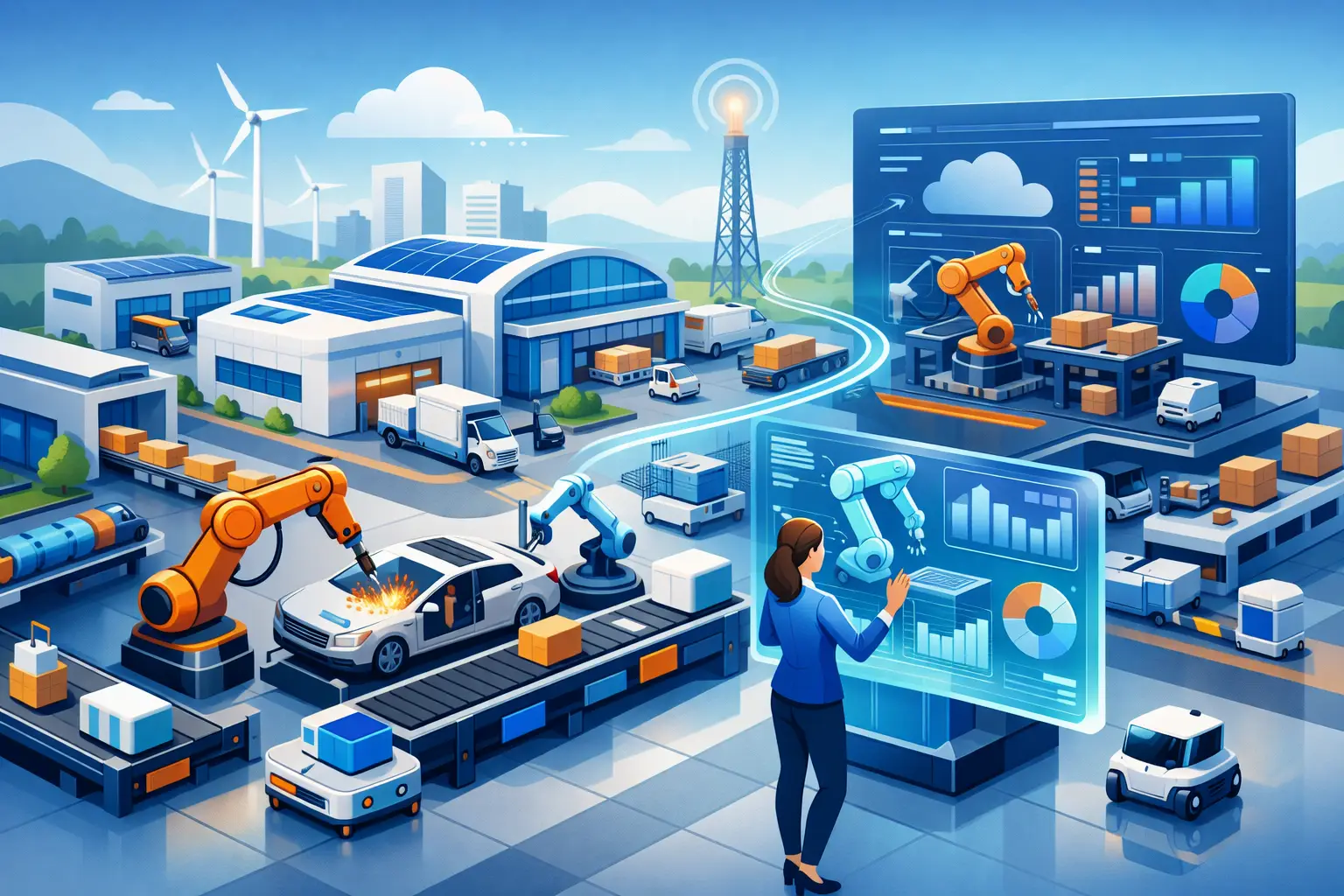
Industrial expansion decisions are rarely delayed by ambition. They are delayed by missing infrastructure, uncertain timelines, weak logistics, and talent ecosystems that stop at the factory gate. That is why the statement Erisha Smart Manufacturing Hub is progressing well matters beyond project optics. For manufacturers, investors, and strategic partners, progress only counts when it translates into real operational readiness, stronger economics, and a credible path to scale.
This is not a conventional industrial park story. The value of Erisha lies in how the project is being shaped as a complete industrial ecosystem – one designed for advanced production, long-term workforce retention, ESG alignment, and sector-specific growth. For decision-makers evaluating expansion in the Middle East, the real question is not whether a site is under development. It is whether that development is moving in the right direction for modern industry.
Why Erisha Smart Manufacturing Hub is progressing well
Progress in industrial development should be measured against outcomes, not headlines. In Erisha’s case, the positive trajectory is tied to a development model built around the actual requirements of high-value manufacturing. That includes purpose-built facilities, integrated logistics, utility planning, workforce support assets, and room for industry clusters that benefit from proximity rather than isolation.
That approach matters because advanced manufacturers do not simply need land. They need infrastructure that reduces time to operation, lowers friction across supply chains, and supports strict technical requirements. A semiconductor supplier, an EV component producer, and a hydrogen mobility company may all need different production environments, but they share the same need for predictability. The fact that Erisha is progressing with this level of sector awareness is a strong signal for institutional and industrial occupiers.
Just as important, progress is being defined through integration. Industrial production no longer succeeds on factory efficiency alone. It depends on whether talent can live nearby, whether technical staff can access healthcare and education, whether logistics networks are designed for movement at scale, and whether the broader environment supports retention. Erisha’s model addresses those variables as part of the asset base, not as afterthoughts.
What progress means for industrial investors
For investors, a well-progressing manufacturing hub is not only a construction milestone. It is a risk-reduction story. Every sign of structured development improves confidence around leasing velocity, tenant attraction, infrastructure timing, and long-term asset performance.
In practical terms, this means the hub is advancing in a way that supports different forms of capital. Industrial occupiers look for speed, facility readiness, and operating cost advantages. Strategic investors look for sector concentration, sustained demand, and ecosystem stickiness. Institutional partners look for governance, sustainability alignment, and evidence that the development can remain relevant as industrial priorities shift.
Erisha is compelling because it sits at the intersection of those interests. A mixed-use, industrial-first master plan creates more resilience than a single-purpose estate. It broadens demand drivers while deepening tenant commitment. When manufacturers can operate inside a live-work-innovate environment instead of a disconnected site, the location becomes harder to replace and more valuable over time.
This is particularly relevant for sectors with long planning cycles and high capital intensity. Electric mobility, clean energy systems, aerospace-adjacent production, and semiconductor-related operations all require confidence that the surrounding ecosystem will mature alongside the factory footprint. A project that is progressing well in these areas is not merely adding inventory. It is building strategic relevance.
Infrastructure quality matters more than simple speed
A fast project that misses technical requirements can create more cost than it saves. That is why the quality of Erisha’s progression deserves attention. The hub is being positioned around infrastructure that reflects where industrial demand is moving, not where it was a decade ago.
That includes turnkey factories for speed-to-market requirements, modular industrial units for scalable entry and phased growth, logistics facilities that support regional distribution, and cleanroom-ready spaces that align with more complex manufacturing needs. Each of these formats serves a different profile of tenant, but together they create a broader industrial platform.
There is also a strategic advantage in cluster planning. Advanced industry increasingly benefits from adjacency. Suppliers want to sit near OEMs. Research partners need access to manufacturing environments. Specialized service providers gain efficiency when multiple relevant tenants are concentrated in one geography. A hub designed around EVs, hydrogen mobility, eVTOL systems, renewable energy production, and related sectors can create shared momentum that standalone facilities cannot.
That clustering effect often determines whether a development becomes a regional landmark or remains a standard industrial address. Progress at Erisha appears to be moving toward the former.
The location advantage only works when the ecosystem is credible
Ras Al Khaimah offers a compelling operating environment for manufacturers that want cost efficiency, access to ports, business-friendly regulation, and strong connectivity into GCC and global markets. But location by itself is never enough. Many expansion strategies fail because a good map position is not matched by good industrial planning.
What strengthens Erisha’s proposition is the way the location advantage is being translated into an ecosystem strategy. Lower operating costs matter more when they are paired with facilities designed for production. Port access matters more when logistics and warehousing are integrated into the master plan. Investor-friendly regulation matters more when the project itself is structured to support cross-border business, technical partnerships, and scalable occupancy.
This is where the development becomes more than real estate. It becomes economic infrastructure. That distinction matters to global manufacturers comparing sites across the Gulf, South Asia, Europe, and North America. They are not selecting a parcel. They are selecting an operating model.
ESG compliance is now an industrial requirement
For many global manufacturers, ESG is no longer a communications layer. It is a procurement issue, an investment committee issue, and in many cases a market-access issue. Sites that cannot demonstrate environmental alignment, resource planning, and long-term sustainability logic are losing ground.
A smart manufacturing hub that is progressing well today must therefore show more than industrial capacity. It must reflect where investor expectations and corporate reporting obligations are heading. The inclusion of sustainable planning principles, integrated community assets, and sector-specific infrastructure for clean technologies gives Erisha an advantage with occupiers that need future-ready positioning, not just near-term space.
There are trade-offs here. ESG-aligned development can require higher early-stage planning discipline and more coordination across utilities, land use, and construction sequencing. But that discipline tends to create a more durable asset. For serious industrial players, that is usually the better equation.
Why sector readiness changes the investment case
Not every manufacturing hub is built for advanced industry. Some are flexible in theory but generic in execution. That creates hidden costs for occupiers who later need technical retrofits, specialized environmental controls, or supply chain adjacency that was never designed into the site.
Erisha’s direction matters because the development thesis is anchored in sectors with strong long-range growth: electric vehicles, hydrogen mobility, semiconductors, renewable energy, and aerospace-adjacent manufacturing. These are not trends built on short-term demand spikes. They are sectors shaped by policy support, capital inflows, decarbonization pressure, and supply chain restructuring.
When a hub is planned with these sectors in mind, the economics improve for everyone involved. Tenants gain a more suitable operating environment. Investors gain exposure to industries with structural tailwinds. Strategic partners gain a platform for R&D, piloting, and market entry. That is a very different proposition from standard industrial leasing.
What decision-makers should watch next
The next stage of confidence will come from continued evidence of readiness: how quickly facilities can move from plan to operation, how effectively cluster logic translates into tenant mix, and how well the broader live-work-innovate model supports workforce attraction and retention.
For multinational manufacturers, the central question is straightforward. Can this hub support production today while staying relevant over the next decade? For investors, the test is whether development quality and sector alignment can translate into lasting demand. For strategic collaborators, the opportunity lies in joining an ecosystem early enough to help shape its industrial identity.
That is why the momentum behind this project deserves serious attention. Erisha Smart Manufacturing Hub is progressing well not because progress is being claimed, but because the development logic aligns with what advanced industry now requires: sector-ready infrastructure, integrated community planning, sustainability discipline, and a location positioned to serve regional and global growth. In a market where many projects promise future value, the stronger signal is a hub that is already being built around how the future works.
