
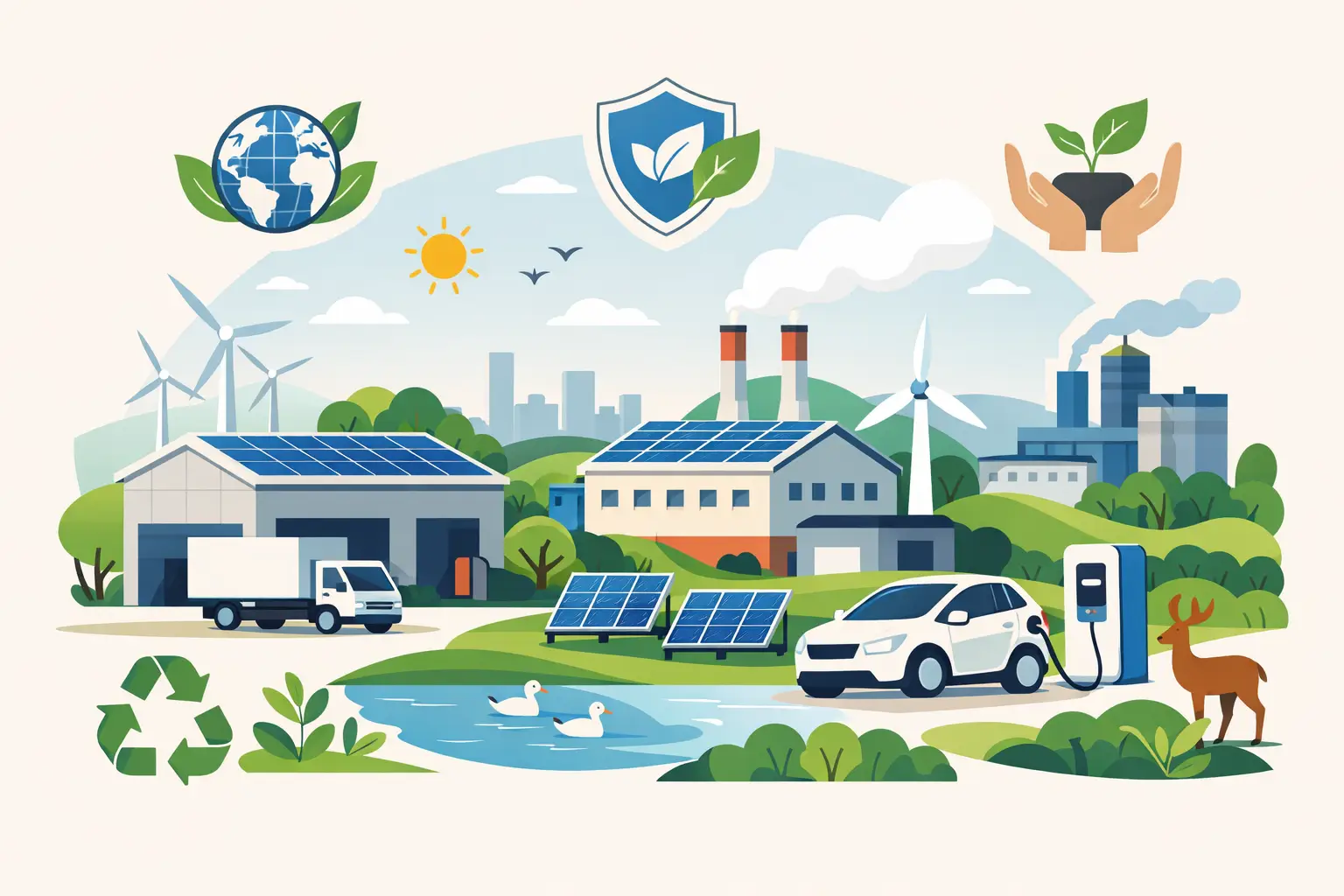
What an ESG compliant industrial park really means
For industrial investors and manufacturers, ESG is no longer a branding exercise handled after site selection. It is now part of the location decision itself. If a park cannot support lower emissions, responsible resource use, workforce well-being, and governance transparency at scale, it creates friction from day one – in financing, compliance, talent retention, and customer trust.
That is why the idea of an ESG compliant industrial park matters more than ever. Not as a marketing label, but as a test of whether industrial infrastructure is actually built for the next decade of manufacturing.
A genuinely ESG-aligned park does more than offer plots, roads, and utilities. It is master-planned to help occupiers meet environmental targets, operate with greater efficiency, and embed social value into the way industrial growth happens. For advanced manufacturing sectors such as EVs, hydrogen mobility, semiconductors, renewable energy, and aerospace-adjacent production, that distinction is becoming commercially decisive.
Why ESG compliance starts with the park, not just the tenant
Many manufacturers already have internal ESG targets. The problem is that these targets are often constrained by the industrial environments they move into. A factory can invest in cleaner systems, better reporting, or workforce programs, but its performance is still shaped by the surrounding infrastructure.
If the power mix is inefficient, if logistics routes are poorly designed, if water systems are wasteful, or if the site lacks access to housing and workforce services, the burden shifts back onto the tenant. That raises capital expenditure, lengthens ramp-up timelines, and weakens the business case for expansion.
An ESG compliant industrial park changes that equation. It embeds sustainability and operational discipline into the base layer of the development. That means utilities, transport planning, land use, building standards, waste systems, worker amenities, and governance structures are aligned from the outset.
This is especially relevant in the Gulf, where industrial growth is accelerating alongside national diversification agendas. Investors are not just asking where production can happen. They are asking where it can happen efficiently, credibly, and at a scale that remains competitive over time.
The environmental standard is higher than basic efficiency
Environmental compliance in an industrial setting is often misunderstood as energy-efficient buildings plus some landscaping. That is far too narrow.
In a serious industrial ecosystem, environmental performance must be designed across the full operating model. It includes power strategy, water stewardship, material flows, mobility, emissions management, and land efficiency. It also has to account for the needs of high-value industries that require specialized conditions, from cleanroom readiness to heavy logistics access.
A strong park reduces emissions not only through building performance, but through location logic. Proximity to ports, regional transport corridors, and supplier networks can materially reduce freight complexity and transport-related emissions. Smart site planning can also cut internal movement times, improve energy load management, and support future integration with renewable energy sources.
But there are trade-offs. Some advanced industrial uses are energy-intensive by nature. Semiconductor fabrication, battery production, hydrogen-related infrastructure, and temperature-sensitive operations cannot be assessed with simplistic sustainability metrics. The real question is whether the park enables these industries to improve environmental performance over time without compromising output.
That is why future-ready utility design matters. A park that can support renewable integration, efficient cooling systems, water recycling, and scalable grid capacity gives occupiers a credible path to better performance. A park that cannot will eventually force expensive retrofits.
The social dimension is where many industrial parks fall short
Industrial development has often treated the workforce as external to the asset. People commute in, work, and leave. That model looks increasingly outdated.
A modern ESG compliant industrial park recognizes that workforce stability is part of industrial productivity. If tenants struggle with recruitment, retention, housing access, training pipelines, healthcare availability, or quality-of-life factors, operational performance suffers. So does long-term investor confidence.
This is where integrated development becomes a strategic advantage rather than an amenity package. When industrial infrastructure is planned alongside residential, healthcare, education, retail, hospitality, and research assets, the park begins to function as an economic ecosystem instead of a disconnected employment zone.
That matters for global manufacturers entering new markets. Expansion is not only about factory delivery and utility access. It is also about whether engineers, technicians, operators, and management teams can build stable lives around the facility. For companies in innovation-heavy sectors, the surrounding environment can influence talent attraction just as much as the production unit itself.
The most credible industrial platforms understand that social infrastructure is not separate from core performance. It supports workforce resilience, lowers churn, shortens onboarding friction, and strengthens the long-term viability of tenant operations.
Governance is the hidden factor investors watch closely
Governance tends to receive less public attention than environmental claims, but for institutional capital and multinational occupiers, it is often the deciding factor.
An ESG compliant industrial park must be governed in a way that gives investors confidence in compliance, reporting, land use discipline, operational transparency, and long-term execution. If standards are vague or inconsistently enforced, the park may look ambitious on paper while creating risk in practice.
Clear governance shows up in practical ways. It appears in development phasing, infrastructure delivery schedules, tenant alignment, environmental monitoring, safety systems, and the ability to coordinate multiple industrial clusters without losing operational order. It also appears in how well the platform supports regulatory clarity and strategic alignment with national industrial priorities.
For foreign manufacturers and investment committees, this matters because they are not simply acquiring space. They are committing capital into an operating environment. Governance determines whether that environment remains credible as the project scales.
Why sector specialization changes the ESG equation
Not every industrial park needs to serve every industry. In fact, trying to do so can dilute both performance and compliance.
Sector-specialized development is often better positioned to deliver meaningful ESG outcomes because infrastructure can be tailored to actual industrial needs. EV manufacturing, hydrogen mobility, advanced materials, aerospace-adjacent production, and semiconductor operations each require different utility profiles, safety parameters, logistics patterns, and workforce ecosystems.
When a park is designed around these realities, efficiency improves. Shared infrastructure can be more relevant. Support services become more targeted. Innovation partners and supply chain participants can cluster in ways that reduce duplication and increase operational coherence.
There is also a strategic signaling effect. A specialized industrial hub tells investors that the developer understands the sectors shaping future economic growth and is willing to build for them with precision. That is very different from offering generic industrial land and expecting tenants to solve the complexity themselves.
ESG compliance has become a competitive advantage in site selection
For years, companies treated ESG criteria as one line item among many. That is changing. In many boardrooms, ESG performance now influences access to capital, customer qualification, procurement standards, and cross-border partnership opportunities. As a result, the quality of the industrial location itself has become part of competitive positioning.
A well-executed ESG compliant industrial park can lower operating friction, support reporting obligations, and improve readiness for future regulation. It can also make an expansion case stronger when leadership is comparing markets across the Middle East, Asia, Europe, or North America.
This does not mean every investor prioritizes ESG in the same way. Some will focus on energy efficiency and cost control. Others will care more about governance, labor ecosystem quality, or alignment with their own decarbonization roadmap. But across these different priorities, one pattern is clear: parks that integrate ESG into infrastructure are better positioned than those that treat it as a later overlay.
What serious investors should look for
When evaluating an ESG compliant industrial park, investors should look beyond claims and examine the operating logic of the site. Does the master plan support efficient industrial movement and land use? Are utilities built for advanced manufacturing loads and future sustainability upgrades? Is the workforce ecosystem treated as core infrastructure? Are governance standards visible in delivery planning and tenant strategy?
They should also ask whether the park supports long-term industrial clustering rather than isolated occupancy. Clusters create compounding advantages when suppliers, manufacturers, R&D partners, and service providers can operate in proximity. That is where ESG moves from compliance language to measurable business value.
This is the model now gaining momentum in the UAE, where industrial policy, infrastructure investment, and sustainability ambitions are increasingly moving in the same direction. Platforms such as Rana Group’s Erisha Smart Manufacturing Hub reflect this shift toward integrated, sector-specific environments designed for long-horizon industrial growth.
The future will not be built in industrial parks that simply warehouse production. It will be built in ecosystems that help manufacturers scale responsibly, attract talent, and stay aligned with the expectations of capital, regulators, and global markets. For investors making location decisions now, that is the real standard worth measuring against.
