
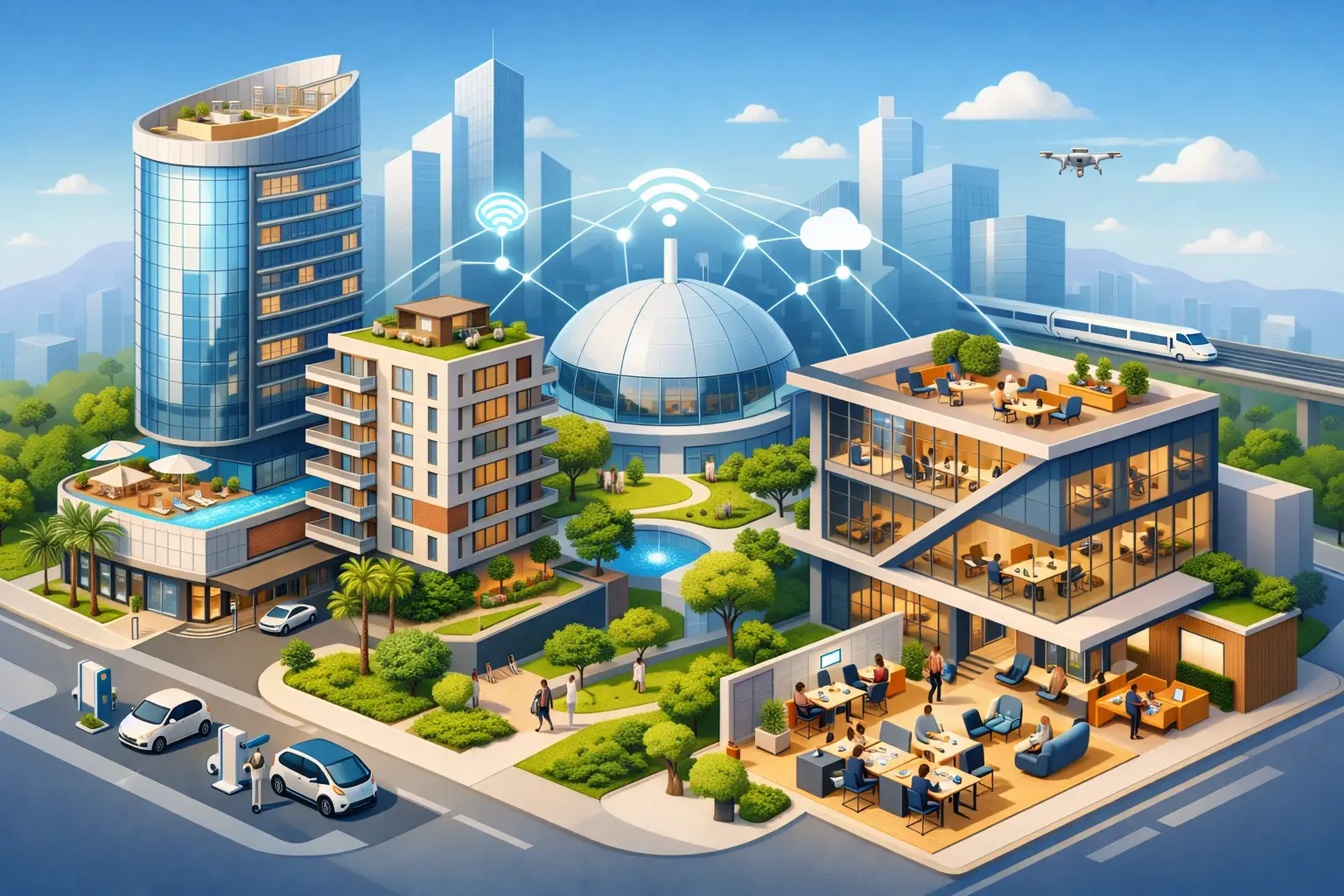
A manufacturing platform stops being strategic the moment executives, engineers, suppliers, and technical teams have to leave the site to live, meet, recover, or collaborate. That is why hotels residence and co working space in smart manufacturing hub developments are no longer lifestyle add-ons. They are core operating infrastructure.
For industrial investors and advanced manufacturers, the question is not whether mixed-use assets look attractive on a master plan. The real question is whether they reduce friction across talent mobility, project delivery, customer engagement, and long-term expansion. In a high-value manufacturing environment, the answer is often yes – if these components are planned with the same discipline as factories, logistics corridors, utilities, and sector clusters.
Why hotels residence and co working space in smart manufacturing hub matter
A smart manufacturing hub is built to compress time, cost, and complexity. Production space does part of that work. So do logistics facilities, power systems, and regulatory access. But industrial performance is also shaped by what happens between shifts, between meetings, and between project phases.
A visiting semiconductor equipment supplier arriving for a three-day installation needs immediate proximity, not a one-hour commute from a city hotel. A hydrogen mobility startup scaling from pilot to production needs flexible workspace before it commits to larger floorplates. A senior operations lead relocating for a new plant launch needs residential options that support family stability, not a temporary patchwork of off-site arrangements. These are not soft factors. They affect speed to market, hiring outcomes, and operational continuity.
When hospitality, residential, and co-working assets are embedded within a manufacturing hub, the result is a more investable environment. It signals that the hub understands how industrial ecosystems actually function. Companies do not expand into isolated boxes. They expand into places where people can work, stay, build, and return.
The operating value of on-site hospitality
Hotels inside or adjacent to industrial districts have a practical advantage that traditional business hotels often miss. They serve a specific rhythm of industrial activity. Commissioning teams arrive in waves. Auditors visit with little notice. Procurement partners need overnight stays tied to plant schedules. Customers touring advanced production lines expect a professional hosting environment close to the factory floor.
That proximity shortens dead time and improves coordination. It also changes how a hub presents itself to international partners. A serious industrial ecosystem should be able to receive delegations, host technical workshops, accommodate consultants, and support executive decision-making without depending on fragmented third-party infrastructure.
There is also a brand effect. Investors notice whether a manufacturing district feels temporary or fully formed. On-site hospitality suggests permanence, confidence, and readiness for international business. For emerging industrial sectors such as EVs, clean energy systems, aerospace-adjacent production, and advanced materials, that perception matters.
Still, not every hotel model fits. A hub focused on long-stay technical visitors may need serviced accommodations more than luxury inventory. A hub attracting investors and government delegations may need executive-grade conference and lodging capacity. The right mix depends on tenant profile, visitor frequency, and the maturity of the industrial base.
Why residence is a retention strategy, not a real estate feature
Manufacturing leaders know that workforce attraction is only half the challenge. Retention is where expansion plans either stabilize or start leaking value. Skilled operators, engineers, plant managers, and R&D professionals are far more likely to commit to a location when residential infrastructure is part of the ecosystem.
Residence within a smart manufacturing hub supports a deeper form of industrial continuity. It reduces commute volatility, improves shift reliability, and makes relocation easier for specialist talent. More importantly, it helps create a community around production rather than a workforce that disperses each evening into disconnected urban zones.
For employers, that has measurable value. Lower turnover protects training investment. Better residential options support family relocation and longer tenure. A live-work environment can also strengthen recruitment for globally mobile talent who compare industrial locations not only on salary and tax conditions, but on quality of daily life.
The trade-off is that residential assets must be planned carefully. Heavy industry and housing cannot simply sit side by side without environmental controls, mobility planning, and service buffers. Noise, freight movement, safety requirements, and land-use sequencing all matter. The most effective hubs solve this through master planning, not improvisation.
Co-working has a real role in industrial ecosystems
Co-working is often associated with startups, creative sectors, or urban office culture. In a smart manufacturing hub, its value is different and much more strategic.
Industrial co-working space creates an early-stage landing zone for companies that are not ready for a full facility but need to begin market entry, local hiring, engineering coordination, or partner engagement. It gives project teams a place to operate during pre-construction, fit-out, certification, or pilot phases. It also supports ecosystem participants that are essential to manufacturing growth but do not require factory floors of their own, such as design consultants, software partners, testing specialists, legal advisors, and procurement teams.
This is especially relevant in sector-specific clusters. Clean-tech companies, mobility firms, component suppliers, and advanced engineering groups benefit from short distances between office collaboration and technical operations. Decisions move faster when the meeting room, prototype discussion, and site walk can happen within one integrated environment.
Co-working also helps a hub maintain momentum. Not every tenant enters at full scale. Some begin with representation offices or innovation teams before committing capital to industrial units. Flexible workspace captures that early demand and converts it into longer-term occupancy.
What decision-makers should evaluate
For C-suite leaders and expansion teams, hotels residence and co working space in smart manufacturing hub projects should be assessed as infrastructure with performance implications, not as amenities listed on a brochure.
The first test is proximity. If these assets are too far from core industrial zones, their value drops quickly. Travel minutes matter when schedules are tied to production windows, installation timelines, or visiting delegations.
The second is alignment with tenant profile. A hub serving advanced manufacturing, R&D-heavy sectors, and globally mobile technical teams needs a different hospitality and workspace mix than a conventional warehousing park. Short-stay executives, long-stay engineers, startup partners, and institutional visitors each create different demand patterns.
The third is integration with services. Residence without healthcare, retail, and education support can struggle to retain families. Co-working without meeting infrastructure, business services, and digital reliability becomes decorative. Hospitality without transport coordination and site access loses practical value.
The fourth is governance. Mixed-use industrial ecosystems succeed when a single vision shapes operations, standards, ESG compliance, mobility, and land use over time. Without that, the experience becomes fragmented, and the strategic case weakens.
From industrial park to complete ecosystem
This is where the market is separating. Traditional industrial parks provide land and sheds. Next-generation hubs provide a platform for growth. The difference is not cosmetic. It affects how quickly tenants scale, how confidently investors commit, and how resilient the ecosystem becomes over a ten-year horizon.
An advanced manufacturing hub that combines production infrastructure with hospitality, residential capacity, and flexible collaboration space is better positioned to attract multinational occupiers and strategic partners. It speaks to the real operating model of modern industry, where engineering, supply chain, talent, compliance, and capital all need to move together.
That is the logic behind integrated developments such as Rana Group’s vision for Erisha Smart Manufacturing Hub. The industrial proposition gains strength when workforce support, investor hosting, innovation space, and daily livability are built into the same environment rather than outsourced to disconnected districts.
Hotels residence and co working space in smart manufacturing hub environments are ultimately about one thing: reducing the friction that slows industrial growth. For manufacturers building regional platforms, and for investors backing long-term production capacity, that friction matters more than almost anything else.
The hubs that lead the next cycle of industrial development will not be the ones with land alone. They will be the ones where the future works – efficiently, credibly, and every single day.
