
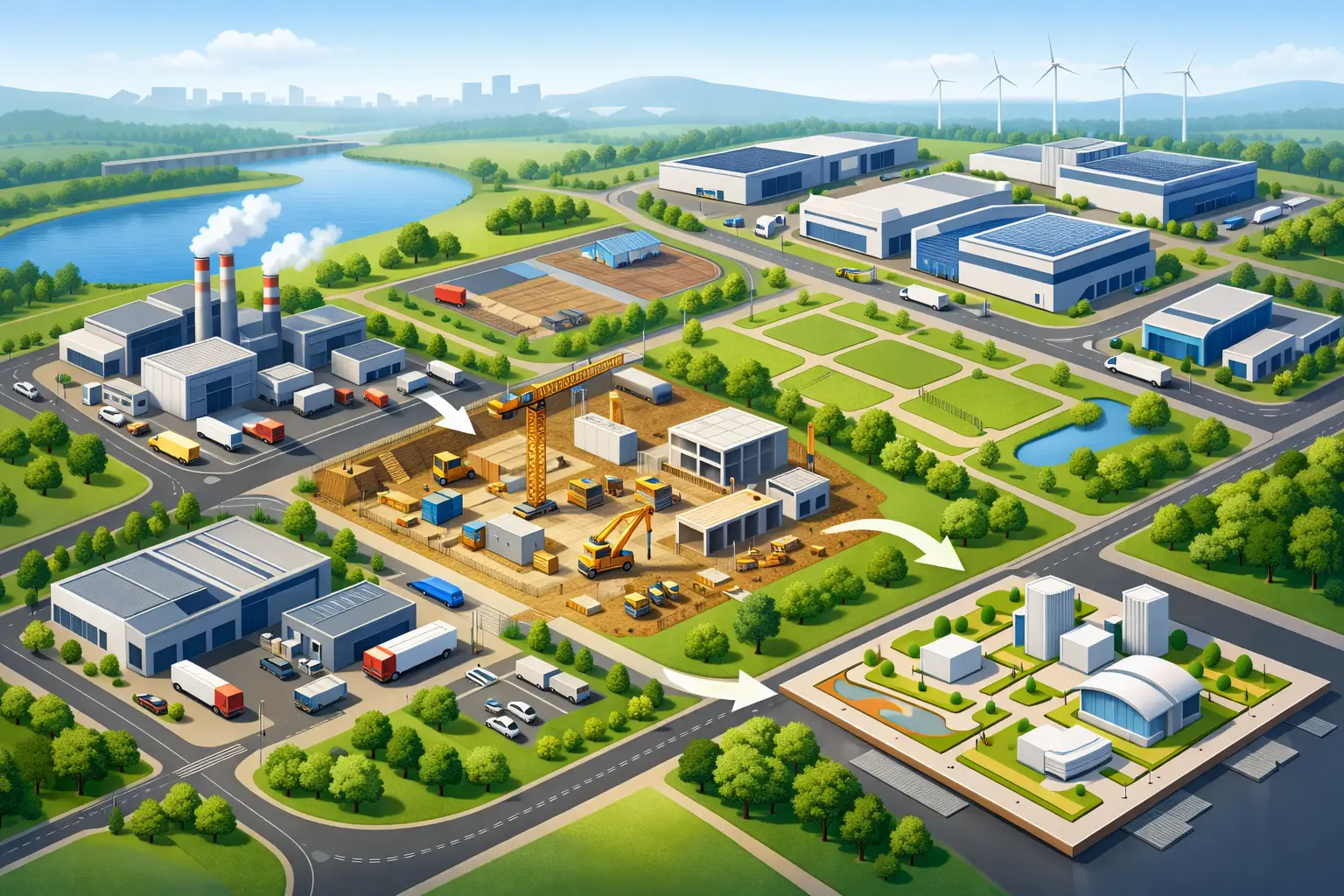
When an industrial project tries to build everything at once, it usually creates one of two problems – stranded capital or constrained growth. Too much early infrastructure can weigh on returns for years. Too little can force manufacturers to expand into a platform that was never designed for their operating reality. That is why phased industrial masterplan development has become a serious strategic discipline, not just a construction sequence.
For investors, occupiers, and strategic partners, the issue is not whether a site can be built. The issue is whether it can mature in step with demand, sector evolution, infrastructure capacity, and labor needs without losing its long-term logic. In advanced manufacturing, that distinction matters. Industrial platforms serving EV supply chains, semiconductor assembly, hydrogen mobility, aerospace-adjacent production, and renewable energy systems cannot rely on generic land release models. They need staged delivery that protects capital efficiency while preserving the future value of the whole ecosystem.
Why phased industrial masterplan development matters
A credible industrial hub has to do two things at once. It must be operationally ready for near-term tenants, and it must remain expandable for industries that may not arrive in full force until later phases. That tension sits at the center of phased industrial masterplan development.
The first phase is where many projects reveal their strengths or weaknesses. If Phase 1 is too narrow, it attracts isolated tenants but fails to establish the shared infrastructure, utilities logic, logistics systems, and support services that serious manufacturers require. If it is too ambitious, it can overbuild amenities, roads, utilities, and speculative facilities before demand is proven. Either mistake weakens the platform.
The right phased strategy creates an early operating core with enough scale to attract anchor occupiers and enough flexibility to absorb changes in sector demand. It also protects the masterplan from becoming fragmented over time. That matters because industrial value is not created only by individual buildings. It is created by the performance of the entire environment – movement of goods, workforce access, utility resilience, ESG readiness, supplier proximity, and the ability to add capacity without disrupting production.
The core logic behind a strong phasing strategy
Industrial masterplans succeed when phasing is tied to economics, not simply land availability. A site may have hundreds of acres available, but that does not mean the first release should be driven by plot count. It should be driven by the mix of sectors being targeted, the infrastructure intensity those sectors require, and the revenue profile of what can be absorbed in the market.
Advanced manufacturing clusters illustrate this clearly. EV and battery-related occupiers may need high-power capacity, hazardous materials planning, and strong freight access. Semiconductor-related users may require cleanroom-ready envelopes, vibration control considerations, and utility reliability from day one. Logistics users may be able to move faster into modular space, but they can also drive traffic patterns and road design that shape later industrial parcels. If these demands are not coordinated early, future phases become more expensive to correct.
That is why the best phasing plans begin with a platform view. Roads, substations, water systems, drainage, worker accommodation options, service corridors, digital connectivity, and logistics interfaces must be conceived for the full build-out, even if only a portion is delivered first. The capital deployment can be staged. The operating logic cannot be improvised.
What Phase 1 should actually accomplish
The first phase should do more than launch the project. It should establish confidence in the operating model.
That usually means Phase 1 has to deliver a usable ecosystem, not just isolated plots. Manufacturers evaluating regional expansion want to see whether the site can support production timelines, regulatory compliance, labor attraction, and supply chain movement with minimal friction. They are not only assessing rent or land cost. They are assessing execution risk.
A strong Phase 1 often includes a mix of purpose-built factories, modular industrial units, logistics support, utility backbone, and selected workforce-serving uses. In some masterplans, limited residential, retail, healthcare, or training functions are introduced early because they strengthen workforce retention and reduce operating friction. In others, those uses arrive slightly later because industrial absorption must lead. The right answer depends on tenant profile, labor sourcing strategy, and market depth.
This is where many conventional industrial parks fall short. They phase buildings but not ecosystems. That may work for low-complexity warehousing. It is far less effective for future-facing manufacturing sectors that depend on talent availability, supplier adjacency, and coordinated infrastructure.
Phased industrial masterplan development for sector clusters
Sector specialization changes the phasing conversation. A mixed-use industrial hub designed for high-value manufacturing cannot treat every parcel as interchangeable.
In phased industrial masterplan development, clustering should be intentional from the start. High-power users should be grouped where electrical infrastructure can scale efficiently. Clean manufacturing should be protected from incompatible adjacencies. Logistics-intensive functions should be placed to reduce internal congestion and protect future production zones. R&D, prototyping, and higher-spec manufacturing often benefit from closer proximity to collaborative and talent-support assets.
This cluster-led approach creates operational advantages, but it also improves investment signaling. When a project shows dedicated pathways for sectors such as EVs, hydrogen mobility, eVTOL, semiconductors, or renewable energy systems, it tells the market that the masterplan is aligned with actual industrial requirements rather than broad marketing language. That clarity can accelerate tenant decisions because the ecosystem appears designed for the user, not retrofitted after the fact.
There is a trade-off, though. Sector-specific infrastructure can increase early capital requirements. The answer is not to avoid specialization. It is to sequence it intelligently. Some clusters merit immediate delivery because they are tied to anchor demand or strategic policy momentum. Others should be safeguarded in the masterplan and brought online once the supporting pipeline matures.
Infrastructure timing is the real test
The most sophisticated masterplans are often judged on buildings, but their long-term performance is decided by infrastructure timing. Utility oversizing can burden early returns. Utility undersizing can stall expansion and damage tenant confidence.
A disciplined phasing model uses scalable infrastructure architecture. Power, water, wastewater, roads, and data systems are designed for ultimate capacity, but delivered in expandable increments. This protects cash flow while reducing future disruption. It also supports ESG targets more credibly, because energy systems, mobility networks, and resource efficiency measures can be embedded into the growth model rather than added later as corrective measures.
For institutional capital, this is a meaningful distinction. A phased industrial platform with clear infrastructure triggers is easier to underwrite than one that relies on broad assumptions. It gives investors a line of sight into how capex converts into occupancy, how occupancy drives ancillary demand, and how each stage reinforces the value of the next.
Why mixed-use integration changes the economics
Industrial growth is no longer only about factories and freight yards. For many advanced sectors, the quality of the surrounding ecosystem directly affects speed to occupancy and long-term retention.
That is why integrated masterplans are gaining strategic relevance. When industrial development is planned alongside housing, healthcare, education, hospitality, and innovation assets, the result is not lifestyle branding. It is operational resilience. Skilled employees stay longer. Specialist teams relocate more easily. Partners can collaborate closer to production environments. International occupiers gain a more complete landing platform.
This is especially relevant in locations competing for globally mobile manufacturers. Cost matters. Port access matters. Regulation matters. But increasingly, decision-makers also ask whether the site can support a durable workforce ecosystem and whether future phases will strengthen that environment rather than dilute it.
At www.ranagroup.ae, this broader ecosystem logic sits at the center of industrial planning because the next generation of manufacturing hubs must function as complete economic platforms, not isolated real estate products.
What investors and occupiers should look for
Not every phased plan is strategically sound. Some are simply delayed buildouts presented as masterplanning discipline. The difference lies in how clearly each phase supports the next.
Serious decision-makers should ask whether the first phase establishes genuine operating readiness, whether infrastructure expansion paths are already protected, whether sector clustering has been thought through, and whether non-industrial uses are timed to strengthen industrial performance rather than distract from it. They should also ask how the project responds if market demand changes. A strong masterplan is structured enough to create order and flexible enough to absorb new industries, different building typologies, or faster-than-expected growth.
That balance is where real industrial leadership shows. The future will not be built by projects that merely release land in stages. It will be built by ecosystems that phase infrastructure, industry, talent support, and investment logic with precision. For manufacturers and capital partners planning for the next decade, that is where the strategic edge begins.
