
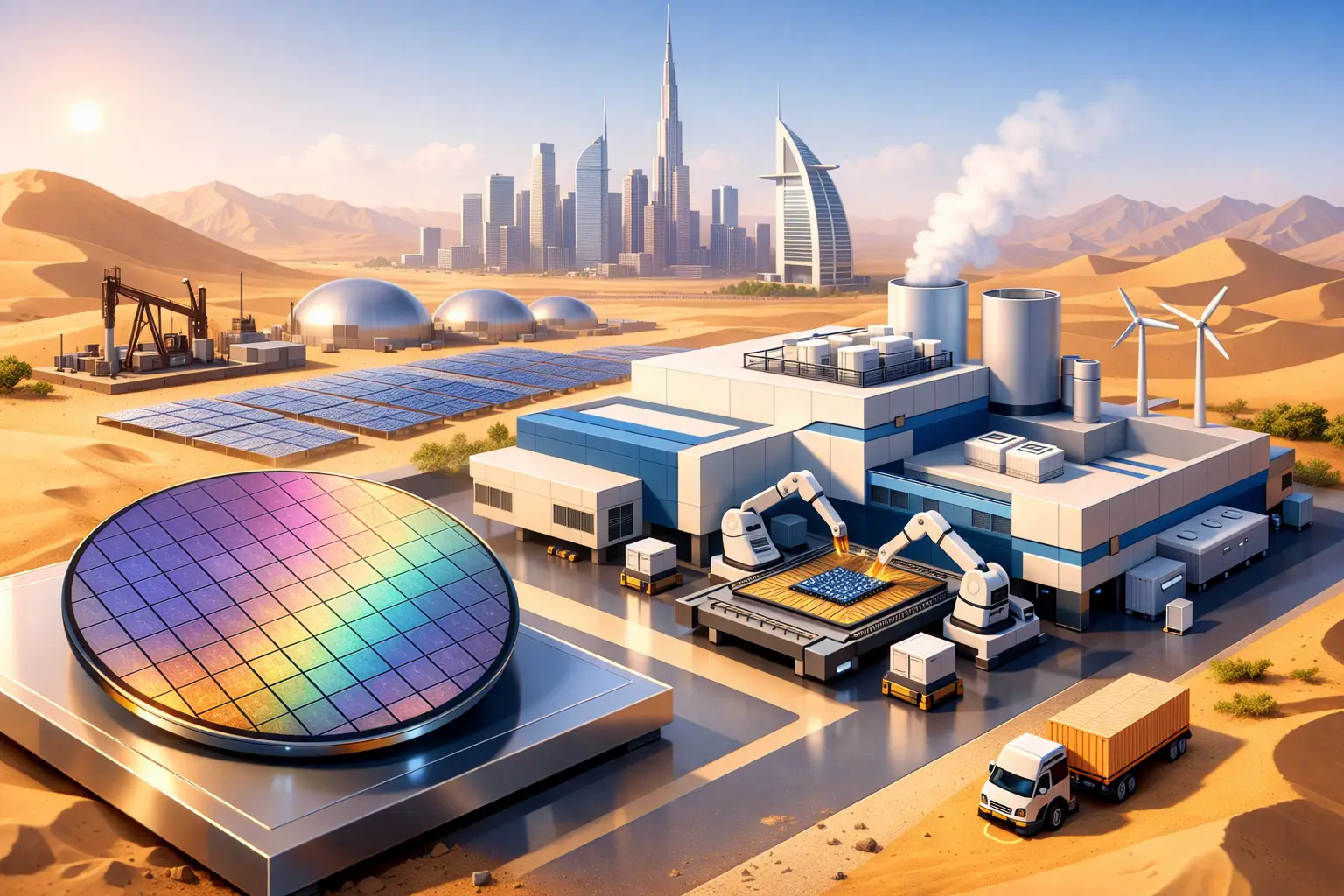
A decade ago, most boardroom conversations about chip production in this region stopped at demand growth. The Middle East consumed advanced electronics, funded technology, and imported the hardware behind modern industry, but it was rarely treated as a serious base for fabrication, packaging, or semiconductor-adjacent manufacturing. That assumption is changing. Semiconductor manufacturing in the Middle East is moving from a strategic aspiration to a practical industrial question: where can high-value production scale with the right mix of infrastructure, energy reliability, policy support, and long-term cost discipline?
For investors and manufacturers, that shift matters because semiconductors are no longer a narrow technology category. They sit inside EV platforms, renewable energy systems, aerospace electronics, industrial automation, medical devices, defense applications, and next-generation communications. Any region that wants durable industrial relevance now has to decide whether it will merely import chips or help build the supply chain around them.
Why semiconductor manufacturing in the Middle East is now credible
The case for the region is not built on rhetoric alone. It rests on structural advantages that have become more valuable as global supply chains have turned more fragile and more political.
First, energy matters. Semiconductor production is power-intensive, and the economics of fabrication, packaging, testing, and cleanroom operations are highly sensitive to energy stability and long-term utility strategy. Middle Eastern markets with reliable power infrastructure and serious clean energy ambitions can offer a proposition that aligns with both cost control and ESG requirements.
Second, geography matters in a different way than it did ten years ago. The region sits between Asian manufacturing depth, European industrial demand, and African growth markets. For companies serving multiple corridors, that positioning creates optionality. It does not replace East Asia’s entrenched semiconductor ecosystems, but it can support regionalization strategies, redundancy planning, and selective production footprints closer to end-use demand.
Third, capital and industrial policy are increasingly aligned. Governments across the Gulf are not treating advanced manufacturing as a branding exercise. They are tying it to economic diversification, export competitiveness, skilled job creation, and national technology capability. That is the right frame. Semiconductor manufacturing requires patience, policy continuity, and ecosystem thinking. Regions that approach it as core economic infrastructure are far more likely to attract meaningful investment than those chasing headlines.
The real opportunity is not just fabs
When many executives hear the phrase semiconductor manufacturing middle east, they immediately think about leading-edge wafer fabrication. That is understandable, but it is too narrow.
The semiconductor value chain is broader than front-end fabs. It includes specialty materials, gases, chemicals, precision equipment servicing, cleanroom engineering, backend assembly, packaging, testing, power electronics manufacturing, compound semiconductors, sensor production, and a wide layer of industrial support functions. In many cases, these segments offer a more realistic and commercially attractive market entry point for emerging manufacturing hubs.
That distinction matters because the barrier to entry is different across the value chain. A cutting-edge logic fab demands extraordinary capital expenditure, years of talent development, dense supplier networks, and a proven operating ecosystem. Advanced packaging, power semiconductor production, MEMS, compound semiconductors, and semiconductor-grade industrial support infrastructure can be more attainable while still delivering strategic value.
For the Middle East, the winning model may not be to replicate Taiwan or South Korea in full. It may be to build targeted excellence in the parts of the chain that align with regional strengths: energy access, export connectivity, industrial land availability, capital formation, and policy-backed infrastructure.
What advanced manufacturers will evaluate first
Serious semiconductor investors are disciplined. They do not choose a location based on incentives alone, and they certainly do not choose one based on branding. They assess execution risk.
Power quality is near the top of the list. The issue is not simply whether electricity is available, but whether supply is stable, scalable, and priced predictably over the life of the asset. Water strategy follows closely, especially for more intensive semiconductor processes. Any credible manufacturing platform also needs high-spec logistics, customs efficiency, and proximity to port and air cargo networks that reduce friction for sensitive equipment and time-critical components.
Then comes facility readiness. Semiconductor-related manufacturing cannot be dropped into generic industrial stock. It requires cleanroom-capable environments, vibration control, air handling systems, contamination management, and utility redundancy. Sites that can shorten the path from investment decision to operational readiness have a significant advantage.
Talent is the next filter. A region does not need a mature chip workforce at massive scale on day one, but it does need a plan that is believable. That means technical education pipelines, international talent access, strong residential and social infrastructure, and operating environments where highly skilled employees can stay for the long term. This is one reason integrated industrial ecosystems matter more than conventional industrial zones. The question is not just whether a company can build a facility. It is whether it can sustain a workforce and supplier base around that facility.
The Middle East advantage comes with limits
There is a strong case for semiconductor growth in the region, but discipline requires acknowledging the constraints.
No Middle Eastern market currently matches the supplier density, process know-how, or labor concentration of the world’s most established chip clusters. Building that depth takes time. It also takes anchor tenants willing to commit early and ecosystem developers capable of planning beyond Phase 1 construction.
Scale can also be misunderstood. Regional ambition is high, but not every announced advanced manufacturing plan will become a globally relevant production node. Some projects will serve domestic or regional demand. Some will be strongest in packaging, testing, or specialty devices rather than wafer fabrication. That is not a weakness. It is often the smarter path.
The right strategic question is not whether the Middle East can become the world’s sole semiconductor center. It is whether it can secure durable positions in the global semiconductor value chain while supporting adjacent industries such as EVs, clean energy systems, aerospace electronics, and automation hardware. The answer is increasingly yes, provided infrastructure and policy remain synchronized.
Infrastructure-led ecosystems will define who wins
This is where the next phase becomes more selective. Semiconductor manufacturing does not thrive in isolation. It thrives in ecosystems that reduce complexity across operations, workforce, logistics, and long-range expansion.
An industrial platform built for advanced manufacturing should offer more than land parcels and warehouse shells. It should combine cleanroom-ready space, modular scaling options, utilities planning, multimodal logistics access, and an environment that supports engineers, operators, and research talent beyond the factory gate. For investors, that ecosystem model lowers friction. For manufacturers, it improves resilience and speed.
This is especially relevant in the Gulf, where industrial development is becoming more specialized. The strongest hubs will be those designed around sectors that reinforce each other. Semiconductor-related manufacturing benefits from proximity to EV component production, power electronics, renewable energy systems, aerospace supply chains, and precision engineering services. Those adjacencies create demand, attract suppliers, and justify deeper technical infrastructure.
That is also why integrated developments such as Erisha Smart Manufacturing Hub deserve attention from strategic occupiers evaluating regional manufacturing footprints. The future of industrial competitiveness will not be decided by land cost alone. It will be decided by whether a location can support high-value production with the infrastructure, talent environment, and ecosystem depth that advanced sectors require.
What the next five years may look like
The next chapter of semiconductor manufacturing in the Middle East will likely be defined less by one headline mega-project and more by a layered buildout.
Expect growth in power semiconductors, advanced packaging, electronics manufacturing services, chip testing, and industrial support infrastructure before any broad regional leap into large-scale leading-edge fabrication. Expect stronger links between semiconductor strategy and national priorities around AI, electrification, defense capability, and renewable energy deployment. And expect site selection decisions to favor locations that can prove operational readiness, not just policy ambition.
For manufacturers, the message is straightforward: the region should no longer be assessed as a passive market alone. It should be evaluated as a platform for selective, high-value industrial deployment. For investors, the message is just as clear: the opportunity will favor ecosystems that combine infrastructure quality, regulatory clarity, and real execution capacity.
The companies that move early will not simply gain access to a growing market. They will help shape where the future works, and who gets to build it.
