
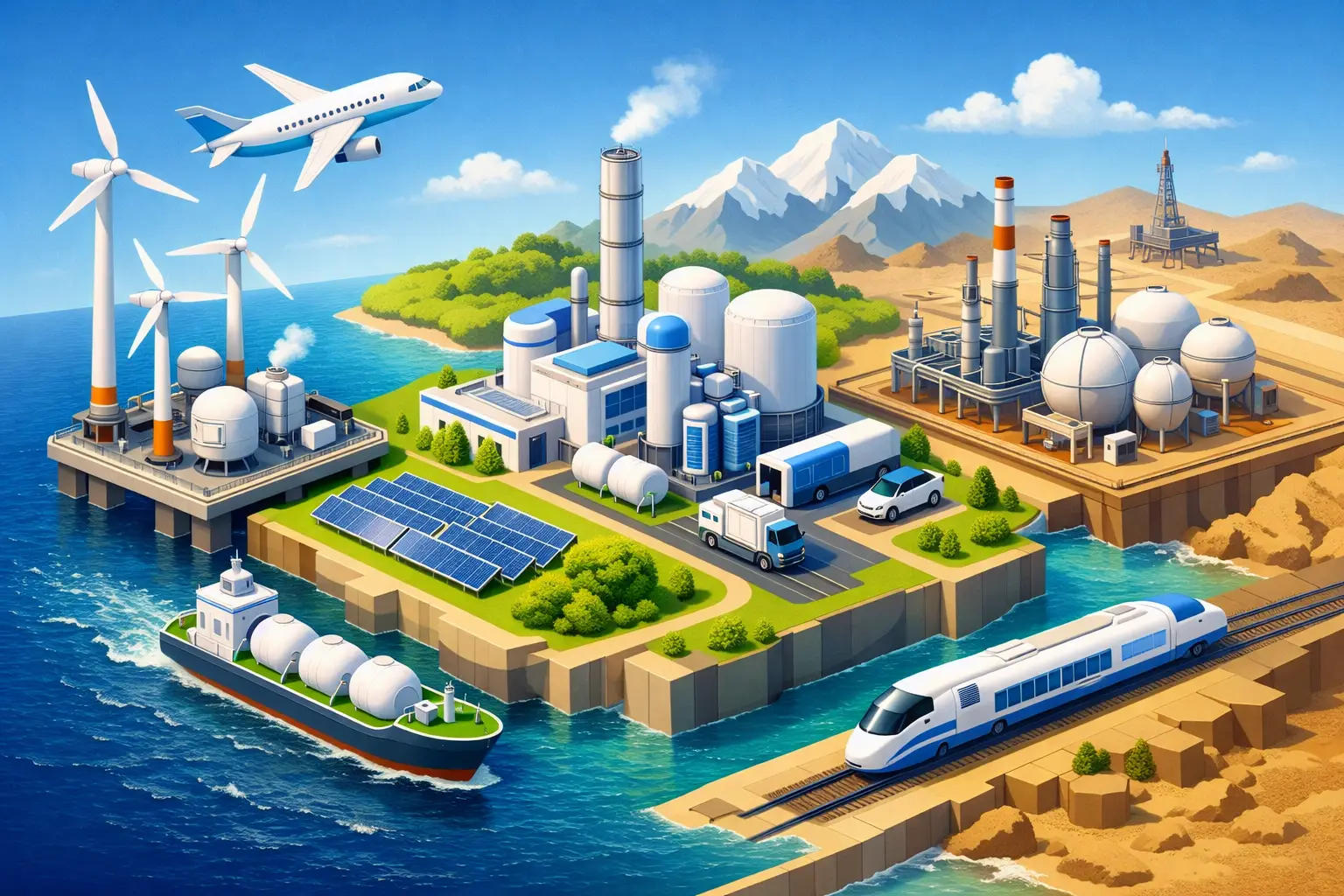
Hydrogen manufacturing is moving out of the pilot phase and into a far more demanding reality – scale, cost discipline, export readiness, and industrial integration. That shift is changing the conversation around the top locations for hydrogen manufacturing. The question is no longer which market has the strongest headline ambitions. It is which locations can support production at commercial volumes, connect output to real demand, and keep long-term operating economics competitive.
For investors, manufacturers, and clean-tech operators, geography now carries strategic weight. Hydrogen is not a uniform opportunity. A location with low-cost renewable power but weak logistics may struggle to compete. A market with strong subsidies but limited land, grid bottlenecks, or slow permitting may lose momentum. The strongest locations combine policy support with industrial fundamentals that stand up over time.
What defines top locations for hydrogen manufacturing
The most credible hydrogen manufacturing locations tend to share five characteristics. They have access to low-cost energy, especially renewable electricity or competitively priced natural gas with carbon management pathways. They offer industrial land at sufficient scale. They provide logistics infrastructure that can handle feedstocks, equipment, and downstream distribution. They sit within a regulatory framework that gives investors clarity rather than delay. And they are close to demand centers, whether in refining, chemicals, steel, heavy mobility, shipping, or export markets.
That last point matters more than many early hydrogen discussions suggested. Production alone does not create value. Hydrogen projects become durable when they are part of a wider industrial ecosystem with offtake visibility, utility coordination, storage potential, and transport links. This is why ports, manufacturing corridors, and integrated industrial zones are appearing repeatedly in serious project pipelines.
The regions leading the market
Gulf states
The Gulf has emerged as one of the most strategically advantaged regions for hydrogen manufacturing. That advantage is not based on one factor. It comes from the combination of large-scale land availability, capital capacity, port access, industrial policy, and a growing ability to pair renewable energy with export-oriented infrastructure.
The UAE and Saudi Arabia are especially important in this picture. Both markets are positioning hydrogen within broader industrial diversification agendas, not as standalone energy experiments. That distinction gives projects a stronger foundation. Hydrogen is being aligned with logistics, advanced manufacturing, mobility, and export growth, which improves the case for long-term infrastructure buildout.
For many manufacturers, the Gulf also offers something practical that is often underestimated – room to build at scale without the land fragmentation and permitting complexity common in more mature industrial regions. In markets where speed to operation matters, that can become a decisive competitive edge.
United States
The United States remains one of the top locations for hydrogen manufacturing because it combines resource diversity with policy acceleration and deep industrial demand. Different states offer different pathways. Texas and the Gulf Coast bring established energy infrastructure, export terminals, and a concentration of industrial consumers. California offers mobility demand and climate-driven policy momentum. Other states are moving through hydrogen hub initiatives that can strengthen local ecosystems.
The American advantage is breadth. Producers can pursue green hydrogen where renewable resources are strong, blue hydrogen where natural gas and carbon management systems are available, or hybrid strategies depending on regional economics. The trade-off is complexity. Incentives can be compelling, but project developers still face variation in state policy, permitting timelines, labor costs, and grid conditions.
Europe
Europe is a major demand center and a serious policy market, but it is a more mixed case for manufacturing leadership. Countries such as Germany, the Netherlands, Spain, and Portugal are shaping the hydrogen economy through funding, regulation, and import planning. Europe’s strengths include clear decarbonization targets, industrial demand, and a strong willingness to support hydrogen adoption in steel, chemicals, transport, and power.
The challenge is cost. In several European markets, power prices, land constraints, and regulatory complexity can make large-scale hydrogen manufacturing less competitive than in export-oriented regions. That does not reduce Europe’s importance. It simply means some of its future role may be as much about demand aggregation, technology leadership, and imports as about hosting the lowest-cost production.
Australia
Australia has been discussed for years as a hydrogen powerhouse, and for good reason. It offers vast renewable energy potential, large tracts of land, and a strong export mindset shaped by decades of commodity trade. For markets in Asia looking for future hydrogen or ammonia imports, Australia remains highly relevant.
Still, scale does not guarantee timing. Transmission needs, water considerations, project execution risk, and distance from some end-use markets can slow progress or affect economics. Australia remains one of the world’s strongest long-term contenders, particularly for export-linked green hydrogen, but execution discipline will determine how quickly potential becomes sustained manufacturing output.
India
India is becoming increasingly important in hydrogen manufacturing because it brings a combination of industrial demand, renewable expansion, and national policy alignment. The country’s scale matters. When hydrogen is tied to domestic refining, fertilizers, heavy transport, and industrial decarbonization, demand creation can move faster than in smaller economies.
India’s appeal is strongest where hydrogen production can be integrated into broader manufacturing and export strategies. Cost competitiveness will depend on power access, infrastructure quality, land readiness, and local execution conditions, which vary significantly by state and industrial corridor. For investors, India is not a single market but a portfolio of regional opportunities.
Why ports and industrial ecosystems matter more than headlines
A recurring mistake in hydrogen market analysis is overrating national ambition and underrating site-level execution. The most valuable hydrogen location is rarely just a country. It is usually a specific industrial cluster with the right power profile, utility support, logistics base, and downstream ecosystem.
Ports are central to this equation. Hydrogen and hydrogen derivatives such as ammonia require export and import handling capacity, storage planning, and transport integration. A well-located port does more than move product. It lowers friction across the full supply chain, from equipment imports during construction to offtake logistics after commissioning.
Integrated industrial ecosystems matter just as much. Hydrogen projects gain resilience when they are surrounded by manufacturers, mobility players, chemical processors, technology providers, and workforce-supporting infrastructure. This is where the market is heading – not isolated production assets, but industrial platforms built for multi-sector growth. In regions where manufacturing, logistics, R&D, housing, and workforce services are planned together, the long-term operating case becomes stronger.
That is why ecosystem-led industrial development has strategic value in the hydrogen economy. A facility may have access to power and land, but if talent attraction is weak, logistics are fragmented, and supplier networks are thin, growth becomes more expensive. Future-ready industrial hubs address those issues upfront.
What investors should watch when comparing locations
The best location for one hydrogen project may be the wrong location for another. Export-oriented green hydrogen has different requirements than blue hydrogen for domestic industrial use. Mobility-focused hydrogen manufacturing has different infrastructure needs than ammonia production or steel decarbonization supply.
Investors should look beyond national press releases and ask harder operational questions. What is the delivered cost of energy over time, not just at project launch? Is land fully serviced and zoned for industrial use? How close is the site to ports, highways, and freight systems? Is water supply secure and sustainable? Are permitting pathways clear enough to support bankable timelines? Most important, is there visible demand or credible offtake development within reach?
The strongest locations usually perform well across all of these areas, even if they are not perfect in every category. A market with slightly higher energy costs but world-class export infrastructure and faster approvals may outperform a theoretically cheaper location that struggles to get projects built.
The Middle East’s strategic position in the next phase
As the hydrogen market matures, the Middle East is likely to hold an increasingly central position. The region has the ingredients that large industrial projects require – available land, strategic shipping access, capital alignment, and governments that are treating hydrogen as part of a broader industrial future.
That makes the region especially relevant for companies seeking a manufacturing base rather than a narrow project site. In locations where advanced industry, logistics, workforce ecosystems, and ESG-aligned infrastructure are being developed together, hydrogen manufacturing can scale with fewer structural constraints. This is one reason integrated industrial platforms in the Gulf are drawing serious attention from companies planning for the next decade, not just the next pilot.
The market will keep evolving. Incentives will shift, technologies will improve, and transport economics will change. But the fundamentals are becoming clearer. The top locations for hydrogen manufacturing will be the ones that combine low-cost production with industrial readiness, export access, and ecosystem depth. In hydrogen, ambition gets attention. Infrastructure wins the market.
For decision-makers mapping expansion, that is the real opportunity – choosing locations built not just for production, but for long-term industrial leadership.
