
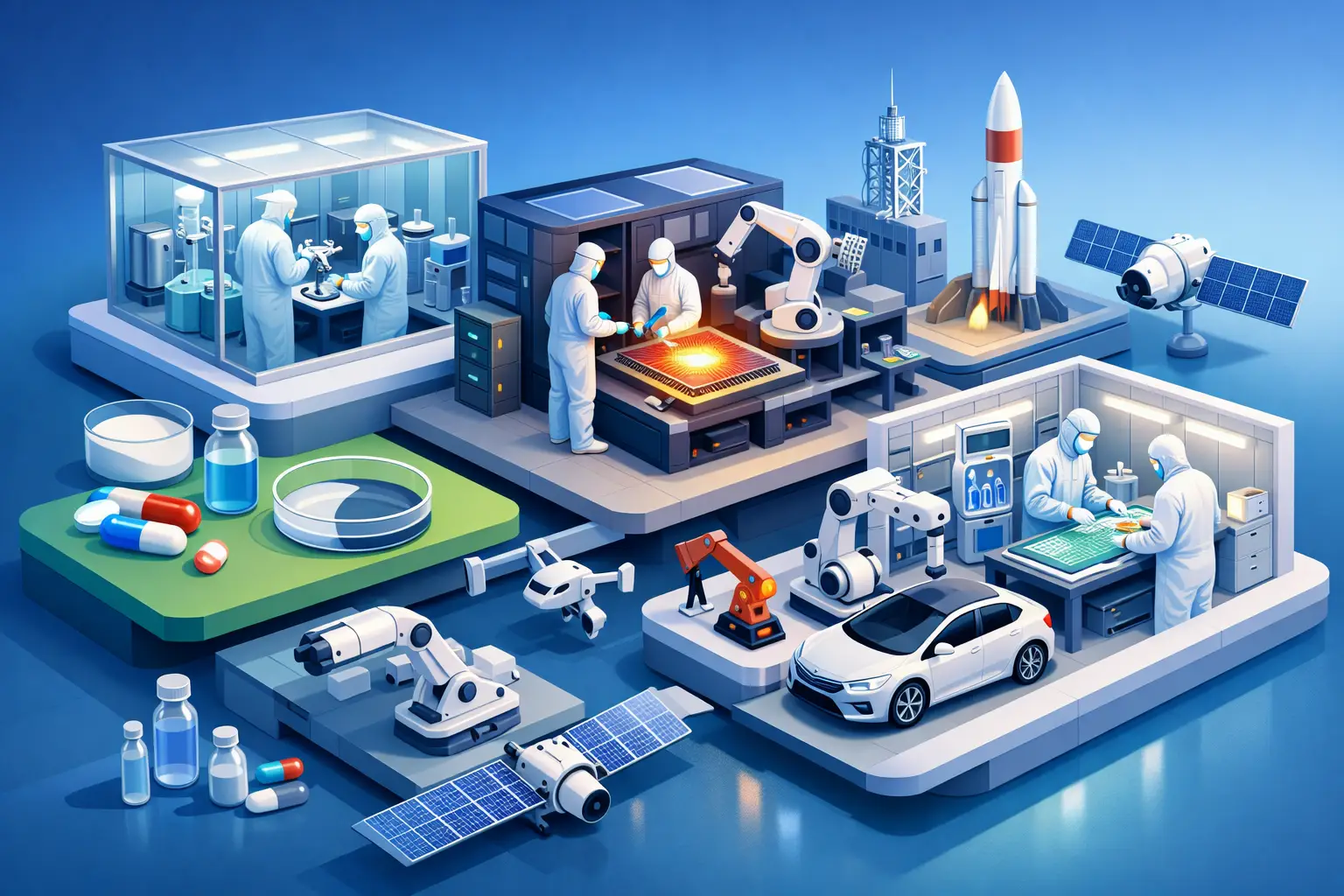
A single airborne particle can ruin a semiconductor wafer, compromise a sterile injectable drug, or shorten the life of a high-density battery cell. For advanced manufacturers, cleanroom infrastructure is not a premium feature. It is a production requirement tied directly to yield, compliance, and investor confidence. That is the real answer behind the question of what industries need cleanroom infrastructure: the sectors building high-value, contamination-sensitive products at industrial scale.
The bigger issue for decision-makers is not whether cleanrooms matter. It is which industries depend on them most, what level of control they actually need, and how infrastructure choices affect speed to market, operating cost, and long-term competitiveness.
What Industries Need Cleanroom Infrastructure Most?
The short answer is any industry where microscopic contamination can disrupt performance, safety, or regulatory approval. But not all cleanroom demand looks the same. Some sectors need sterile conditions. Others need strict particulate control, electrostatic management, humidity stability, or process segregation. The infrastructure brief changes with the product.
This distinction matters for investors and manufacturers evaluating expansion. A cleanroom for semiconductor packaging is fundamentally different from one designed for cell therapy, aerospace optics, or precision electronics. The industries that rely on these environments share one trait: their products carry too much value, too much technical sensitivity, or too much compliance risk to leave environmental control to chance.
Semiconductors and Microelectronics
Semiconductors are the clearest example of why cleanroom infrastructure has become strategic national infrastructure. At advanced nodes, even a microscopic contaminant can interrupt patterning, reduce yield, and create defects that only appear later in field performance. That makes contamination control central to economics, not just engineering.
Wafer fabrication requires some of the most stringent cleanroom environments in industrial manufacturing, with tightly controlled airborne particulates, vibration, temperature, humidity, and pressure differentials. But the need does not stop at front-end fabrication. Back-end assembly, packaging, advanced testing, and specialty electronics manufacturing also depend on cleanroom-ready environments.
For companies entering new markets, the key issue is readiness. Building these environments from scratch can delay production ramps and add substantial capital burden. That is why cleanroom-capable industrial ecosystems are gaining importance. They reduce lead time and support a faster path from site selection to output.
Pharmaceuticals and Biotechnology
Pharmaceutical manufacturing depends on cleanroom infrastructure for a different reason: patient safety and regulatory compliance. Sterile injectables, biologics, vaccines, medical formulations, and many laboratory processes require controlled environments that prevent microbial and particulate contamination.
This sector faces a more layered compliance environment than many others. It is not just about clean air. It is about validated processes, documented airflow performance, gowning protocols, material transfer, pressure cascades, and facility designs that support auditability. In other words, the cleanroom is part of the quality system.
Biotechnology adds another layer of complexity. Cell and gene therapy, tissue engineering, and advanced biologics production may require specialized suites, segregated workflows, and infrastructure that can evolve with the science. Flexibility matters here because process requirements can change quickly as products move from pilot stage to commercial scale.
Medical Devices and Diagnostics
Medical device manufacturers often need cleanrooms even when their production is not fully sterile. Devices such as implants, catheters, surgical kits, diagnostic cartridges, and sensitive sensor-based systems must be assembled in controlled environments to protect product integrity and meet quality requirements.
The level of control depends on the device classification and manufacturing process. Some products require highly controlled assembly and packaging but not the same sterile conditions as pharmaceutical filling lines. Others, especially implantable or invasive devices, demand stricter controls and validated cleanliness throughout production.
Diagnostics manufacturing has become especially relevant as precision testing platforms grow more complex. Microfluidic components, reagent-sensitive cartridges, and point-of-care systems can all be compromised by contamination during assembly. In a market where reliability drives trust, cleanroom infrastructure becomes a commercial safeguard.
Batteries, EV Components, and Advanced Energy Systems
Battery manufacturing is rapidly becoming one of the most important industrial use cases for controlled environments. Lithium-ion cells, solid-state battery development, and high-performance energy storage systems are highly sensitive to moisture, particulates, and process inconsistency. Dry rooms and cleanroom conditions are often essential, especially in electrode production, cell assembly, and electrolyte handling.
This is where the conversation around what industries need cleanroom infrastructure expands beyond traditional pharma and semiconductors. The energy transition is creating new cleanroom demand across EV supply chains, power electronics, fuel cell components, and advanced materials processing.
For battery and mobility manufacturers, the trade-off is straightforward. Tighter environmental control raises infrastructure cost, but poor control can reduce safety, cycle life, and product consistency. At scale, that is a far more expensive problem. As EV and clean-tech production localizes across new geographies, infrastructure that is designed for contamination-sensitive manufacturing becomes a strategic differentiator.
Aerospace, Defense, and Precision Optics
Aerospace-adjacent manufacturing often requires cleanroom infrastructure because performance tolerances are unforgiving. Satellites, avionics, sensors, guidance components, optical assemblies, and composite systems can all be affected by contamination introduced during production or integration.
Precision optics is a particularly strong example. Dust, surface films, and humidity variation can degrade optical performance, especially in high-spec imaging systems, lasers, and aerospace instrumentation. In these applications, cleanroom conditions protect both functionality and certification outcomes.
Defense manufacturing brings its own complexity. Security protocols, traceability requirements, and specialized material handling may need to sit alongside contamination control. That means the right facility is not just a technical fit. It must also support operational segregation, secure logistics, and long-term capacity planning.
Electronics, Sensors, and High-Value Assemblies
Not every electronics manufacturer needs an ultra-high-spec cleanroom, but many require some level of environmental control. Printed circuit board assemblies for sensitive applications, MEMS sensors, photonics, telecom modules, and industrial automation components often perform better when produced in low-contamination environments.
This is especially true as products become smaller, denser, and more performance-sensitive. A facility standard that worked for legacy electronics may no longer support next-generation output. Companies moving into miniaturized devices, smart systems, and advanced industrial controls often find that contamination control is now part of core process capability.
The practical question is one of threshold. How clean is clean enough? Overbuilding a facility can strain capital budgets. Underbuilding can undermine yield and quality. The answer depends on product architecture, customer requirements, and target markets.
Food, Nutraceuticals, and Specialized Packaging
Food manufacturing does not usually sit at the center of cleanroom discussions, yet specialized segments increasingly rely on controlled environments. Infant nutrition, aseptic processing, nutraceutical ingredients, and high-sensitivity packaging operations may require cleanroom or near-cleanroom conditions to maintain hygiene, product quality, and shelf stability.
This category is more variable than semiconductors or pharma. Many food operations do not require full cleanroom infrastructure. But premium formulations, high-spec export products, and sensitive filling processes often justify it. For manufacturers serving tightly regulated or high-value segments, contamination control supports both brand protection and market access.
What Drives Cleanroom Demand Across These Industries?
Three forces are reshaping demand. First, product complexity is increasing. As tolerances tighten and technologies become more sensitive, conventional industrial space is no longer enough. Second, regulatory scrutiny is rising, particularly in life sciences, medical devices, and critical electronics. Third, manufacturers want speed. They need facilities that support rapid deployment without years of custom infrastructure development.
That is why cleanroom infrastructure is increasingly viewed as part of industrial strategy, not just facility engineering. It affects where companies invest, how quickly they can commission operations, and how effectively they can scale. In specialized hubs, cleanroom-ready capacity can support entire sector clusters, from semiconductors and EV systems to biotech and advanced aerospace production.
For ecosystem developers and industrial occupiers alike, the real opportunity lies in alignment. The best manufacturing environments are not generic. They are purpose-built around sector needs, supply chain logic, workforce access, utilities, compliance pathways, and long-term expansion potential. That is the model now shaping the next generation of industrial development, including platforms like Rana Group that are positioning advanced infrastructure as a foundation for future industry.
The most valuable question is not simply what industries need cleanroom infrastructure. It is whether your sector can afford to grow without it.

[…] and power. It includes specialized factory formats, modular expansion options, logistics assets, cleanroom-ready environments, utility resilience, digital readiness, ESG compliance, and layouts that reduce movement […]
[…] matters because energy transition is not uniform across industries. A cleanroom-ready semiconductor facility has very different load characteristics from an EV component plant. The best developments account […]