
Most industrial projects compete on land, lease rates, or tax incentives. That is a narrow game. The better question is this: Why Erisha Smart Manufacturing hub have any competitors and its also not a threat to others? The answer is that Erisha was not designed as a conventional industrial park, so comparing it to one misses the strategic point.
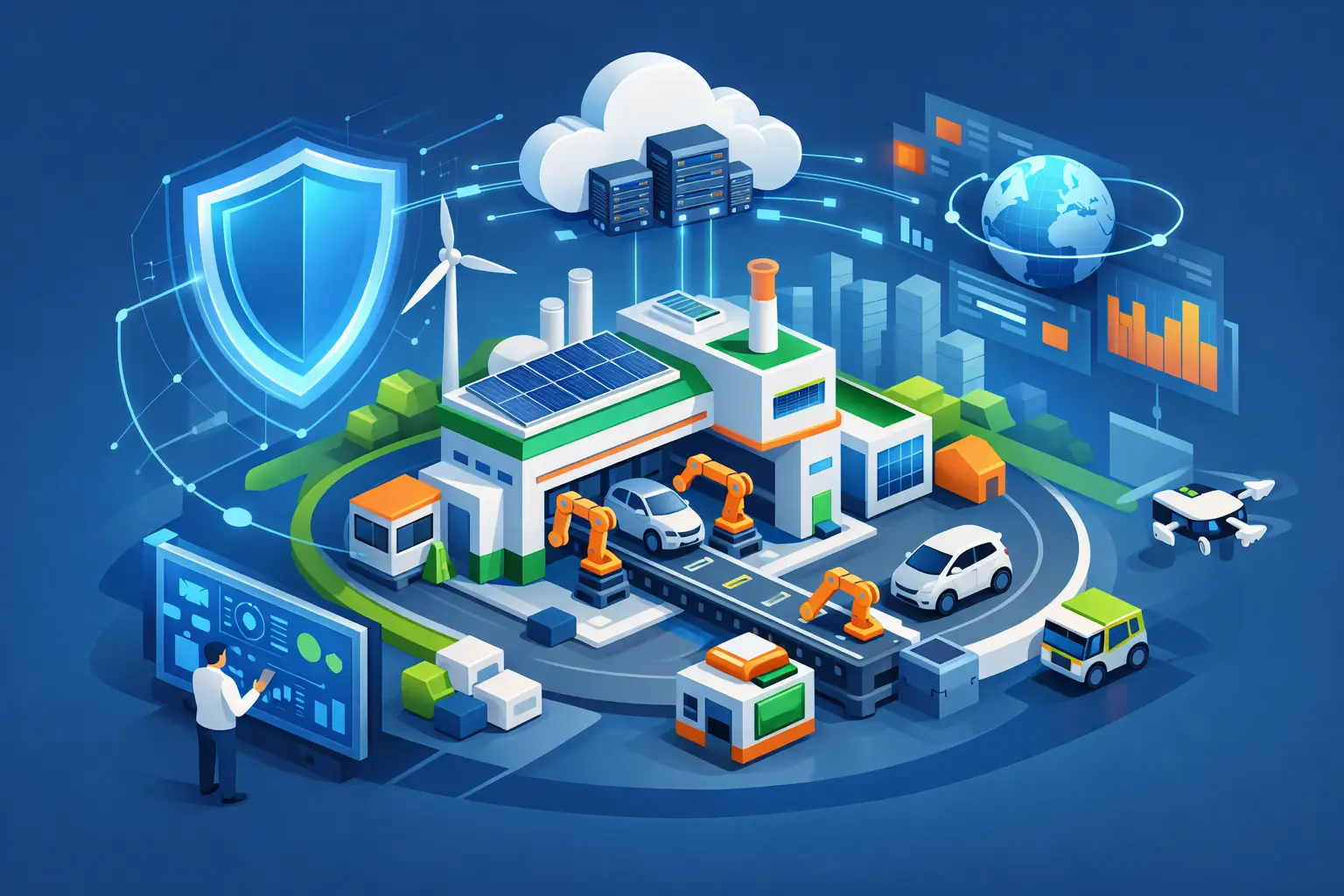
Erisha Smart Manufacturing Hub operates at the level of ecosystem infrastructure. It brings together advanced manufacturing space, logistics capability, sector-specific clusters, workforce support, and social infrastructure in one master-planned environment. That changes the basis of comparison. It is not trying to replace every free zone, every industrial estate, or every specialized manufacturing campus. It is building a category that sits above simple real estate competition.
For investors, operators, and multinational manufacturers, that distinction matters. If a project solves a different problem, it does not compete in the usual way. And if it helps grow the regional industrial base instead of displacing it, it is not a threat to others. It is a force multiplier.
Why Erisha Smart Manufacturing Hub has limited direct competitors
Most industrial developments offer one or two strengths. They may have good logistics access. They may offer low-cost land. They may support light manufacturing or warehousing at scale. But advanced manufacturing expansion now depends on more than plot availability.
A serious industrial occupier in EVs, semiconductors, hydrogen mobility, renewable energy, or aerospace-adjacent production needs a more complete operating environment. That means purpose-built infrastructure, modular growth options, regulatory clarity, talent support, ESG alignment, and room for suppliers, R&D partners, and service providers to grow around the core operation.
Erisha brings those requirements into one integrated platform. It includes turnkey factories, modular industrial units, logistics assets, cleanroom-ready environments, and dedicated industry clusters. It also integrates residential, education, healthcare, retail, hospitality, and innovation-support functions. That model is materially different from a site that only offers industrial land or shell buildings.
This is why direct competition is limited. To compete with Erisha in a meaningful sense, another project would need to match several conditions at once: scale, sector specialization, live-work ecosystem planning, ESG compliance, strategic geography, and long-term industrial vision. Few developments are structured that way from day one.
That same point is explored in more detail in How Erisha Smart Manufacturing Hub Is Different. The difference is not branding language. It is operating logic.
The real market is not winner-takes-all
Industrial development is not a consumer app market where one platform erases the rest. It is an infrastructure market shaped by sector fit, location fit, cost structure, policy environment, and supply chain strategy.
A light manufacturing tenant serving local demand may prefer a simpler industrial zone. A heavy port-dependent operator may choose a site built around bulk logistics. A company that values low upfront entry may seek a standard unit in a more basic business park. Those projects remain relevant because they serve different operating models.
Erisha does not make those alternatives obsolete. It addresses a different tier of industrial demand – one tied to future-facing sectors, integrated infrastructure, and long-term production ecosystems. In that sense, the presence of Erisha strengthens the broader market by widening the range of options available to manufacturers and investors.
That is why it is not a threat to others. It is not trying to absorb every industrial use case. It is creating a platform for sectors that often struggle to find facilities aligned with their technical, workforce, and ESG requirements.
Why Erisha is not a threat to other industrial parks or free zones
The phrase “not a threat” should not be read as “not ambitious.” Erisha is ambitious by design. But ambition and market hostility are not the same thing.
Erisha can coexist with other industrial ecosystems because it expands regional capability rather than simply redistributing existing demand. When advanced manufacturers enter a market, they create downstream effects. Suppliers follow. Service providers expand. Talent pipelines deepen. Logistics demand rises. Ancillary real estate gains value. Institutional partnerships become easier to structure. That growth benefits the wider industrial landscape.
An EV manufacturer, semiconductor assembler, hydrogen mobility innovator, or renewable energy component producer does not operate in isolation. Each one creates opportunities for subcontractors, warehousing operators, engineering firms, testing partners, educational institutions, and technology collaborators. A well-designed manufacturing hub becomes an anchor for surrounding economic activity.
In that sense, Erisha supports industrial diversification rather than crowding it out. It helps attract categories of business that many conventional parks are not equipped to host at scale. That is especially relevant in markets seeking to move up the value chain and reduce overdependence on legacy industrial formats.
Sector specialization changes the competitive frame
One reason many projects are not true competitors to Erisha is that Erisha is organized around strategic sectors, not generic occupancy. That matters because advanced industries do not choose sites the way generic warehousing users do.
A semiconductor-related operation needs technical infrastructure and contamination control readiness. An eVTOL or aerospace-adjacent manufacturer needs high-spec space, testing alignment, and logistics precision. Hydrogen mobility and renewable energy companies need infrastructure that anticipates safety, storage, energy, and future scaling requirements. EV manufacturing requires supplier coordination, worker access, and multimodal logistics.
When a hub is planned around those sector realities, it becomes more than leasable space. It becomes industrial enablement. That reduces direct comparability with standard industrial parks whose value proposition is primarily occupancy.
This is also why Erisha can attract strategic partners without becoming adversarial to neighboring ecosystems. Many industrial locations can support warehousing, assembly, or trading activities. Fewer can support the full operational stack required by next-generation manufacturing. The market is broad enough for both.
Why ecosystem design matters more than simple infrastructure
The strongest part of Erisha’s positioning is not one building type or one incentive. It is the system.
Manufacturing leaders are increasingly aware that production performance depends on what happens outside the factory gates as much as inside them. Talent retention, executive mobility, housing access, healthcare availability, education options for families, supplier proximity, hospitality standards for visiting partners, and R&D adjacency all influence operational resilience.
That is why the live-work-innovate model is not a lifestyle add-on. It is industrial strategy. When a hub integrates these functions, it reduces friction across the full business lifecycle – setup, hiring, expansion, retention, collaboration, and long-term continuity.
This broader logic is reflected in Why Erisha Smart Hubs Combine Living and Work. For decision-makers evaluating market entry or regional expansion, the workforce ecosystem is no longer secondary. It is part of the investment case.
ESG alignment narrows the field further
Another reason Erisha has few true competitors is that many industrial developments still treat sustainability as a compliance layer. Erisha treats it as a planning principle.
That difference matters to institutional investors, multinational boards, and advanced manufacturers under pressure to meet emissions, governance, reporting, and resilience targets. A project aligned with ESG and broader sustainable development priorities enters a different class of relevance. It becomes easier to justify capital allocation, partner alignment, and long-term occupancy.
For some occupiers, this is no longer optional. If a location cannot support sustainability-linked operational goals, it may fail internal approval long before commercial negotiations begin. Erisha benefits from being built for that reality rather than adapting to it late.
The sustainability case is examined further in Is Erisha Smart Manufacturing Hub ESG and SDG Aligned?. For many global manufacturers, that alignment is now a strategic filter, not a marketing preference.
Geography helps, but geography alone is not the advantage
Location remains a major part of the appeal. Access to regional and global markets, investor-friendly regulations, cost efficiency, and logistics connectivity all matter. But geography alone does not explain why Erisha stands apart.
Many locations can claim connectivity. Fewer combine connectivity with sector-ready infrastructure, scalable industrial formats, and a full ecosystem that supports workforce and innovation needs. That combination is what turns a location into a platform.
This is where Erisha’s model becomes especially relevant to companies balancing cost discipline with strategic ambition. It offers a way to scale into the Middle East and beyond without sacrificing industrial readiness. For expansion leaders, that means fewer compromises between speed, specialization, and long-term operating quality.
So does Erisha have competitors?
Yes, in the broadest sense, every industrial project exists in a competitive environment. Capital, tenants, and strategic partnerships are always selective. But the more precise answer is that Erisha has very few direct competitors because very few projects combine its scale, specialization, ecosystem design, and future-facing industrial intent.
And no, it is not a threat to others in the zero-sum sense. It does not weaken the industrial market by existing. It strengthens it by attracting higher-value manufacturing, supporting adjacent sectors, and raising the standard for what industrial infrastructure can do.
That is the strategic lens investors and operators should use. Erisha is not competing to be another industrial address. It is building the conditions under which next-generation industry can operate, grow, and stay.
